
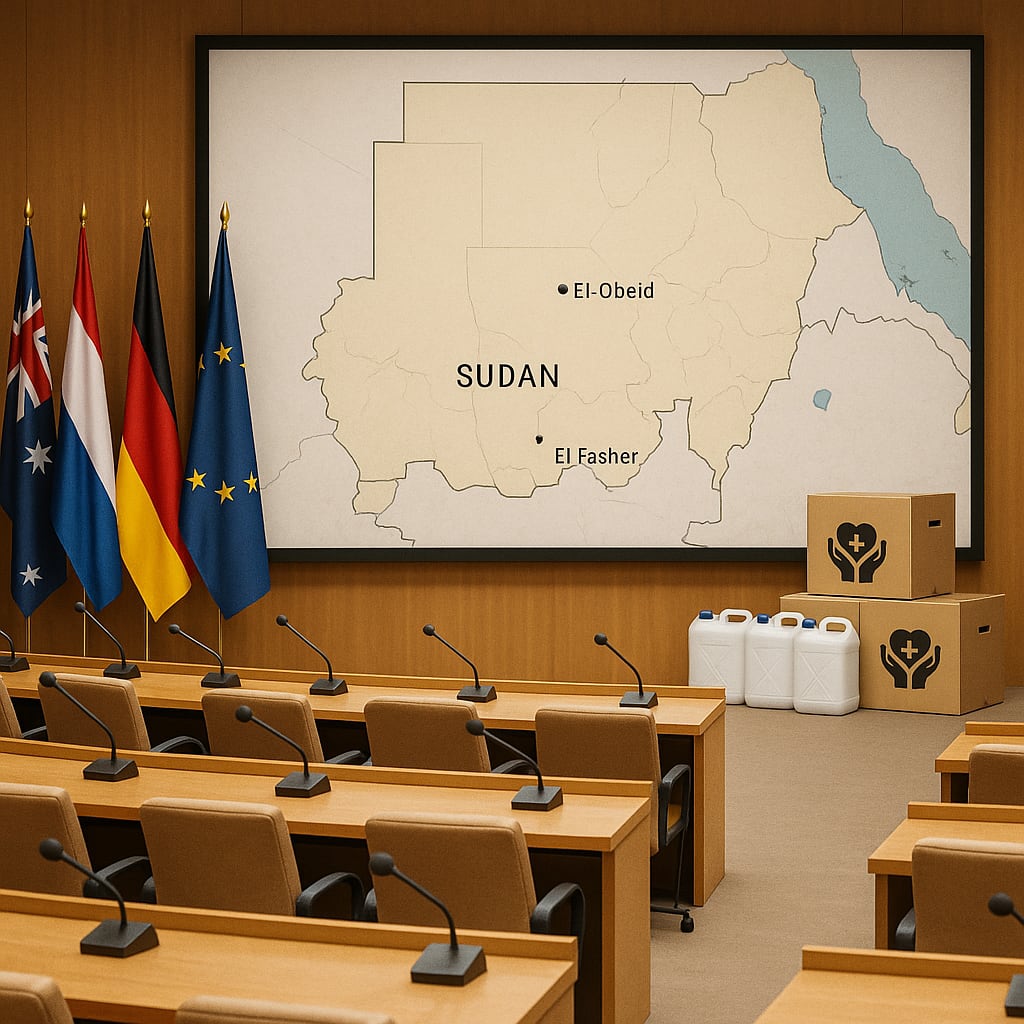
RSF siege of El-Obeid intensifies with drone strikes as UN alarms mount and Europe urges terrorist listing
Narrative Snapshot
Across outlets, the humanitarian picture in and around El-Obeid is starkly aligned. Al Jazeera reports intensifying RSF drone attacks on the besieged city, while France 24’s on-the-ground interviews describe bombed water infrastructure, continuous strikes, and looming famine as food runs out. UN-linked reporting amplified by AllAfrica warns El Obeid “must not become the next crime scene,” explicitly referencing atrocity patterns previously documented in El Fasher. Deutsche Welle frames the same trajectory in prevention terms, asking whether sanctions can still avert mass violence.
Accountability coverage converges on a widening evidentiary record for crimes in Darfur and rising political pressure. BBC, the South China Morning Post, and The Hindu summarize Amnesty International’s findings of crimes against humanity and ethnic cleansing by RSF in the El Fasher assault, which UN investigators, cited by Middle East Eye and UN News via AllAfrica, say bears genocide markers. Parallel reporting by BBC, Middle East Eye, and CGTN highlights the ICC deputy prosecutor’s stated “breakthrough,” describing new evidence linking crimes in Darfur to leadership levels. Middle East Eye also juxtaposes this with its earlier scoop that ICC prosecutors shelved an RSF arrest warrant as atrocities mounted.
Policy lines of effort diverge in tone and tools. The European Parliament’s call for EU member states to list the RSF as a terrorist organization, covered by AllAfrica and France 24, sits alongside a Chinese UNHRC intervention via CGTN emphasizing humanitarian relief and preventing a repeat of El Fasher’s large-scale atrocities without attributing blame. Folha de S.Paulo, citing UNICEF, quantifies the conflict’s toll on children this year, underscoring civilian protection stakes as diplomatic and legal responses gather pace. A statement from U.S. Senator Bernie Sanders, carried by AllAfrica, signals continued political attention in Washington.
What Happened
The RSF has tightened its siege of El-Obeid with escalating drone attacks, according to Al Jazeera and France 24, which also relay residents’ accounts of bombed water systems, constant strikes, and deepening food scarcity. UN-linked investigators warned El Obeid could mirror atrocity patterns seen in El Fasher; Amnesty’s latest report, summarized by BBC, SCMP, and The Hindu, alleges crimes against humanity and ethnic cleansing by RSF in El Fasher, while UN investigators cited by Middle East Eye and UN News say those atrocities bear genocide markers. The ICC deputy prosecutor told BBC, Middle East Eye, and CGTN of a “breakthrough” in evidence linking Darfur crimes to leadership levels. The European Parliament urged EU states to designate the RSF a terrorist organization, as France 24 reported UN concern over ongoing drone attacks in Sudan. Folha de S.Paulo, citing UNICEF, reported at least 330 children killed or injured in 2026. AllAfrica carried a statement by U.S. Senator Bernie Sanders on Sudan’s civil war and genocide.
Why It Matters
The European Parliament’s push to list the RSF as a terrorist organization would, if acted on by member states, reshape the EU’s sanctions and law-enforcement posture, complicate financial flows, and affect contact policies with armed actors, even as humanitarian agencies must maintain access to besieged civilians. UN investigators’ genocide markers for El Fasher and Amnesty’s findings of crimes against humanity move the debate from generic civilian harm to atrocity-crime prevention, raising pressure for protection measures and arms-transfer constraints. The ICC’s asserted evidentiary “breakthrough” on leadership responsibility signals potential for higher-level accountability, with implications for negotiations and the behavior of commanders on all sides. China’s UNHRC messaging, focused on humanitarian response and preventing repeats of mass atrocities without attribution, points to constraints on Security Council action and a continued split between punitive and engagement-heavy approaches to crisis management.
Diverging Narratives
Outlets converge on the severity of civilian harm in El-Obeid but differ on remedies and accountability pacing. European coverage and UN-linked reporting emphasize atrocity risks and legal consequences: France 24 details siege conditions; AllAfrica and France 24 highlight the European Parliament’s call for terrorist designation; UN News via AllAfrica and Middle East Eye align on genocide markers in El Fasher and warnings for El Obeid. By contrast, CGTN’s account of China’s UNHRC stance underscores humanitarian relief and the imperative to prevent repeats of El Fasher’s atrocities, without assigning actors, reflecting a sovereignty-first framing.
Legal-process reporting also presents tension. BBC, Middle East Eye, and CGTN relay the ICC deputy prosecutor’s claim of a “breakthrough” linking crimes to leadership, yet Middle East Eye’s earlier investigation alleges ICC prosecutors had shelved an RSF arrest warrant even as abuses escalated. CGTN notes the ICC did not specify which forces the implicated leadership belongs to, leaving key attribution and timing questions open. Deutsche Welle’s focus on whether sanctions could still prevent bloodshed contrasts with the operational immediacy in France 24 and Al Jazeera’s coverage of drones and infrastructure strikes. Folha’s UNICEF-based casualty figures foreground child protection, while AllAfrica’s publication of Senator Sanders’ statement indicates growing U.S. political attention without detailing concrete policy shifts.
What Happens Next
Three decision points emerge. First, whether EU member states translate the European Parliament’s call into national or EU-level terrorist listings; movement in EU Council deliberations or national designation processes will signal traction and determine knock-on effects for financing, travel, and diplomatic contacts. Second, how the ICC operationalizes its reported “breakthrough”; watch for filings, applications for arrest warrants, or cooperation requests that indicate leadership-linkage cases advancing, mindful that the court has not publicly specified implicated forces. Third, crisis management around El-Obeid: outcomes of the UNHRC urgent debate noted by CGTN, any UN-facilitated humanitarian corridors, and verifiable changes in attack patterns on water systems and food supply reported by France 24 and Al Jazeera will show whether protection and access are improving. Parallel indicators include sanctions deliberations referenced by Deutsche Welle, updated UNICEF casualty data via outlets like Folha, and additional UN investigator warnings specific to El Obeid.