
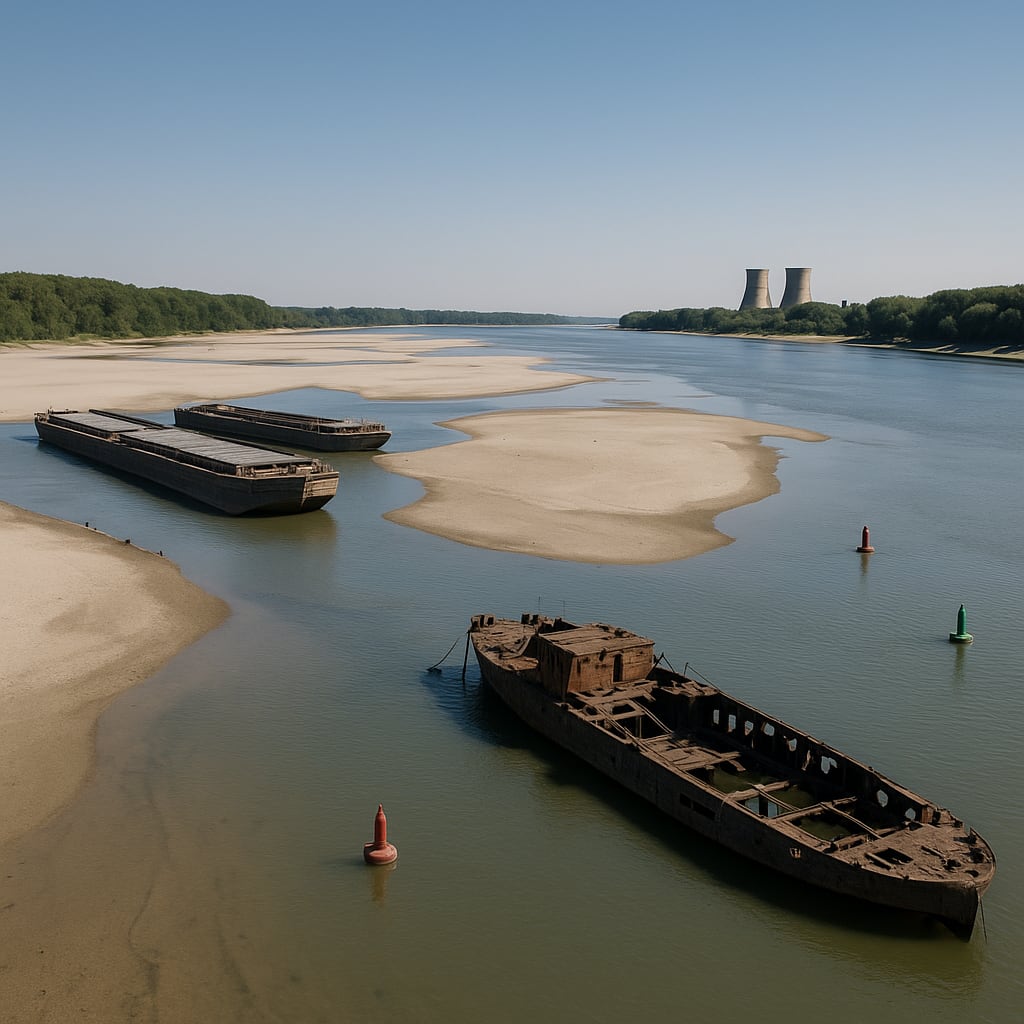
Record-low Danube halts navigation, exposes WWII wrecks, and prompts Romania to bolster water levels near Cernavoda nuclear plant
Narrative Snapshot
Across outlets, there is broad agreement that a heatwave-driven drought has pushed the Danube to historically low levels, with two clusters of consequences emphasized. Regional and Russian coverage centers the operational fallout for navigation and industry. TASS reports a suspension of navigation between Giurgiu in Romania and Ruse in Bulgaria, underlining the incident risk from vessels carrying flammable or toxic cargo such as fertilizers and coal. Politika highlights halted traffic near Ilok with Austrian and Hungarian ships loaded with coal and slag, and notes continuing drops near Ruse that keep convoys waiting.
Anglophone and Italian outlets foreground the river’s exposure of Second World War wrecks and associated hazards. The New York Times and the Guardian describe German vessels emerging and impeding navigation, with the Guardian adding references to unexploded ordnance and even a recovered motorcycle. Corriere della Sera reports about 20 wrecks visible near Prahovo, while ANSA stresses that some were scuttled in 1944 and may still carry explosives. NHK situates the Danube within a wider European heatwave, noting that record lows have revealed both sunken ships and bones thought to be from a mammoth. One thread distinct to Politika is a Romanian intervention: loading a final barge to raise water levels around Cernavoda to support nuclear plant operations.
What Happened
In early August, a persistent heatwave and drought dropped Danube water levels to record lows. Navigation was suspended between Giurgiu (Romania) and Ruse (Bulgaria), with TASS noting that stranded vessels include those carrying flammable or toxic cargo such as fertilizers and coal. Politika reports that cruisers and cargo ships were halted near Ilok, including Austrian and Hungarian vessels loaded with coal and slag, and that levels near Ruse continued falling on August 8, keeping convoys waiting at critical stretches. Low water has exposed sunken German World War II vessels along the river, including near the Serbian–Romanian border and around Prahovo, impeding navigation and, according to the Guardian and ANSA, presenting potential ordnance risks. NHK adds that the riverbed has revealed bones believed to be from a mammoth. Politika also reports that Romania loaded a final barge intended to raise levels near Cernavoda to sustain the nearby nuclear plant’s operations.
Why It Matters
The immediate effects span navigation safety, hazardous cargo management, and energy system continuity. TASS’s account of a cross-border navigation halt at Giurgiu–Ruse, combined with Politika’s reports of stalled convoys and coal shipments, underscores the Danube’s role in moving industrial inputs and the risks when traffic stops with sensitive cargo aboard. Western coverage of newly visible WWII wrecks highlights a different layer of public safety and environmental management, as the Guardian and ANSA note possible weapons and explosives on some vessels now obstructing channels. Politika’s reporting on Romania’s water-level intervention near Cernavoda shows how low flows can affect nuclear plant operations, prompting hydrological measures to protect generating capacity. For governments and river authorities, the situation aligns drought response, navigation control, and ordnance safety in an explicitly transboundary context, with actions in one sector—such as targeted water-raising—intersecting with navigation rules and hazard mitigation along shared river sections.
Diverging Narratives
Outlets diverge primarily in emphasis and granularity. Politika and TASS foreground operational disruptions: the historic low that stopped ships near Ilok, the continued decline near Ruse that keeps convoys idle, and a formal navigation suspension on the Giurgiu–Ruse reach, where TASS stresses incident risks from flammable or toxic cargoes such as fertilizers and coal. By contrast, the New York Times and the Guardian emphasize the exposure of German WWII wrecks that now impede navigation, with the Guardian adding details about recovered items and potential unexploded ordnance. Italian coverage adds specificity on scale and location: Corriere della Sera reports about 20 visible wrecks near Prahovo, while ANSA highlights their 1944 scuttling and the possibility that some remain laden with explosives. NHK broadens the lens to the continental heatwave and drought, mentioning mammoth bones alongside shipwrecks. Across reports, unresolved questions include the precise number and condition of exposed vessels, the extent of remaining ordnance, and how quickly suspended navigation can safely resume. Only Politika describes a concrete mitigation effort—Romania’s barge operation near Cernavoda—leaving its effectiveness an open issue in other accounts.
What Happens Next
Three decision points emerge from the reporting. First is navigation control on the most constrained reaches: resumption between Giurgiu and Ruse will hinge on water-level improvements and safety assessments, while Politika’s note that levels near Ruse are still dropping suggests continued pressure on convoy movements through critical sections. Second is hazard management around exposed WWII wrecks. The Guardian and ANSA point to possible weapons and explosives on some vessels, implying forthcoming choices by Serbian and Romanian authorities on clearance, cordoning, or routing measures to balance safety with keeping channels usable. Third is targeted hydrological support for critical infrastructure, exemplified by Politika’s report that Romania has loaded a final barge to raise levels near Cernavoda; monitoring river gauges and any subsequent navigation advisories will indicate whether the intervention stabilizes local conditions. In parallel, the risk from stranded flammable or toxic cargo flagged by TASS will shape how authorities sequence any phased reopening.