
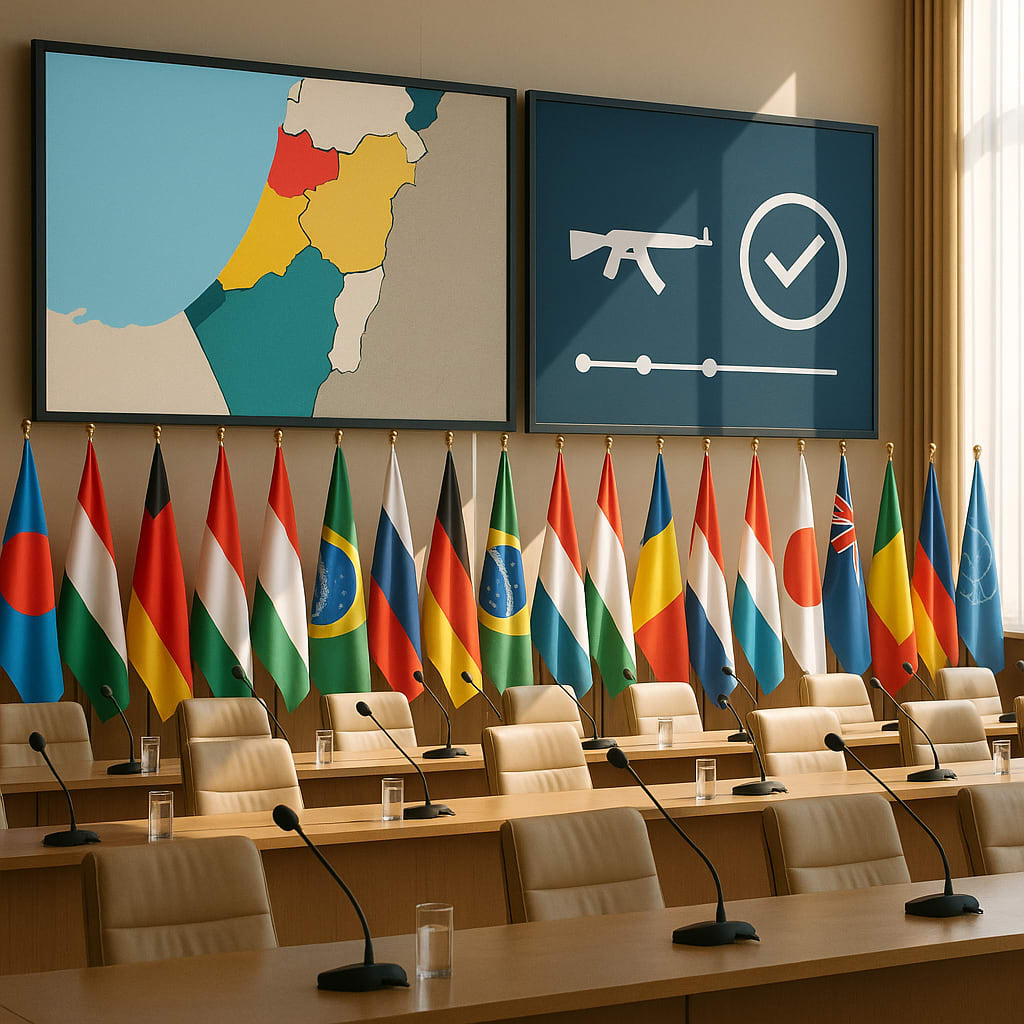
Trump unveils Hamas disarmament framework tied to Gaza pullback; Hamas conditions sequencing, Israel’s position uncertain
Narrative Snapshot
U.S. and allied outlets largely treat the announcement as a U.S.-brokered framework whose scope hinges on new mechanisms the White House has built around it. Reports emphasize President Trump’s “historic” framing and the centrality of his Board of Peace, including plans for board-appointed governing bodies in Gaza and an International Stabilization Force with a new Palestinian police component, while stressing unanswered operational details and timelines (Haaretz; TASS; DW; New York Times; Toronto Star/AP; BBC; Guardian; Bangkok Post; Folha de S.Paulo; NHK).
Regional and European coverage foregrounds ambiguity and political obstacles. French and Italian papers underscore that modalities are undefined and that both parties are already hedging, with Hamas tying steps to Israeli withdrawal and reconstruction, and Israel not signaling concessions (France24; Le Monde; Corriere della Sera). A Serbian outlet reports Berlin’s welcome of gradual disarmament coupled with demands that Hamas genuinely lay down arms, suggesting cautious European receptivity linked to verifiable implementation (Politika).
Arabic- and Israel-focused outlets anchor the story in sequencing and domestic constraints. Middle East Eye and Al Jazeera highlight Hamas statements that no disarmament will begin before a withdrawal and that compliance will determine next steps; the Times of Israel says Israel opposes the offer and is unlikely to endorse a pullback ahead of elections, with mediators seeking to “place the ball in Israel’s court” (Middle East Eye; Al Jazeera; Times of Israel). A BBC analysis piece notes that while the plan could constitute the first credible de-escalation step, Palestinian audiences are skeptical after years of collapsed agreements (BBC analysis).
What Happened
On July 30, President Donald Trump announced via Truth Social that his Board of Peace had reached an agreement for the “complete disarmament” of Hamas and other armed groups in Gaza, describing phased steps that would pave the way for an Israeli withdrawal and a new Palestinian governing arrangement (Al Jazeera; BBC; Guardian; DW). Haaretz reported that weapons would be collected by board‑appointed bodies tasked with governing Gaza, while TASS said an International Stabilization Force would work alongside a new Palestinian police (Haaretz; TASS). Initial reports noted no immediate comment from Hamas or Israel (BBC; CBC). France24 later reported Hamas had confirmed agreeing to a deal that would lead to disarmament in return for a gradual Israeli troop withdrawal, even as senior Hamas figures insisted sequencing must start with withdrawal and reconstruction (France24; Middle East Eye). The Times of Israel said Israel opposes the offer (Times of Israel).
Why It Matters
The framework tests whether a U.S.-backed, ad hoc conflict-resolution architecture can drive disarmament and security sector reform in Gaza outside established UN-led channels. The Board of Peace—an international body created by Trump—sits at the core of the proposal, from weapons collection to interim governance, positioning Washington to broker disarmament, stabilization, and reconstruction through a bespoke mechanism rather than traditional multilateral forums (New York Times; Haaretz; DW). Incorporating an International Stabilization Force and a new Palestinian police implies a DDR/SSR model whose feasibility turns on third‑party commitments, verification capacity, and local legitimacy (TASS; Haaretz). Israeli domestic politics and electoral timing, highlighted by Israeli outlets, could constrain acceptance of any withdrawal sequence, while early European signaling of conditional support underscores that donor and troop-contributing states will calibrate engagement to verifiable compliance and credible timelines (Times of Israel; Politika; Toronto Star/AP; Le Monde).
Diverging Narratives
Sequencing remains the principal point of friction. Multiple outlets quote Hamas officials stating that no disarmament steps will precede an Israeli military withdrawal and progress on reconstruction, whereas Trump’s announcement and allied briefings present phased disarmament as unlocking a withdrawal and governance transition under the Board of Peace (Middle East Eye; Al Jazeera; TASS; Haaretz). Reports also diverge on status and certainty: several noted the absence of immediate confirmation from either party, while France24 reported Hamas confirmation of an agreement conditioned on gradual withdrawal; Italian and French coverage emphasized that modalities are still undefined and that each side is already hedging (BBC; CBC; France24; Le Monde; Corriere della Sera). Within Israel-focused reporting, one line centers on institutional design and governance of Gaza under board-appointed bodies; another stresses political feasibility, with Israel’s government portrayed as opposing the offer and unlikely to back a pullback before elections (Haaretz; Times of Israel). Meanwhile, ANSA cited an Israeli media source suggesting Hamas appeared to accept complete disarmament, contrasting with subsequent Hamas statements linking any steps to Israeli compliance (ANSA; Middle East Eye; Telesur).
What Happens Next
Three decision points will shape trajectories. First, Israel’s formal stance: Israeli acceptance or explicit rejection of withdrawal-linked sequencing, as reported likely to face pre‑election resistance, will determine whether mediators can “place the ball in Israel’s court” or must recalibrate terms (Times of Israel). Second, Hamas’s codified commitments: movement from public conditionality to a signed, sequenced timetable—such as the 15‑point draft text published by Middle East Eye—would clarify verification, handover, and reconstruction linkages (Middle East Eye). Third, third‑party enablement: announcements on the composition, mandate, and contributors to an International Stabilization Force and a new Palestinian police, plus European donor conditionality, will signal whether the proposed DDR/SSR architecture is resourced and politically tenable (TASS; Politika; DW; Haaretz). Analysts should watch for official texts, verification provisions for weapons collection, and synchronized timelines for withdrawal, governance transfer, and aid disbursement (Toronto Star/AP; Le Monde).