
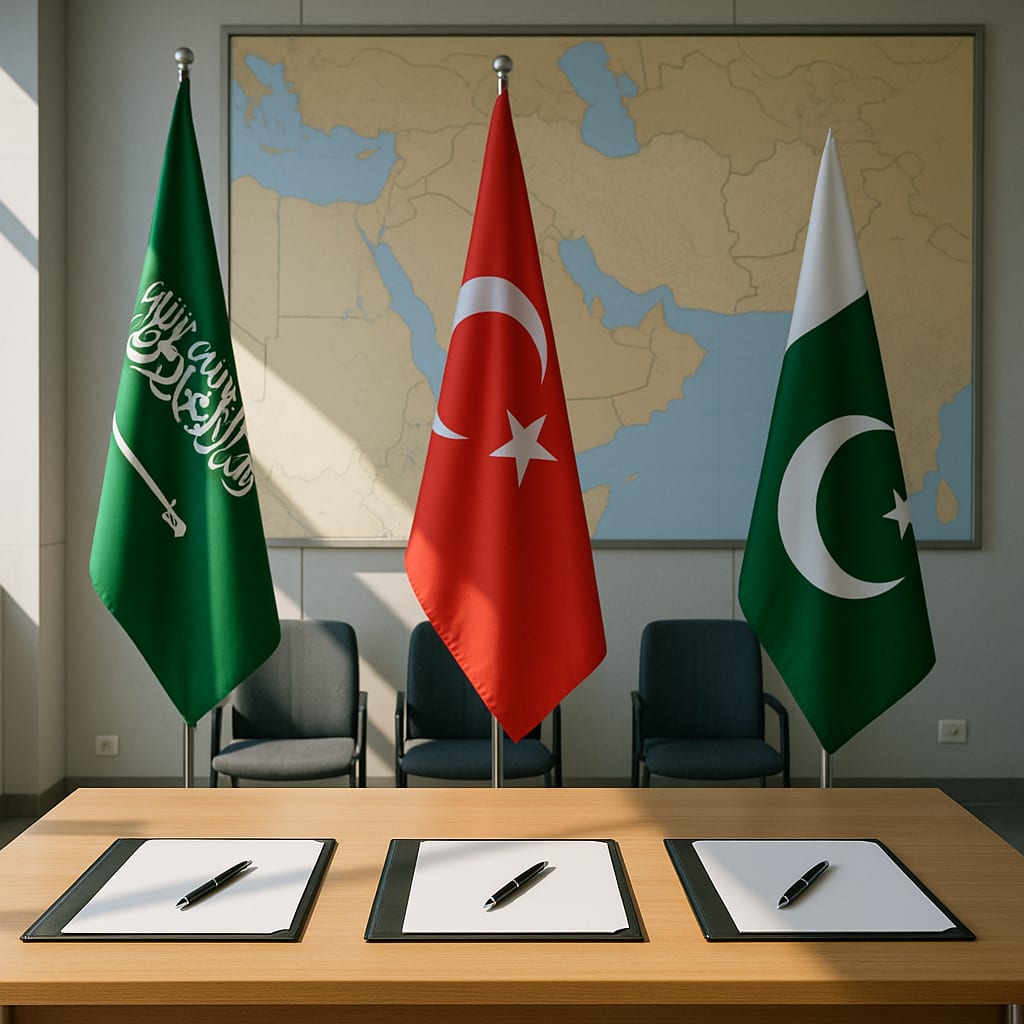
Saudi Arabia, Turkey and Pakistan sign mutual defense pact in Mecca
Narrative Snapshot
Across outlets, the core contours are consistent: Saudi Arabia, Turkey and Pakistan signed a mutual defense pact in Mecca that treats an armed attack on one as an attack on all, with leaders Mohammed bin Salman, Recep Tayyip Erdogan and Shehbaz Sharif presiding. Multiple reports name it the Mecca/Makkah Joint Defence Agreement and emphasize collective deterrence.
Where they diverge is in framing purpose and context. Several Western and regional reports situate the move in the ongoing U.S.–Iran conflict and related violence, including Houthi attacks and shipping disruption (Bangkok Post via AFP; RFE/RL; Japan Times). Middle East Eye and RT explicitly tie timing to Israeli and U.S. strikes on Iran, while France 24 and Le Monde stress Riyadh’s drive to diversify security partnerships after infrastructure attacks and amid doubts about U.S. reliability.
Israeli outlets foreground intent and signaling: Haaretz highlights that the pact is open to other regional countries, and the Times of Israel notes signatories say it is not directed at any specific country even as all three are wary of Iran and, in Israel’s reading, Israel. Russian state media amplify the “Islamic NATO” analogy and argue American guarantees have proved insufficient, while TASS anchors the move in geopolitics and official deterrence language. Iran-focused coverage in Tehran Times reports the signing without overt critique; RT, by contrast, carries an Iranian lawmaker’s denunciation.
What Happened
On August 7, 2026, Saudi Arabia, Turkey and Pakistan signed a mutual defense pact in Mecca, with the Saudi crown prince, Turkey’s president, and Pakistan’s prime minister in attendance (Al Jazeera English; DW). The agreement—described as the Mecca/Makkah Joint Defence Agreement—stipulates that an armed attack on any member will be regarded as an attack on all, and aims to strengthen collective deterrence (DW; Haaretz; TASS; France 24). A joint statement after the Mecca summit emphasized bolstering joint deterrence against any aggression (TASS). Reporting indicates the framework had been under negotiation since last year (Middle East Eye). Haaretz adds the pact is described as open to other regional countries. Outlets based in Europe, the Middle East, and Asia set the signing against intensifying regional conflict, including U.S.–Iran hostilities, Houthi attacks, and broader security shocks (Bangkok Post via AFP; RFE/RL; Japan Times).
Why It Matters
The pact formalizes a collective defense commitment that links a NATO member (Turkey), a nuclear-armed state (Pakistan), and the Gulf’s pivotal power (Saudi Arabia), with potential implications for security architectures spanning the Middle East and South Asia (Times of Israel; Folha de S.Paulo). It signals Riyadh’s effort to diversify beyond its traditional reliance on Washington amid repeated strikes on critical infrastructure and perceived erosion of U.S. reliability (France 24; Le Monde). For Ankara and Islamabad, it institutionalizes a platform for defense coordination with Gulf resources and political reach, while embedding a mutual defense clause into a trilateral Muslim-majority framework that some narratives compare to NATO—an analogy several reports raise but the parties themselves do not adopt (RT; DW; Haaretz). The agreement’s openness to others, if acted upon, would test regional appetite for collective security outside existing U.S.-led or ad hoc coalitions (Haaretz; Le Monde).
Diverging Narratives
Intent and signaling are contested in the coverage. The Times of Israel reports the trio says the deal is not directed at any particular country, even as it notes all three are wary of Iran and, from its vantage point, Israel. Le Monde characterizes the announcement as a message to Iran and also to the United States, reflecting doubts about U.S. dependability. TASS and Politika emphasize the agreement’s stated purpose—strengthening collective deterrence against any aggression—while a TASS-cited expert roots the alliance in geopolitical dynamics rather than targeting a single adversary.
Scope and ambition are framed differently. Haaretz underscores that the pact is described as open to other regional countries, suggesting possible expansion, while France 24 and Japan Times focus on near-term security pressures, including attacks on Saudi infrastructure and war-related shipping disruptions. RT advances an “Islamic NATO” label and features an Iranian lawmaker dismissing the pact as a “paper agreement,” whereas Tehran Times reports the signing tersely as deepening security cooperation without polemic. Middle East Eye points to the pact’s gestation since last year and notes prior Saudi analyst discussion of potential activation, indicating that operationalization questions remain salient.
What Happens Next
Three decision points emerge from the reporting. First is membership: Haaretz says the agreement is open to other regional states. Signals to watch include invitations, accession criteria, or joint communiqués hinting at outreach. Second is implementation: TASS stresses deterrence, while RT notes plans to expand military coordination and defense-industry cooperation. Concrete indicators would be creation of consultative mechanisms, joint exercises, procurement or co-production announcements, and defined thresholds for invoking the mutual defense clause. Third is external management of escalation risks and messaging. The Times of Israel cites assurances that the pact targets no specific country; Le Monde frames it as a message to Iran and the U.S.; RT carries early Iranian parliamentary criticism. Analysts should track official reactions from Tehran and Washington, and whether member responses to ongoing incidents—such as Houthi attacks or maritime disruptions highlighted by Bangkok Post and Japan Times—reference or test the pact’s clauses.