
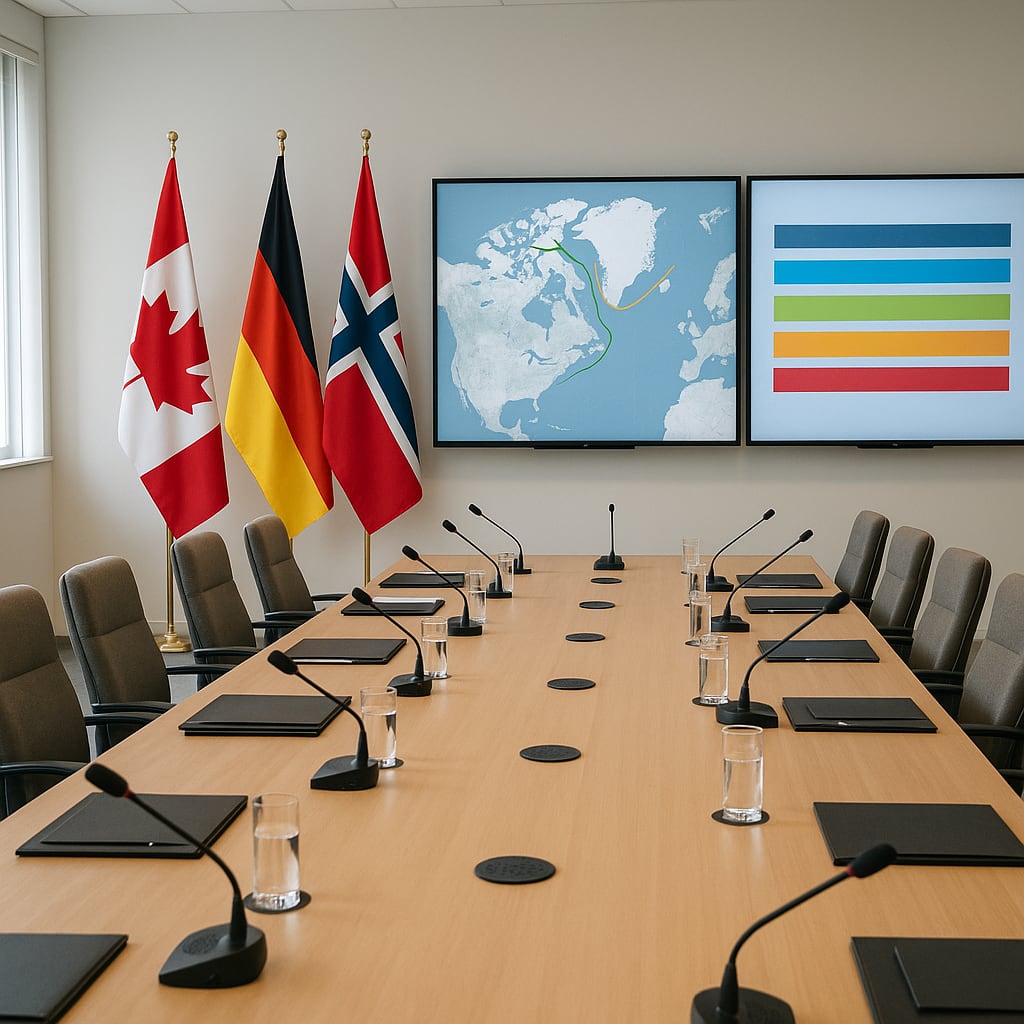
Canada selects German–Norwegian bid led by TKMS for up to 12 submarines
Narrative Snapshot
- Convergence: Outlets frame the choice as a strategic alignment with European NATO partners and a setback for South Korea’s Hanwha Ocean (CBC, Guardian, NYT, DW, SCMP, Al Jazeera).
- Differing emphases: The New York Times and South China Morning Post stress reduced reliance on the United States; Japan Times highlights Arctic imperatives; CBC foregrounds accelerated rearmament; the Guardian underscores the obsolescence and availability issues of Canada’s current boats.
- Scale and timing: DW reports the purchase as the largest in Canadian history; Le Monde adds a concrete negotiation and delivery timetable extending to 2027 and 2034, respectively.
- Summit context: Several outlets tie the announcement to NATO’s Ankara summit, presenting it as a pre-summit signal of Canadian commitment (Guardian, DW, SCMP).
What Happened
Prime Minister Mark Carney announced that Canada has selected a German–Norwegian consortium led by Thyssenkrupp Marine Systems (TKMS), beating South Korea’s Hanwha Ocean, to supply up to 12 submarines in a multibillion-dollar program (Guardian; Al Jazeera; SCMP; CBC). CBC characterizes the move as choosing a European partnership and launching negotiations on one of Canada’s biggest defense projects. DW quotes Carney calling it the largest purchase in Canadian history, and both DW and the Guardian situate the decision just ahead of a NATO summit in Ankara. Le Monde reports that negotiations with TKMS are to conclude by end-2027, with a first delivery planned for 2034. The Guardian notes the new fleet will replace aging, secondhand submarines, most of which are currently in maintenance. The New York Times frames the choice as both an expansion of Canada’s naval power and a step to reduce military and economic dependency on the United States.
Why It Matters
The decision reinforces Canada’s defense integration with European NATO partners and signals burden-sharing ahead of a NATO summit (Guardian; DW). It also reflects a broader trend of “mid-tier” allies coordinating more closely amid questions about U.S. reliability, as highlighted by the South China Morning Post and the New York Times. Japan Times situates the move within Canada’s evolving Arctic strategy, with melting sea ice increasing the salience of undersea capabilities. CBC’s framing of accelerated rearmament points to domestic defense capacity and modernization imperatives. For NATO and allied planners, the procurement timeline through 2034 (Le Monde) shapes future North Atlantic and Arctic maritime postures. For industry, the outcome underscores European shipbuilders’ pull in allied markets, while marking a notable loss for South Korea’s Hanwha Ocean (Al Jazeera; SCMP). Collectively, the sources depict a procurement that aligns force planning, alliance politics, and defense-industrial integration.
Diverging Narratives
Outlets are broadly aligned on the outcome but emphasize different drivers and consequences. NATO alignment and transatlantic signaling dominate European and UK reporting (Guardian; DW), while North American and Asia-focused coverage more explicitly links the choice to managing U.S. dependency and reliability concerns (NYT; SCMP). Japan Times centers the Arctic rationale, suggesting geography- and climate-driven capability requirements as a core justification distinct from alliance politics. CBC stresses pace—Ottawa’s intent to “accelerate military rearmament”—as a central frame for understanding the procurement’s urgency. There are also differences in how scope and certainty are presented: DW highlights the purchase as Canada’s largest, while Le Monde underscores that negotiations will run to end-2027 and that delivery does not begin until 2034, indicating major details remain to be finalized. The Guardian’s focus on the current fleet’s maintenance backlog adds an operational lens that is less present elsewhere, raising implicit questions about near-term readiness while the new program unfolds.
What Happens Next
- Contract structure and quantity: Le Monde reports negotiations through end-2027 with first delivery in 2034. Analysts should watch for confirmation of the final number within the “up to 12” range (DW; Le Monde), pricing, milestones, and any schedule risk.
- Alliance signaling at NATO: With the announcement timed before the Ankara summit (Guardian; DW), monitor summit communiqués and Canadian statements for how the submarines will be integrated into NATO maritime posture and Arctic planning.
- Strategic framing: The New York Times and SCMP highlight reduced reliance on the U.S.; Japan Times points to Arctic drivers. Watch whether Canadian messaging continues to foreground European partnerships and Arctic roles, which would indicate enduring priorities shaping basing, training, and interoperability decisions.
- Industrial execution: CBC frames the choice as selecting Germany and Norway “to build” the submarines; subsequent releases will clarify build arrangements and workshare within the consortium, affecting timelines and risk profiles.