
[SECTION 1]
Lukas: [quietly] They signed a framework to stop the fighting… and then a drone hit Nabatieh hours later.
Elena: [short pause] The pen and the drone are operating on different calendars.
Lukas: [skeptical] Is this a ceasefire or a press release?
Elena: [carefully] It’s a framework, not a ceasefire. Ambassadors in Washington signed language about “first steps,” “security,” “sovereignty.” The details are thin by design.
Lukas: [interrupts] Thin because… no one agrees on the parts that matter?
Elena: [matter-of-fact] Exactly. One Brazilian outlet noted the strike within a day. The paper symbol says pause; the battlefield rhythm says not yet.
Lukas: [curious] So what actually changes on the ground, if anything?
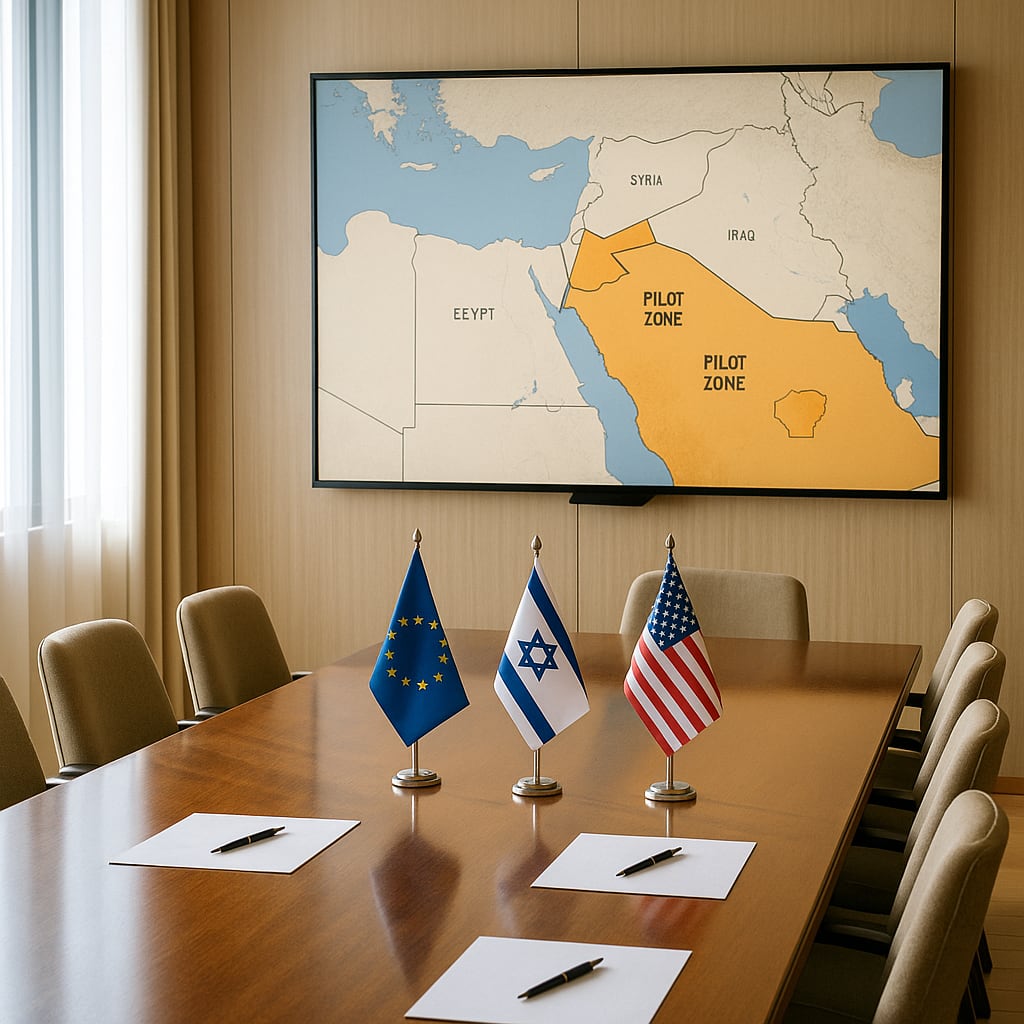
Elena: [thoughtful] One French report said the text puts two “pilot zones” under the Lebanese army, with only a slight Israeli pullback elsewhere. No full withdrawal. Sequencing is the crux: Israel says it stays in the south until Hezbollah disarms.
Lukas: [exhales] That’s not a small ask. [short pause] And Hezbollah… has already said no.
Elena: [serious] Called it null and void. And the Israeli defense establishment told troops to prepare for an extended stay. So both armed parties are bracing, while diplomats talk about architecture.
Lukas: [dryly] “First step.” [short pause] Followed by first strike.
Elena: [amused] That line basically wrote itself.
Lukas: Help me with the mechanism. Who holds the veto here? The Lebanese state signed. The U.S. brokered. Why doesn’t that end it?
Elena: [carefully] Because the actor with real coercive capacity in south Lebanon is not the Lebanese state. The framework tries to reinsert the Lebanese army as the ground enforcer. But the army is under-resourced, politically constrained, and historically reluctant to confront Hezbollah directly.
Lukas: [softly] So Washington is doing state-to-state ceremony in a place where the state isn’t the decider.
Elena: [short pause] That’s the uncomfortable heart of it.
Lukas: And yet some outlets treat it like a peace breakthrough. I saw breathless quotes about “a path to normalization.”
Elena: [measured] One U.S. network framed it as a rejection of Iranian interference; that sells at home. In Lebanese coverage, the word “sovereignty” comes out two ways: the government says it’s reclaiming it; Hezbollah says the deal gives it away.
Lukas: [skeptical] And in Israel?
Elena: [matter-of-fact] Mixed. A Jerusalem outlet even ran the text—“slight IDF pullback,” “pilot zones,” the promise of “neighborly relations.” But the prime minister also told audiences Israel would remain in the south until Hezbollah disarms. That’s the conditional peace: security first, quiet later.
Lukas: [quietly] So whose peace is this?
Elena: [thoughtful] The audience for the signing ceremony is Washington and Europe. Donors, partners, domestic voters. The audience for the airstrike is the front line. Those are two different theaters.
Lukas: [pause] Which one decides how the story ends?
[SECTION 2]
Elena: [serious] Power does. And that’s why the framings diverge so sharply. European statements welcomed a “critical step” and immediately named the key next step: disarm non‑state groups. That reveals the theory—fold Hezbollah’s role back into the state.
Lukas: [carefully] But if Hezbollah’s identity is built on armed resistance, asking them to disarm as the opening move is asking them not to exist.
Elena: [softly] And they hear it that way. Iranian media leans into that narrative: principles, dignity, no capitulation. On the other side, an American outlet packages the framework as proof the U.S. can still shape the region and box out Tehran.
Lukas: [dry laugh] Two press releases, one battlefield.
Elena: [short pause] Meanwhile, a British report reminded readers that previous “ceasefires” still had near-daily exchanges. History is doing some quiet fact-checking.
Lukas: [hesitant] There’s another piece I can’t shake. Legal advocates warned the deal could limit war-crimes accountability. Is there a trade being made—stability for silence?
Elena: [carefully] Some experts told a London paper that language in the framework might hinder future ICC avenues. Even the hint of that is telling: to get guns to cool, you sometimes offer insulation from consequences. It’s an old incentive, rarely advertised.
Lukas: [quietly] That would also explain Hezbollah’s fury—if the state signs a paper that normalizes an Israeli presence without justice, it’s a political torpedo for them.
Elena: [matter-of-fact] And for Israel, the calculus is blunt. A daily rocket threat from the border is intolerable; keep troops in a “security zone” until the threat is neutralized. The Hindu press quoted the line almost verbatim.
Lukas: [exhales] So “framework” becomes a word that lets everyone hold their own victory photo: the U.S. gets a diplomacy win, Israel gets staying power, the Lebanese government gets a lifeline. And the militia keeps the only chip that counts.
Elena: [thoughtful] That chip asserted itself immediately. Strikes in the south within a day; an Israeli soldier killed near Deir Siryan that night, reported by regional outlets. The paper didn’t jam the signal.
Lukas: [skeptical] Was all this ambiguity deliberate? Write a text so vague both sides can sign it, then hope momentum does the rest?
Elena: [amused] That’s how many frameworks are birthed. You build enough scaffolding to claim progress and pray the building appears. But when the core clause is effectively “disarm first,” time works against you. Every hour without change proves the militias’ veto.
Lukas: [softly] And yet—if you’re a parent in Tyre or Kiryat Shmona, you just want the shelling to stop. You don’t care about frameworks or framings.
Elena: [long pause] Which is why these ceremonies matter emotionally, even when they’re thin materially. They offer a horizon. But horizons can also be used to freeze a status quo—“we’re on the way, don’t push.”
Lukas: [cuts in] That’s the fear, right? That “first step” becomes the destination.
Elena: [dryly] Transitional arrangements have a habit of getting comfortable.
Lukas: [quietly] So who, in this picture, has the power to actually end it?
Elena: [serious] The same actor everyone’s trying to route around. The framework imagines the Lebanese army stepping in; the facts on the ground say Hezbollah decides when rockets stop. And Israel decides when it trusts that decision.
Lukas: [pause] A peace that requires your enemy to weaken itself before you move an inch. [short pause] That’s not a roadmap, that’s a bet.
Elena: [softly] And bets get called.
Lukas: [after a beat] If the only way to make this “peace” real is to empower the one group the agreement tries to erase… what are we actually building here?
Elena: [quietly] Something that calls itself an end, while negotiating with the fact that it isn’t.