
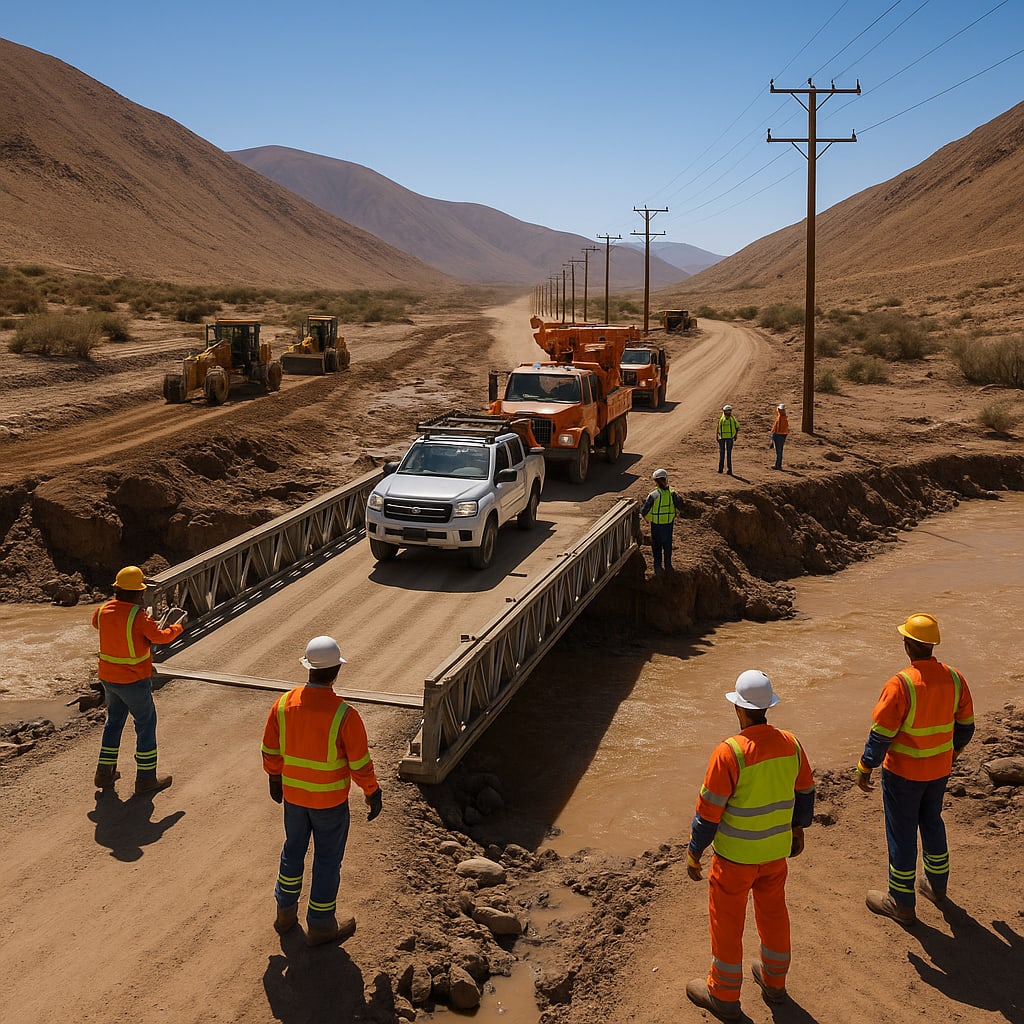
Severe storms in northern Chile kill at least 10 and isolate over 100,000 as state of catastrophe declared
Narrative Snapshot
Across outlets, the basic contours are consistent: unusually intense precipitation hit Chile’s northern regions, triggering floods, landslides, and mass isolation. Le Monde underscores the event’s intensity with the interior minister’s description that a month’s worth of rain fell in an hour and notes the episode began around July 15. BBC News focuses on images of inundated towns and evacuations and specifies formal emergency measures in Coquimbo and Huasco. CGTN and Telesur situate impacts squarely in the typically arid Atacama and Coquimbo regions and foreground the scale of humanitarian need, including injuries, displacements, and infrastructure damage.
Explanations for causation diverge. The Toronto Star’s Associated Press report and CGTN explicitly attribute the weeklong storms to El Niño, while European coverage led by Le Monde and Deutsche Welle emphasizes the severity and official response without assigning a meteorological driver. Telesur highlights landslides and “entire regions under mud” but does not dwell on climate teleconnections.
An economic thread enters via the Toronto Star’s business coverage: Lundin Mining suspended operations at the high-altitude Caserones complex due to heavy snowfall and power disruption, and reported effects at Candelaria as well. That industry lens complements flood-centered reporting by signaling how extreme weather simultaneously strains power systems, logistics, and extractive operations in the Atacama. The policy locus across sources is the state’s emergency posture—“state of catastrophe” or “state of emergency”—and the scale of isolation that complicates access.
What Happened
Severe storms that began around July 15 battered northern Chile with extraordinary rainfall intensity, prompting President José Antonio Kast’s government to declare a state of catastrophe or emergency in affected areas, notably Coquimbo, Huasco, and Atacama. Le Monde cites Interior Minister Maximo Pavez saying a month’s rain fell in a single hour, while BBC News documents flooding and evacuations. Fatalities reached at least 10 in multiple accounts, with Folha de S.Paulo also reporting four missing and more than 100,000 people cut off by blocked roads. CGTN adds 16 injured, over 4,000 displaced, and 1,031 in shelters, and Telesur describes widespread landslides. Chile’s army was mobilized for rescue, according to Folha. The weather disrupted energy and industry: Toronto Star reports Lundin Mining suspended operations at its Caserones site due to heavy snowfall and power loss, also affecting Candelaria. CGTN notes rains and strong winds continued to lash the usually arid north.
Why It Matters
The episode tests Chile’s disaster governance architecture and emergency logistics in a sparsely populated but strategically important region. The government’s use of “state of catastrophe” and army support for rescue, documented by BBC News and Folha de S.Paulo, illustrates reliance on exceptional powers to restore access to more than 100,000 isolated residents. CGTN’s characterization of one of the worst weather disasters in decades, combined with Le Monde’s depiction of rainfall intensity, points to stress on infrastructure designed for arid conditions. That raises policy questions about standards for roads, drainage, power supply, and communications in the north.
Economic implications are immediate. The Toronto Star’s report on Lundin Mining’s halted Caserones operations due to snowfall and power disruption shows how concurrent hydrometeorological hazards affect extraction, electricity, and transport. Attribution to El Niño by the Toronto Star’s AP piece and CGTN frames the event within a recurring climate mode, underscoring the value of seasonal risk planning and coordination between national authorities, regional governments, and operators handling critical services and supply chains.
Diverging Narratives
Casualty and damage figures differ across outlets, reflecting evolving tallies and varied official sources. Several reports hold fatalities at “at least 10” (Le Monde, Folha de S.Paulo, Telesur, CGTN, Toronto Star/AP), while Politika cites 13 dead and seven missing alongside detailed housing damage counts—81 homes destroyed and 2,761 seriously damaged—and 2,281 displaced. CGTN, by contrast, reports over 4,000 displaced and 1,031 in shelters. The range indicates partial snapshots of a moving emergency, differing definitions, or updates issued at different times.
Terminology and geography also vary. BBC News and Telesur refer to a “state of catastrophe” in Coquimbo and, respectively, Huasco/Atacama, whereas CGTN uses “state of emergency” for Atacama and Coquimbo; all describe the same emergency posture but differ in phrasing. Le Monde situates the crisis in northern Chile broadly, while BBC names specific subnational jurisdictions. As to causes, the Toronto Star/AP and CGTN explicitly link the storms to El Niño, whereas Le Monde, Deutsche Welle, and Folha emphasize impacts and response without advancing causal attribution. Finally, outlet focus diverges: Telesur centers on humanitarian conditions and mud-covered regions; BBC prioritizes visual evidence of evacuations; the Toronto Star’s business desk tracks mining and power disruptions at altitude, adding an industry operations frame to flood-driven narratives.
What Happens Next
Two decision tracks emerge from the reporting. First is restoring access to isolated communities. Folha de S.Paulo cites more than 100,000 people cut off, with the army mobilized for rescue. Movement on road clearance, bridge safety, and power restoration—referenced across Le Monde, BBC News, and CGTN—will determine the pace of evacuations and supply delivery. Indicators to watch include updated isolation counts, shelter occupancy (CGTN’s 1,031), and whether rains abate as CGTN noted continued lashing of the north.
Second is industrial and grid recovery. The Toronto Star reports Lundin Mining’s suspension at Caserones due to snowfall and power loss, also affecting Candelaria. Company statements on power restoration and site access will signal whether operations resume quickly or remain curtailed. Parallel updates from authorities on the scope and duration of the “state of catastrophe/emergency” in Coquimbo, Huasco, and Atacama (BBC, Telesur, CGTN) will indicate resource allocation and any extension of emergency powers as casualty and displacement figures—currently divergent across Politika and CGTN—are reconciled in official tallies.