
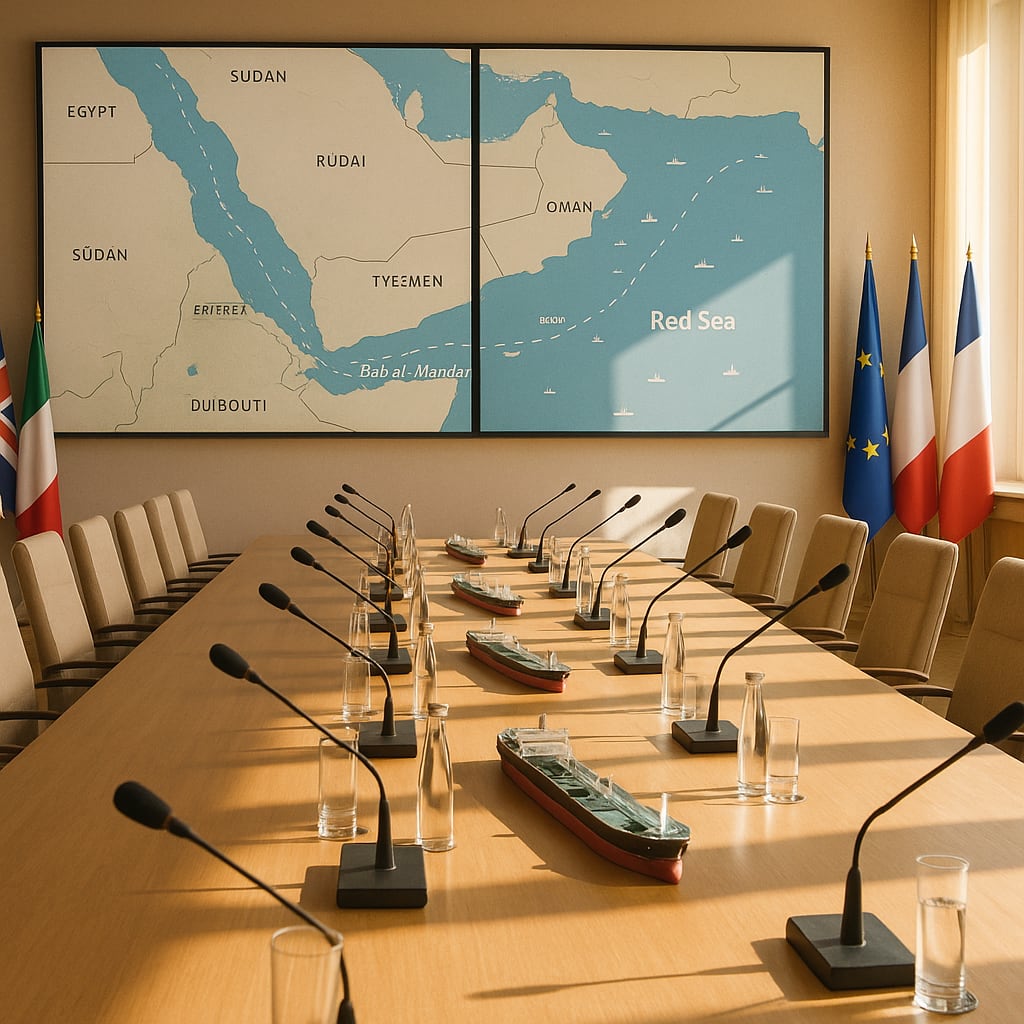
Houthis claim Red Sea strikes on Saudi tankers amid declared blockade, testing Bab al-Mandeb as US–Iran hostilities persist
Narrative Snapshot
Across outlets, there is consensus that Yemen’s Houthi movement has moved beyond rhetoric to claim responsibility for hitting two Saudi oil tankers while announcing restrictions on Saudi-linked shipping through the Red Sea. Coverage aligns on the risk to a second critical artery for energy and trade, with the Bab al-Mandeb joining the Strait of Hormuz as a live concern. Public warnings by Saudi authorities and the International Maritime Organization’s condemnation reinforce the sense of an operational, not merely hypothetical, threat.
Emphasis diverges on enforcement and scope. South China Morning Post notes the reported transit of a Chinese Cosco VLCC through Bab al-Mandeb despite the declared blockade, suggesting selective passage under certain conditions, while also underscoring continued US strikes on Iran. France 24 frames the Red Sea incidents as a potential new front in the US–Iran confrontation, and the Times of Israel pairs the tanker attacks with reports of Iran claiming strikes on US military assets in Kuwait and Jordan. CGTN highlights the Houthis’ “blockade for blockade” justification and the US resumption of strikes following American fatalities.
Operational reporting coalesces around Saudi West Coast vulnerabilities. Middle East Eye relays multiple civil defense alerts in Yanbu and Jizan, Houthi claims of missile fire, and Reuters-based accounts of Saudi interceptions using a Greek-operated air defense system targeting refineries near Yanbu. RT’s analysis spotlights the prospect that Yanbu and the East–West pipeline could be drawn into a standoff, a reading echoed indirectly by Saudi warnings and localized incident reports.
Several outlets situate the developments within a broader regional pivot to reduce dependence on Hormuz. Middle East Eye describes a pipeline-building push from the Mediterranean to the Gulf of Oman; Al Jazeera and Politika report Iraqi plans and US-linked deals to revive routes to Syria and Turkey that would bypass Hormuz. The Hindu parses downstream exposure for India’s economy if Bab al-Mandeb faces sustained disruption, while SCMP’s note on Chinese tanker passage introduces a state-to-state risk management dimension.
What Happened
Yemen’s Houthi movement said it attacked two Saudi oil tankers in the Red Sea and declared a blockade on Saudi shipping, a move multiple outlets link to rising risks at the Bab al-Mandeb chokepoint. Middle East Eye reports the IMO chief condemned the attacks and cites a Saudi outlet confirming one of the vessels was ablaze. In parallel, South China Morning Post and the Times of Israel note the United States conducted a 12th consecutive night of strikes on Iran, with CGTN adding that Washington renewed strikes after US personnel were killed in Jordan. Inside Saudi Arabia, Middle East Eye documents civil defense alerts in Yanbu and Jizan, Houthi claims of a missile strike on Jizan, and Reuters-based reports that two ballistic missiles targeting Yanbu refineries were intercepted by a Greek-operated system. South China Morning Post also reports the Chinese VLCC Xin Long Yang was allowed to transit Bab al-Mandeb despite the Houthi announcement.
Why It Matters
The Red Sea incidents intersect with two structural dynamics: the militarization of energy chokepoints and a regional race to dilute dependence on them. A declared Houthi blockade and reported strikes raise the prospect of Bab al-Mandeb functioning as a second constraint on oil flows alongside Hormuz, as flagged by SCMP, the BBC, France 24, Al Jazeera, and the Toronto Star. If threats extend to Yanbu and the East–West pipeline—the onshore alternative that moves crude to the Red Sea—Saudi redundancy could be compromised, a risk RT underscores and which Saudi alerts implicitly recognize. Simultaneously, governments are advancing bypass infrastructure. Al Jazeera and Politika detail Iraq’s agreements, including reviving the Iraq–Syria pipeline and planning routes to Turkey; Middle East Eye describes a wider pipeline boom from the Mediterranean to the Gulf of Oman. The Hindu’s assessment of India’s exposure and SCMP’s account of negotiated Chinese passage underscore how major importers may combine diversification with transactional access strategies while the IMO’s condemnation frames a multilateral baseline expectation for maritime safety.
Diverging Narratives
Outlets differ on how to interpret the Houthis’ declared “blockade.” CGTN relays the group’s framing as “blockade for blockade,” while RT notes the unusual vagueness of an “embargo” against a counterpart with limited direct trade and reads it as readiness to strike vessels entering or leaving Saudi ports, potentially including Yanbu-linked traffic. By contrast, SCMP’s report that a Chinese VLCC received passage suggests selective enforcement or negotiated exemptions, raising questions about criteria for targeting and the role of state-to-state engagement. Economic risk is widely acknowledged, but tones vary: the BBC and the Toronto Star stress fears of wider conflict and global damage; France 24 positions the Red Sea as a possible new front in the US–Iran confrontation; the Times of Israel links the tanker incidents to continued US strikes on Iran and Iranian claims of targeting US assets in Kuwait and Jordan. Ground reporting from Middle East Eye centers on immediate Saudi threat management—civil defense alerts, claims and counterclaims of strikes, and reported interceptions—without asserting the breadth of the blockade’s enforcement. Unresolved issues include whether the Houthis will apply destination, flag, or ownership-based rules, how consistently such rules will be communicated and enforced, and whether onshore Saudi infrastructure like the East–West pipeline will become routine targets.
What Happens Next
Key decisions cluster around enforcement, protection, and rerouting. For the Houthis, further clarification or repetition of attacks will indicate whether the blockade targets Saudi-destined cargo generally or is applied selectively; SCMP’s account of a Chinese tanker’s passage and CGTN’s citation of “blockade for blockade” are baseline indicators to track. For Saudi Arabia, civil defense communications, reports of interceptions, and any confirmation of damage near Yanbu or Jizan—as noted by Middle East Eye—will signal the effectiveness and posture of defenses around Red Sea export infrastructure. For shippers, Lloyd’s List–type reporting referenced by SCMP on negotiated transits, plus observable changes in routing around Bab al-Mandeb, will show whether transactional access is viable. Regionally, follow-through on Iraq’s pipeline revival deals reported by Al Jazeera and Politika, alongside the broader pipeline push described by Middle East Eye, will indicate whether governments are accelerating structural workarounds. Finally, the persistence of US strikes on Iran and any proxy or Iranian claims of responses in Kuwait or Jordan, as reported by SCMP, CGTN, and the Times of Israel, will shape whether the maritime arena remains a distinct risk vector or becomes more tightly coupled to the broader confrontation.