
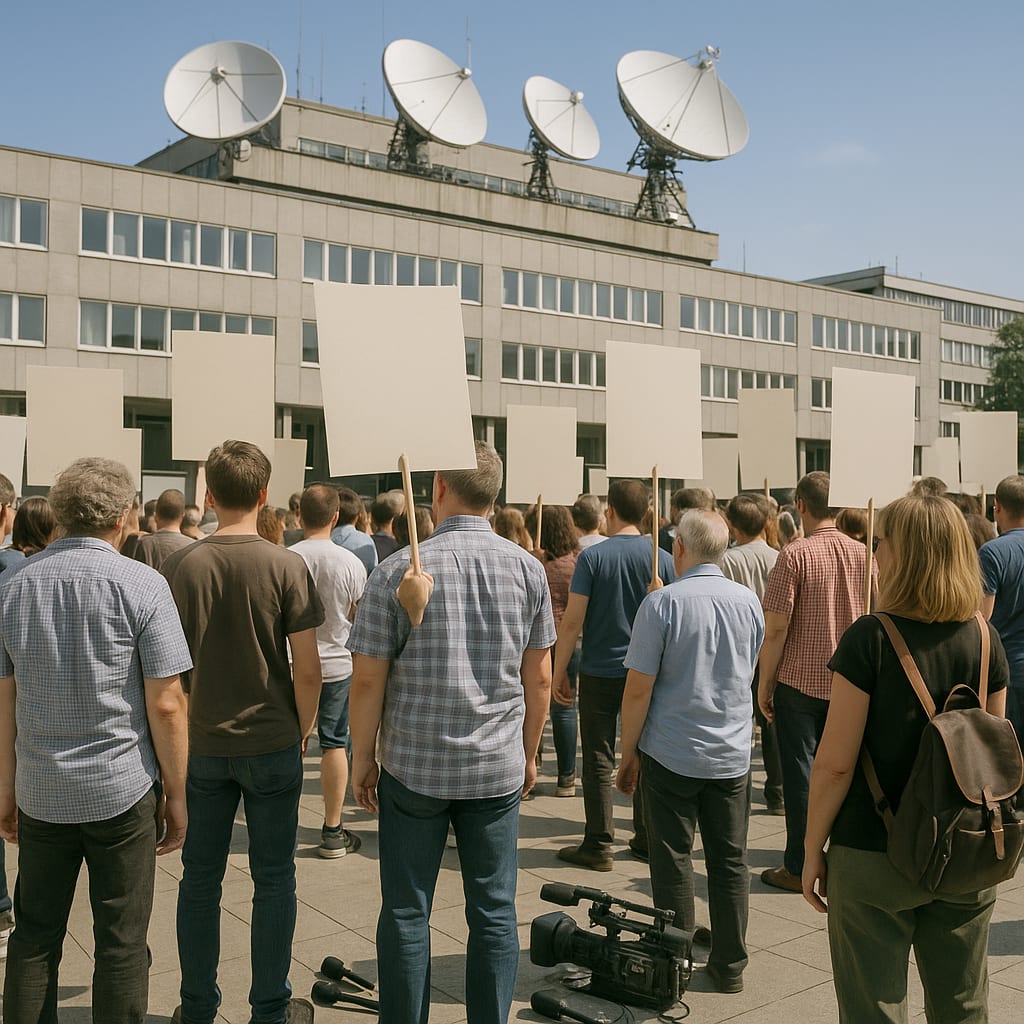
Thousands protest and public media staff strike in Czechia over plan to shift broadcaster funding to the state budget
Narrative Snapshot
- Broad alignment: All outlets report large demonstrations and a 24-hour strike by Czech Television and Czech Radio staff in response to a government plan moving funding from license fees to the state budget, with critics warning of threats to editorial independence (SCMP; The Hindu; DW; The Guardian; Al Jazeera).
- Differing emphases: DW highlights concrete fiscal effects — an immediate 15% cut and no guarantees of continued funding — while The Hindu focuses on the mechanics of the model shift. The Guardian centers on labor escalation at the broadcasters.
- Framing the stakes: Al Jazeera and DW foreground the risk of political control (“direct control” and “seeking to take control”). Corriere della Sera situates the move within regional patterns, referencing Slovakia under Fico and Hungary under Orbán.
What Happened
Thousands rallied in Prague on Sunday outside Czech Television to oppose a government funding overhaul, following earlier marches in regional capitals (SCMP). On Monday, staff at Czech Television and Czech Radio staged a 24-hour strike — the most significant escalation in a months-long dispute — after the government advanced plans to change how public media are financed (The Guardian). The proposal, approved by Prime Minister Andrej Babiš’s government, would replace individual and household fees with direct state budget financing starting next year (The Hindu). DW reports the change would reduce broadcaster funding by 15% and provides no assurances for future allocations, prompting accusations that the government seeks to take control of public media (DW). Al Jazeera likewise reports critics fear political interference from placing funding under direct government control (Al Jazeera). Corriere della Sera reports the measure was approved last week after a month of clashes (Corriere della Sera).
Why It Matters
The funding model shift concentrates financial leverage over Czechia’s public broadcasters in the state budget, a structure critics argue heightens vulnerability to political pressure (DW; Al Jazeera; SCMP). Without guarantees for future allocations, as DW notes, the arrangement could institutionalize year-to-year uncertainty, a known risk factor for editorial independence in public service media. Corriere della Sera’s comparison to developments in Slovakia and Hungary situates the move within a regional trajectory toward stronger executive influence over media systems. For decision-makers, the episode underscores how financing design — not just governance charters — determines the resilience of public broadcasters. It also signals that labor mobilization can become a central vector of contestation when funding reforms are perceived to threaten independence (The Guardian). The case will inform how other governments calibrate media funding reforms amid concerns about political interference.
Diverging Narratives
Coverage diverges on the status of the measure: several outlets describe a government-approved plan (The Hindu; DW; SCMP), while Corriere della Sera reports that a new law was approved last week after a month of clashes (Corriere della Sera). The scale and nature of risk are framed with varying specificity. DW quantifies the immediate budgetary impact (15% reduction) and flags the absence of future funding guarantees, emphasizing structural vulnerability (DW). Al Jazeera characterizes the move as placing funding under “direct control,” and DW reports accusations that the government seeks to take control of public media (Al Jazeera; DW). Other outlets focus on mobilization and institutional response rather than financial specifics: The Guardian highlights the 24-hour strike as the dispute’s largest escalation to date (The Guardian), while SCMP and The Hindu emphasize the mass demonstrations and the core change from license fees to state financing (SCMP; The Hindu). Unresolved questions across reports include what, if any, safeguards or multi-year guarantees will accompany the funding shift (DW).
What Happens Next
Key decision points center on implementation and safeguards. If the measure proceeds as a government-approved plan set to start next year (The Hindu), the government could introduce explicit guarantees or ringfencing to address independence concerns identified by DW; absent such steps, DW’s warning about no future funding assurances would persist (DW). If, as Corriere della Sera reports, the law has already passed, the locus shifts to how the government operationalizes the change and whether amendments or implementing rules add protections (Corriere della Sera). Labor dynamics are another hinge: Monday’s 24-hour strike marked the dispute’s peak so far (The Guardian); further staff actions or negotiations would signal whether pressure is mounting or easing. Analysts should watch for official statements on funding guarantees, any revisions to the reported 15% cut (DW), additional nationwide protests (SCMP), and whether the broadcasters’ staff announce further industrial action (The Guardian).