
AI buildout triggers protests, inflation warnings, and labor demands from the US to Europe
Narrative Snapshot
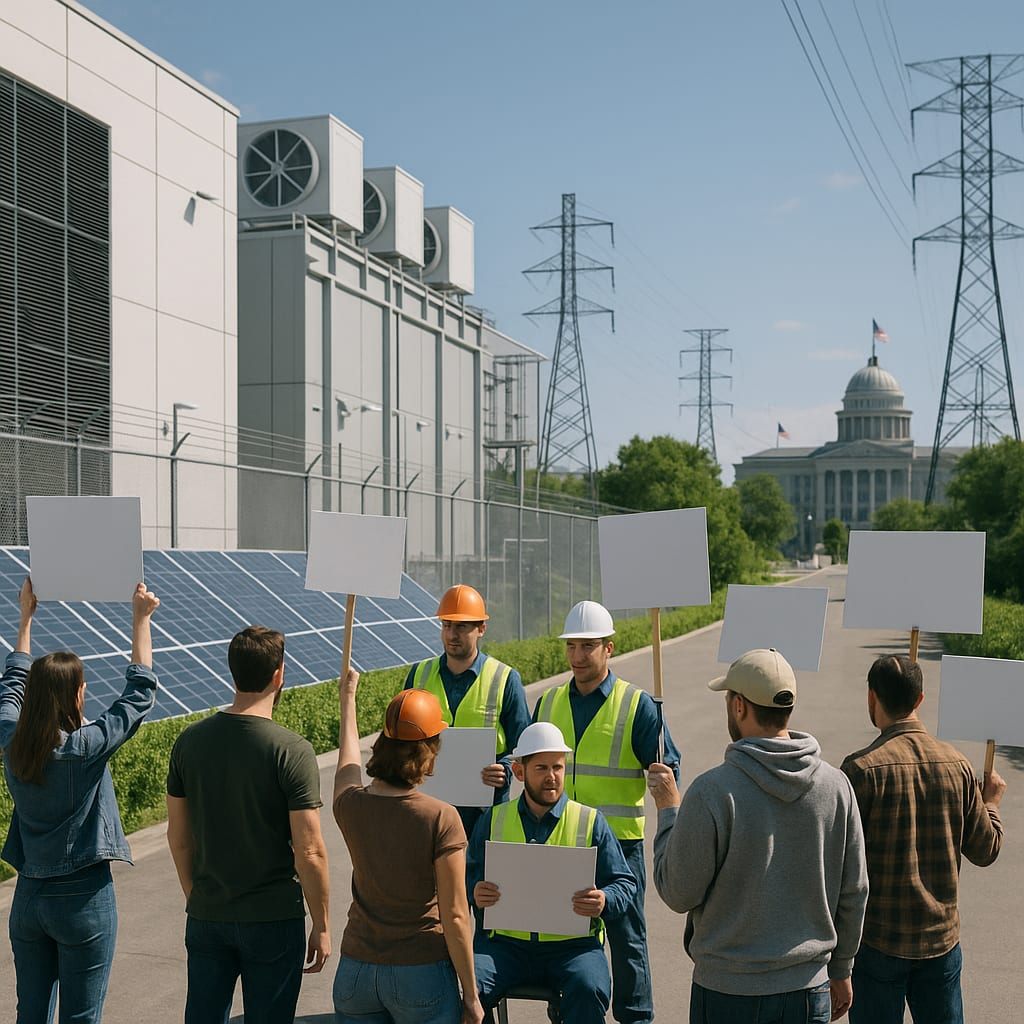
Across outlets, energy and infrastructure costs anchor the story, but with different lenses and geographies. Clarin, citing the Wall Street Journal, foregrounds mounting public protests in the United States against data centers, linking local mobilization to rising electricity tariffs and to broader social concerns such as employment, education, and youth mental health. Toronto Star, via AP, situates similar cost pressures at the macroeconomic level, casting the rapid expansion of AI infrastructure as a fresh inflation headwind for consumers and the Federal Reserve. Balkan Insight diverges by focusing on environmental externalities: Poland’s ascent to holding a third of Central and Eastern Europe’s data-center capacity proceeds amid what it calls a missing national debate on ecological impacts.
Labor-market anxiety is present in all directions but is articulated through distinct channels. Politika reports an explicitly AI-related worker response—a three-day strike at Hyundai, with employees demanding protections from AI. RT, drawing on new ADP Research survey data, underscores a gap between employer preparedness and worker fears, noting that only a small minority strongly feel their job is safe. Clarin addresses the same anxiety from a practical angle, offering expert guidance on how workers can adapt roles and skills. Toronto Star/AP elevates the concern to institutional scale with an open letter from hundreds of economists urging immediate action on potential job displacement and broader economic transformation.
The stakes spill across borders. Clarin notes that public unease in the US is reshaping scrutiny of megaprojects, explicitly naming OpenAI’s 2025-announced “Stargate Argentina,” which signals how infrastructure choices made by global AI firms reverberate in third countries. Meanwhile, Poland’s strategy as a regional data hub continues with limited environmental deliberation, even as US debates spotlight energy pricing and macroeconomic spillovers.
What Happened
New reporting highlights simultaneous economic, social, and labor responses to accelerated AI infrastructure deployment. Clarin, citing the Wall Street Journal, describes growing US protests against data centers, rooted in electricity price concerns and broader fears over employment, education, and youth mental health; it says this backlash is casting fresh scrutiny on large AI buildouts, including OpenAI’s “Stargate Argentina” announced in 2025. Toronto Star/AP reports that the AI buildout is contributing to higher consumer costs for laptops and electricity, posing an inflation challenge for households and the Federal Reserve. Balkan Insight notes Poland already hosts one-third of Central and Eastern Europe’s data center capacity yet lacks a robust debate on environmental impacts. Politika covers a three-day strike at Hyundai where workers seek protections from AI. A separate AP piece in Toronto Star details an open letter by hundreds of economists urging institutions to act on AI’s economic and job displacement risks. RT, citing an ADP Research study, reports widespread worker anxiety and limited retraining.
Why It Matters
The coverage converges on a policy nexus where energy pricing, environmental oversight, labor protections, and macroeconomic management intersect. Clarin and AP underscore how AI-driven electricity demand and hardware costs now figure into inflation dynamics, placing the issue on monetary authorities’ radar and linking local utility policies to national price stability. Balkan Insight’s focus on Poland’s silent environmental ledger highlights regulatory capacity questions in fast-growing AI host countries. Politika’s account of a strike over AI protections points to evolving labor bargaining agendas around automation safeguards and retraining. The economists’ open letter reported by AP broadens this from workplace adaptation to an institutional mandate, while RT’s summary of ADP data suggests a preparedness gap between corporate investment and workforce transition. Clarin’s reference to scrutiny of “Stargate Argentina” illustrates how public acceptance and regulatory due diligence may condition cross-border AI megaprojects.
Diverging Narratives
Outlets differ primarily in the costs they privilege and the locus of remedy. AP’s inflation frame in Toronto Star positions AI infrastructure as a near-term price shock for consumers and a challenge for central banking, whereas Clarin’s protest angle centers community-level grievances spanning utility bills and social concerns beyond macro indicators. Balkan Insight finds the policy conversation in Poland notably thin on environmental externalities despite the scale of investment, contrasting with the explicit social contestation described in the US coverage. On labor, Politika reflects collective action for contractual protections, while Clarin provides individualized adaptation advice; RT, citing ADP Research, stresses systemic under-preparedness by employers, suggesting that voluntary corporate reskilling may lag the pace of automation. The AP-reported economists’ call for immediate institutional action sharpens the question of governance scope and timing, but concrete policy prescriptions are not detailed in these accounts, leaving open how governments, firms, and unions will operationalize safeguards or cost management.
What Happens Next
Key decision points emerge along regulatory, corporate, and labor tracks. In the US, Clarin’s account of protests tied to electricity pricing points to permitting and tariff decisions as near-term levers; watch local utility rate cases, zoning approvals for data centers, and any explicit references to AI-related demand in regulatory filings. In Poland, Balkan Insight’s observation of a missing environmental debate makes ministerial guidance, environmental-impact procedures, or parliamentary hearings critical indicators of whether oversight will catch up with capacity growth. Politika’s report of a three-day strike at Hyundai elevates collective bargaining over AI; signals to monitor include contract clauses on automation safeguards and employer-funded retraining. AP’s coverage of economists’ demands suggests potential legislative or administrative responses; track whether labor ministries, education authorities, or central governments announce reskilling programs or impact assessments. AP’s inflation framing also makes Federal Reserve communications salient; analysts should watch for mentions of AI-related capital and energy costs in inflation diagnostics. Clarin’s note on “Stargate Argentina” suggests monitoring host-country scrutiny of large AI projects.