
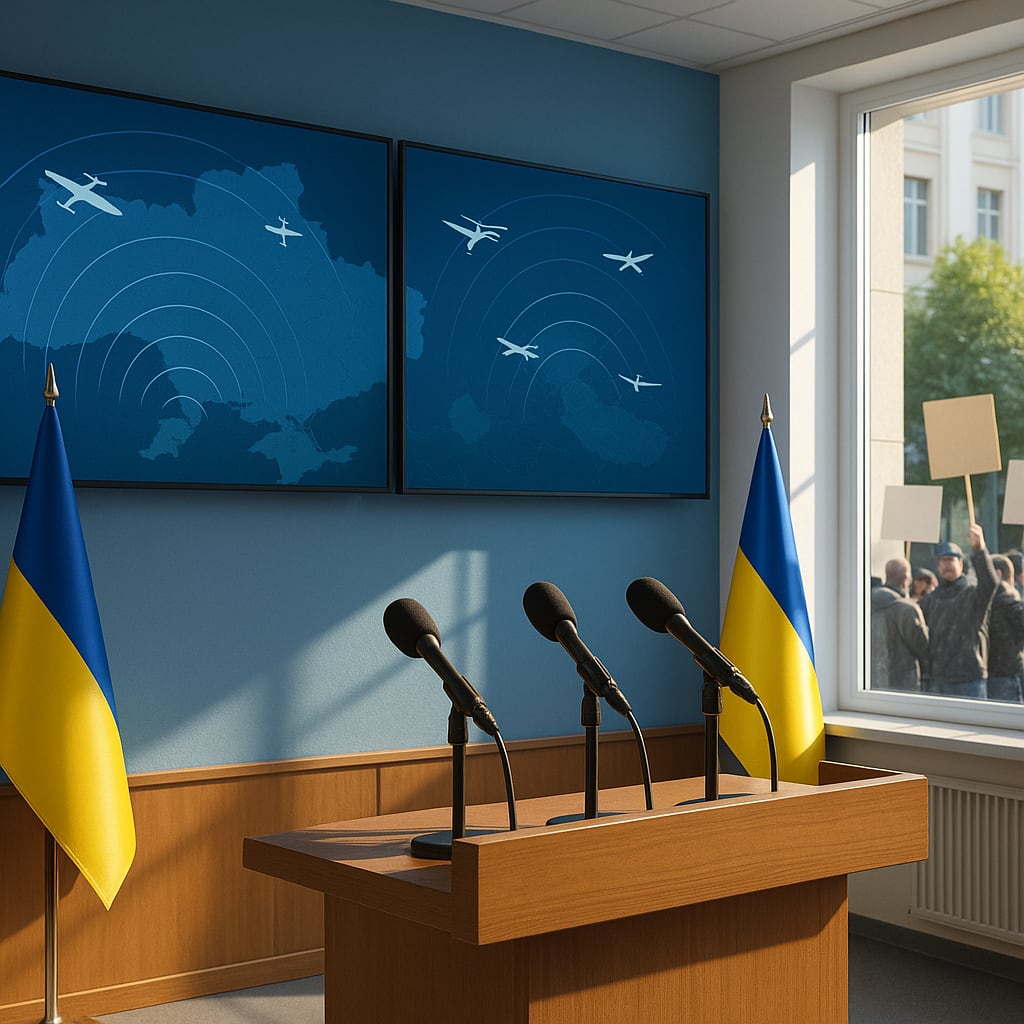
Ukraine appoints Mykhailo Drapatyi commander-in-chief amid protests and cabinet reshuffle
Narrative Snapshot
Across outlets, Drapatyi’s elevation is treated as both a personnel decision and a stress test of Ukraine’s wartime governance. Japanese and North American reporting foreground the domestic political trigger: street protests after the surprise ouster of a popular defense minister and President Volodymyr Zelensky’s removal of his commander-in-chief under public pressure, per the Japan Times and Associated Press reporting via the Toronto Star. Ukrainian official media narrows quickly to deliverables, with Ukrinform specifying Zelensky’s directives to “close the skies” and overhaul recruitment centers.
Profiles from European outlets center Drapatyi’s battlefield pedigree and the technological turn in the war. Corriere della Sera describes him as a Mariupol-born popular hero whose 2014 actions made him emblematic, and argues his tenure will hinge on “dronization.” Deutsche Welle similarly situates the appointment within a wider shakeup that ousted Defense Minister Mykhailo Fedorov. Serbian daily Politika emphasizes a “turbulent” generational shift and carries Oleksandr Syrskyi’s claim that he hands over an army that is on the offensive.
Moscow’s line, carried by Telesur English, is that the leadership change will not alter the front line, presenting continuity as the salient fact. Domestic reception is more fluid. The Kyiv Independent’s street interviews probe expectations for Drapatyi’s command and whether Fedorov should retain influence over defense policy, showing a public that is engaged not just with the battlefield but with institutional reform.
What Happened
President Volodymyr Zelensky dismissed Commander-in-Chief Oleksandr Syrskyi and appointed General Mykhailo Drapatyi to lead Ukraine’s armed forces. The move followed a surprise cabinet reshuffle that removed Defense Minister Mykhailo Fedorov and prompted days of street protests, according to the Japan Times and the Associated Press report carried by the Toronto Star. Deutsche Welle notes Drapatyi’s appointment came amid that broader shakeup. Kyiv-based Ukrinform reports Zelensky tasked Drapatyi and Acting Defense Minister Yevhenii Khmara with two priorities: strengthening air defenses to “close the skies” and reforming territorial recruitment centers. Politika frames the transition as a generational change and quotes Syrskyi on Telegram saying he hands over an army that is not only defending but also in the offensive. The Kremlin’s Dmitry Peskov, via Telesur English, said the switch would not affect the front-line situation. The Kyiv Independent captured mixed public expectations in street interviews.
Why It Matters
The reshuffle tests wartime civil-military accountability under conditions of high societal mobilization. As reported by the Japan Times and AP via the Toronto Star, public pressure shaped leadership outcomes, while Ukrinform’s focus on air defense and recruitment reform links the appointments to two structural constraints: protecting critical infrastructure and stabilizing manpower flows. European coverage highlights adaptation imperatives. Corriere della Sera’s emphasis on “dronization” underscores how command changes are being judged against integration of unmanned systems and countermeasures, not just traditional maneuver.
Moscow’s message of continuity, relayed by Telesur English, signals an effort to discount any deterrent or morale effect from Kyiv’s personnel shifts. For decision-makers, the test is institutional: whether new leadership can translate political signals into procurement choices, training pipelines, and administrative reform of territorial recruitment centers. Deutsche Welle’s framing of the move within a broader cabinet shakeup suggests downstream implications for how Ukraine coordinates defense policy across civilian and military leadership.
Diverging Narratives
Outlets split on whether the change is primarily political or operational. The Japan Times and AP via the Toronto Star foreground protests and presidential responsiveness, locating the decision in domestic contention. Ukrinform moves quickly to an implementation frame, naming air defense and recruitment reform as immediate tasks for Drapatyi and Acting Minister Khmara. Corriere della Sera and Deutsche Welle profile Drapatyi’s experience and the technological demands ahead, with Corriere stressing drones as the defining challenge.
There is also divergence on battlefield implications. Telesur English cites the Kremlin’s view that replacing Syrskyi with Drapatyi will not affect the front line, casting the move as symbolic rather than material. Politika’s coverage amplifies Syrskyi’s claim that Ukraine’s forces are not only holding but conducting offensive actions, an assertion not echoed elsewhere. Al Jazeera English frames the core uncertainty—whether Drapatyi can alter the war’s direction—by recalling his 2014 prominence and posing the question rather than claiming an effect. The Kyiv Independent adds societal texture by probing whether Fedorov, despite his ouster as defense minister noted by DW, should continue shaping defense policy, highlighting unresolved questions about civilian leadership roles.
What Happens Next
Key decisions will revolve around two Zelensky-set priorities reported by Ukrinform: visible steps to “close the skies” and concrete reforms to territorial recruitment centers. Analysts should watch for announced measures from Drapatyi and Acting Defense Minister Khmara that indicate sequencing and accountability for these tasks. A second hinge is doctrinal adaptation to drones, elevated by Corriere della Sera; signals would include publicized training, procurement choices, or organizational changes aligned with “dronization.”
Stability at the civilian helm remains a variable. Deutsche Welle and the Kyiv Independent point to the unsettled status of defense leadership, with Khmara in an acting role and debate over Fedorov’s continued influence. Resolution—either confirming a permanent minister or clarifying advisory roles—will shape policy coherence. Finally, competing frames on battlefield impact bear watching: if front-line dynamics remain unchanged, it would align with the Kremlin’s stance reported by Telesur; if operational emphasis shifts, it would validate the domestic implementation focus emphasized by Ukrainian sources.