
Lead
A cluster of cultural flashpoints in the UK—spanning a postponed British Museum event, a resurfaced street harassment video targeting actor Helen Mirren, and a widening campaign urging theatres to cut ties with Bloomberg Philanthropies—has become a proxy battleground for the wider Israel–Palestine dispute. The common thread across coverage is institutional anxiety about security and reputational risk, alongside escalating arguments over whether protest tactics are sliding into antisemitism and whether cultural bodies are drifting into political litmus tests. Looming behind the arts story is the grim regional context: UNICEF has reported dozens of children killed or injured in Lebanon in a single week, underlining how developments in the Middle East are feeding intensity—and urgency—into debates in European public life.
What Happened
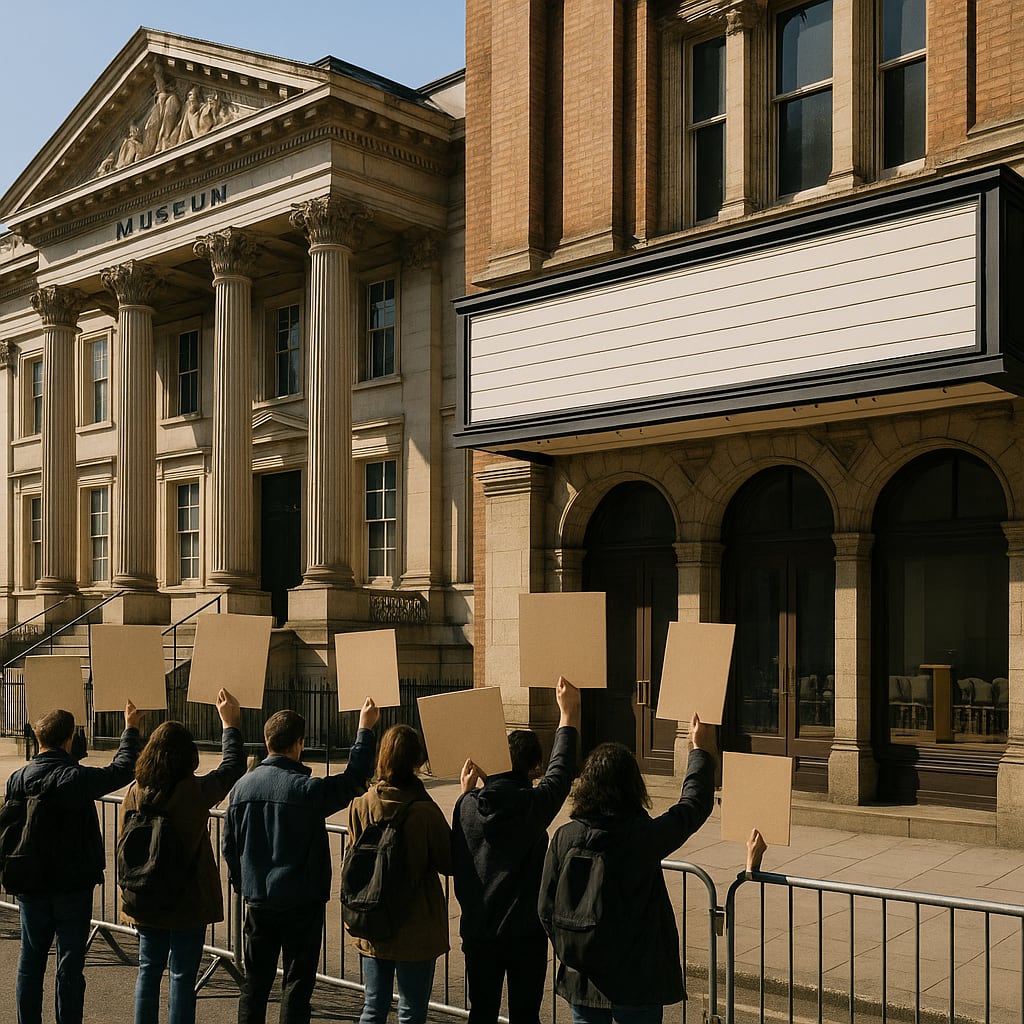
The most concrete institutional decision concerns the British Museum, which postponed a scheduled lecture tied to Jewish Culture Month on the ancient kingdoms of Israel and Judah. The museum cited security concerns, saying it believed a significant number of RSVPs were likely to be protesters and that it could not guarantee the safety of the audience or the integrity of the programme. The event was not framed as cancelled outright; the museum indicated it would be rescheduled when conditions allowed.
The postponement triggered a rapid political and public reaction. Criticism came from free speech advocates and commentators, and also from Conservative Party leader Kemi Badenoch, who condemned the move in political terms as well as on principle. The dispute quickly became less about an academic talk and more about whether cultural institutions are yielding to intimidation—or prudently managing risk.
At the same time, UK police were reported to be examining a resurfaced video clip of a man accosting Helen Mirren in London with misogynistic and explicitly “Zionist” slurs. The footage, filmed earlier and later recirculated online, prompted police scrutiny as a possible hate crime. Mirren’s connection to the issue is not political activism but her portrayal of former Israeli prime minister Golda Meir in a recent film, which was highlighted in coverage as a potential motive for the harassment.
A third strand came from the performing arts: more than 250 artists called on UK theatres to end relationships with Bloomberg Philanthropies, arguing that the organisation’s ties to Israel should disqualify it as a cultural partner. This campaign sits within a larger pattern of pressure on arts institutions over donor relationships and perceived complicity in contested state policies, but in this case the artists’ focus was explicitly linked to Israel.
In parallel, international reporting noted the continuing human toll in the region. UNICEF said that in one week 77 children were killed or injured in Lebanon—an average of 11 a day—and called for hostilities to end. While this report is not about UK culture, it forms part of the factual backdrop against which protest movements and counter-claims of prejudice are escalating in Europe.
Why It Matters
The British Museum episode highlights how the Israel–Palestine conflict is increasingly reshaping the operational reality of European cultural institutions. Museums and theatres are being pulled into roles they did not traditionally occupy: arbiters of political acceptability, managers of protest risk, and—by default—actors in highly polarised debates about identity and historical narratives.
For institutions, the immediate questions are practical: whether public programming can proceed without disruption, what security thresholds justify postponement, and how to protect staff and audiences while maintaining an open forum for scholarship and debate. But these choices also create symbolic consequences. Postponing a Jewish-culture event because of anticipated protest is read by some as a capitulation that chills expression; by others as a necessary decision to prevent disorder, particularly if organisers believe the programme itself could be derailed.
The harassment of a high-profile actor adds a social dimension: the boundary between political protest and hate speech. A slur-laden confrontation on a London street—especially one framed around “Zionism” but delivered with gendered abuse—raises questions about how readily political labels are being used as vehicles for targeting individuals perceived as connected to Israel or Jewish identity. The fact that police are assessing the clip as a potential hate crime underscores official concern about the nature of the rhetoric and whether it crosses legal thresholds.
The Bloomberg Philanthropies campaign shows the conflict’s economic and reputational reach. Cultural philanthropy is a critical funding stream in the UK arts sector; calls to sever ties with major donors test both institutions’ financial resilience and their willingness to take political positions. The pressure is not limited to programming; it extends to sponsorship, board relationships, and the moral signalling expected by parts of the cultural workforce.
The regional context matters because it fuels both moral urgency and polarisation. UNICEF’s figures on child casualties in Lebanon provide a stark indicator of the violence’s impact, reinforcing why activists demand visible institutional stances. At the same time, heightened emotion can harden into absolutist demands—either to boycott anything associated with Israel or to treat protest itself as suspect—tightening the squeeze on cultural spaces that have historically tried to accommodate contested viewpoints.
Diverging Narratives
Across outlets and countries, the same events are framed through notably different lenses—less in terms of disputed core facts than in terms of what each story is “about.”
Security management vs. free speech crisis. The British Museum’s stated rationale—safety and the integrity of the programme—appears consistently. Where accounts diverge is in emphasis: some treat the postponement primarily as a security decision prompted by credible concern over disruption; others elevate it into a free speech and institutional courage issue, foregrounding criticism from commentators and politicians. In the latter framing, the lecture becomes a test case for whether protest threats can veto cultural programming.
Antisemitism as the central frame vs. protest politics as the driver. Italian coverage leans more explicitly into antisemitism as the connective tissue linking the museum postponement and the Mirren video, presenting them as symptoms of a hostile climate for Jews in London. Other reporting treats antisemitism as one important element but keeps the focus on protest dynamics, institutional decisions, and the politicisation of cultural spaces. The difference is less about denying or affirming antisemitism than about whether it is positioned as the primary explanatory key.
Mirren incident: hate crime lens vs. viral outrage lens. Reporting converges on the basic details: the clip shows Mirren being verbally abused; it was filmed earlier and later resurfaced; police are looking into it. Divergence emerges in how the story is contextualised: some accounts emphasise policing and hate-crime scrutiny, while others foreground the social-media spread and the shock value of the insult, treating it as emblematic of a deteriorating public discourse.
Donor pressure: ethical accountability vs. politicised targeting. The artists’ call to end ties with Bloomberg Philanthropies is described as part of a broader push to align cultural funding with activists’ ethical demands. Coverage varies in the weight given to the artists’ moral argument versus the implications for institutional independence and financial stability. Outlets more attuned to activism present the demand as accountability; more institution-focused framings highlight the risk of politicising philanthropy and narrowing the range of acceptable partnerships.
Regional casualties: humanitarian urgency vs. distant context. UNICEF’s Lebanon figures appear as a standalone humanitarian update, but their relevance is implicitly different depending on the editorial lens. In some framings, the suffering in the region is the essential context that explains why cultural protest is intensifying; in others, it is background noise relative to the UK-centric questions of security, speech, and communal relations.
Current Situation
The British Museum lecture remains postponed, with the institution signalling intent to reschedule when it can ensure audience safety and protect the event from disruption. The public argument around the decision continues, shaped by high-level political intervention and broader debates over whether cultural programming is becoming hostage to protest threats.
Police scrutiny of the Mirren video is ongoing, reflecting the seriousness with which authorities are treating incidents that may meet the threshold for hate crime, particularly where targeting is linked to perceived Jewish or pro-Israel association.
In the theatre world, the artists’ push to end ties with Bloomberg Philanthropies adds further pressure on cultural governance and funding relationships, with institutions facing competing expectations: to uphold open cultural exchange, to guarantee safety, and to declare ethical boundaries in their partnerships.
Meanwhile, UNICEF’s report of 77 children killed or injured in Lebanon in a week underscores that the conflict’s human cost is not receding—and that the intensity driving activism, counter-claims of prejudice, and institutional risk management in the UK is being continually replenished by events in the region.