
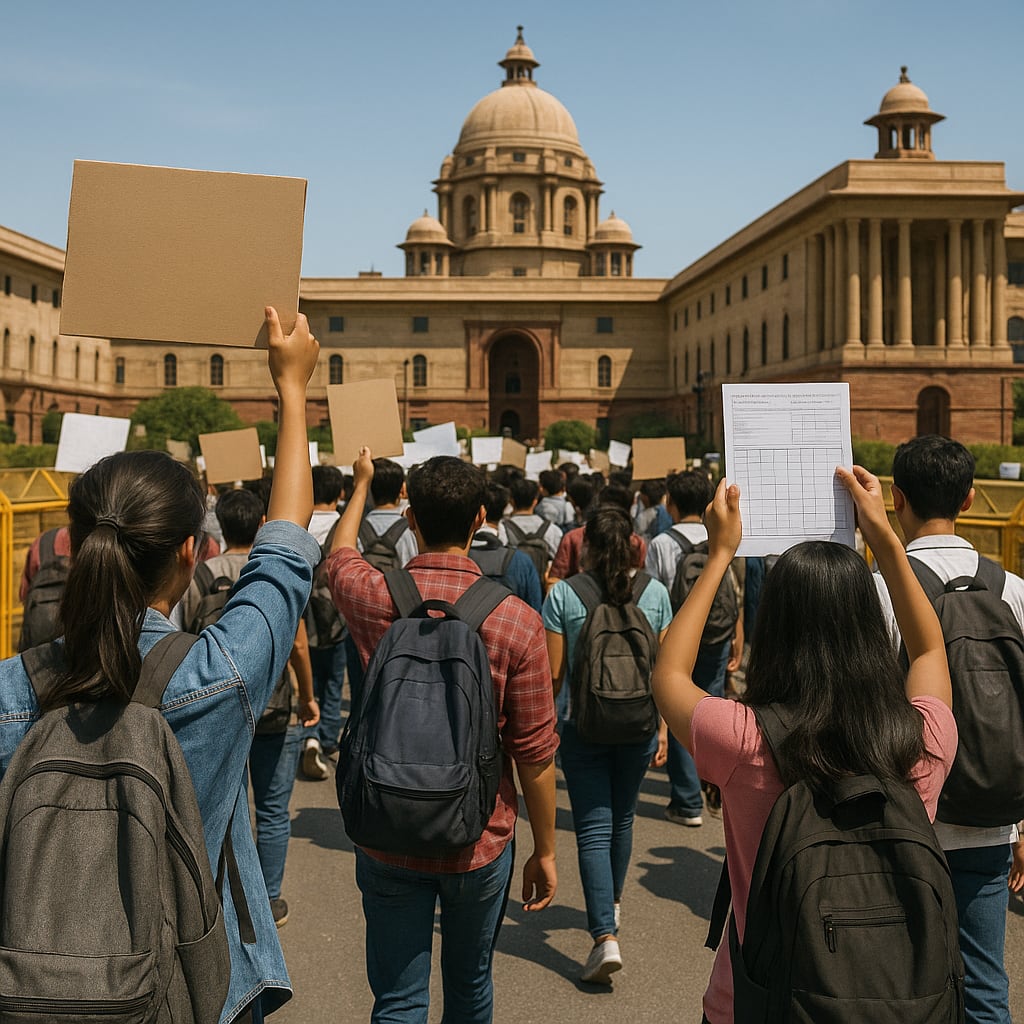
Rahul Gandhi briefly detained during Delhi’s youth-led ‘Cockroach’ protests as opposition presses Modi to resign
Narrative Snapshot
Across outlets, there is broad agreement on the immediate facts: youth-led protests over exam irregularities in higher education escalated in New Delhi; police used force to disperse marchers; and Rahul Gandhi was detained outside the prime minister’s residence after calling for Narendra Modi to resign. International coverage converges on the protests’ trigger—repeated leaks in high-stakes entrance tests—with Le Monde describing a movement catalyzed by recurrent exam scandals, and multiple outlets noting demands for the education minister’s resignation and reforms to restore integrity in testing. Several reports underline scale and persistence: the Japan Times frames the demonstrations as Delhi’s largest since the 2021 farmer protests, while the BBC and The Guardian emphasize that crowds returned despite the previous day’s violence.
The lines of emphasis diverge. France24, Deutsche Welle, Al Jazeera, and the Japan Times center the political confrontation around Gandhi’s detention and demand that Modi step down, while DW and The Diplomat widen the lens to a systemic youth backlash over jobs and education, portraying the “Cockroach” movement as a vehicle for broader accountability claims. Le Monde, La Repubblica, and CBC foreground police tactics—tear gas and batons—and the protesters’ determination to hold ground. Operational details and sequencing are clearest in the BBC and Bangkok Post coverage, which report injury figures, arrests, and Gandhi’s same-day release. France24 adds that two movement representatives met a government minister even as Modi himself has not addressed the issue.
What is most at stake, as drawn from these accounts, is less a single confrontation than the credibility of India’s education governance and the state’s capacity to manage high-stakes exams without recurring scandal. The Diplomat’s “zero accountability” framing, DW’s linkage to employment anxieties, and Le Monde’s account of repeated exam failures situate the protests within longer-running institutional stresses. Al Jazeera’s assessment that the movement poses one of the Modi government’s biggest challenges reflects this structural reading more than a single-day clash.
What Happened
Student-led protests over alleged exam leaks and irregularities in India’s higher education entrance system surged in central Delhi on July 20 and 21, with thousands attempting to march toward parliament to demand reforms and the resignation of Education Minister Dharmendra Pradhan. Police erected barricades and used tear gas and batons to disperse crowds, according to La Repubblica and CBC. The BBC reported at least 60 protesters wounded and police claims of 118 officers injured. The movement, colloquially known as the “Cockroach” Janata Party, has framed its cause around restoring exam integrity, as described by Le Monde and The Diplomat. On July 21, Rahul Gandhi staged a sit-in outside Prime Minister Narendra Modi’s residence, calling for Modi’s resignation; he and Priyanka Gandhi Vadra were detained and later released, according to the Guardian, Japan Times, Al Jazeera, and Bangkok Post. France24 noted two movement leaders met a government minister on July 20, while Modi has not publicly addressed the demands.
Why It Matters
The episode compresses multiple structural pressures: a long-documented pattern of exam fraud and leaks that, as Le Monde reports, has recurred in India’s higher education system; a youth cohort expressing sharper discontent over education and jobs, per Deutsche Welle; and an accountability debate captured by The Diplomat’s portrayal of a “broken system.” The Japan Times’ comparison to the 2021 farmer protests suggests these demonstrations have scaled beyond routine campus unrest, with potential implications for governance and administrative legitimacy. For policymakers, the credibility of examination institutions is central to human capital development and labor-market signaling; repeated failures erode trust in merit-based selection and intensify political mobilization. The persistent police-protestor standoff reported by the BBC, Guardian, and CBC, combined with Al Jazeera’s characterization of a major challenge to the government, indicates that responses on exam governance, ministerial responsibility, and protest policing will shape the trajectory of youth-state relations and the stability of education policy implementation.
Diverging Narratives
Coverage differs less on facts than on interpretive frame. One strand, led by France24, Deutsche Welle’s live updates, Al Jazeera, the Japan Times, and the Guardian, foregrounds Gandhi’s detention and his demand for Modi’s resignation, presenting opposition politics as a central axis of the story. Another, developed by Le Monde, DW’s analytical piece, The Diplomat, and the Bangkok Post’s explainer, anchors the protests in systemic exam integrity failures and youth economic insecurity, with the “Cockroach” movement as a new organizing vehicle rather than a purely partisan surge. There are also differences in assessing the protests’ weight: Al Jazeera calls the youth demands one of the government’s biggest challenges, while the Japan Times contextualizes them as the largest since 2021 without assigning explicit political peril. On tactical details, La Repubblica and CBC stress forceful policing; the BBC quantifies injuries and underscores that protests continued the following day; Bangkok Post confirms Gandhi’s release, tempering any implication of a prolonged detention. France24’s note that movement representatives met a minister contrasts with Modi’s silence, introducing a split between bureaucratic engagement and top-level political response. Politika additionally reports Congress reiterating five formal demands, signaling an effort to codify opposition aims even as details of those demands vary across outlets.
What Happens Next
Three decision points emerge from the reporting. First, on accountability: protesters and several outlets highlight demands for the education minister’s resignation and exam-system reforms; a ministerial change or a credible reform package would mark a shift, while silence at the top—France24 notes Modi has not addressed the issue—risks prolonging mobilization. Second, on engagement: France24 reports a meeting between movement figures and a government minister, suggesting a potential negotiation channel; watch for announcements of inquiries, timelines for exam integrity measures, or formal talks. Third, on policing and protest management: the BBC, CBC, and La Repubblica describe forceful tactics even as crowds returned; changes in crowd-control posture, legal follow-through on arrests, or facilitation of permitted demonstrations would signal either de-escalation or further confrontation. Analysts should track cabinet signals around Dharmendra Pradhan, any public statement by Modi, and whether coverage continues to frame the movement as a broad youth accountability push or reverts to narrower law-and-order narratives.