
Lead
A new UN-backed climate outlook is converging media attention around a blunt message: the world is entering a run of years in which record global heat is not a distant possibility but the central expectation. Across coverage in Europe, Asia, the Middle East and Latin America, the shared takeaway is that between now and 2030 the planet is overwhelmingly likely to set at least one new annual temperature record, while the chance of temporarily surpassing the Paris Agreement’s 1.5°C warming threshold has risen to a level that forecasters now describe in probabilistic terms rather than as an abstract warning. The report also elevates the Arctic as a frontline of accelerated warming and highlights El Niño as a near-term amplifier—especially for 2027—on top of the long-term trend driven by greenhouse gas emissions.
What Happened
The core event is the release of a near-term global climate forecast produced under the auspices of the UN’s meteorological system: the World Meteorological Organization (WMO), working with major forecasting centers including the UK’s Met Office. The outlook covers the five-year window from 2026 to 2030 and translates climate risk into probabilities—how likely it is that average global temperatures in that period will approach or exceed recent extremes.
Across outlets, several elements recur consistently:
Record heat is expected to continue through the next five years. The forecast indicates a high likelihood that at least one year between 2026 and 2030 becomes the warmest on record, extending the recent pattern of successive heat milestones.
Temporary overshoot of 1.5°C is increasingly likely. The coverage broadly agrees that there is a substantial probability that at least one year in the 2026–2030 period will exceed 1.5°C above pre-industrial levels in the global annual mean—presented as the “warming limit threshold” or “international climate threshold” often associated with the Paris framework. The reporting treats this as a one-year exceedance risk, not a declaration that the Paris target has been permanently lost.
The Arctic is warming faster than the global average. Multiple accounts highlight that the forecast projects continued accelerated warming in the Arctic, reinforcing a widely established feature of the climate system known as Arctic amplification and underscoring implications for ice, ecosystems, and global weather patterns.
El Niño is a key near-term factor, with particular attention on 2027. Several outlets, especially in Europe and Latin America, foreground the interplay between a developing or anticipated El Niño and the already-elevated baseline of global temperatures. A notable emphasis is that 2027 could be exceptionally hot if El Niño conditions intensify, with some coverage suggesting it could contend for the hottest year on record.
The stories also situate the forecast in an immediate lived context. One prominent example is the reference to a heatwave in Western Europe at the time of publication—used to connect the statistical outlook to contemporary impacts and to signal that extreme heat is arriving earlier and more intensely than many seasonal expectations.
Why It Matters
The forecast matters not because it introduces a new theory of climate change, but because it turns the next five years into an operational horizon for governments, insurers, health systems, and energy planners. It compresses climate risk from “mid-century” to “this budget cycle.”
Politically and diplomatically, the prospect of crossing 1.5°C even temporarily carries symbolic and strategic weight. The Paris Agreement’s 1.5°C benchmark functions as a global reference point for ambition, finance, and accountability. A rising probability of annual exceedance complicates climate diplomacy in two ways: it can harden demands for faster emissions cuts from high emitters while simultaneously fueling arguments—especially in domestic politics—that targets were unrealistic or that adaptation should dominate policy.
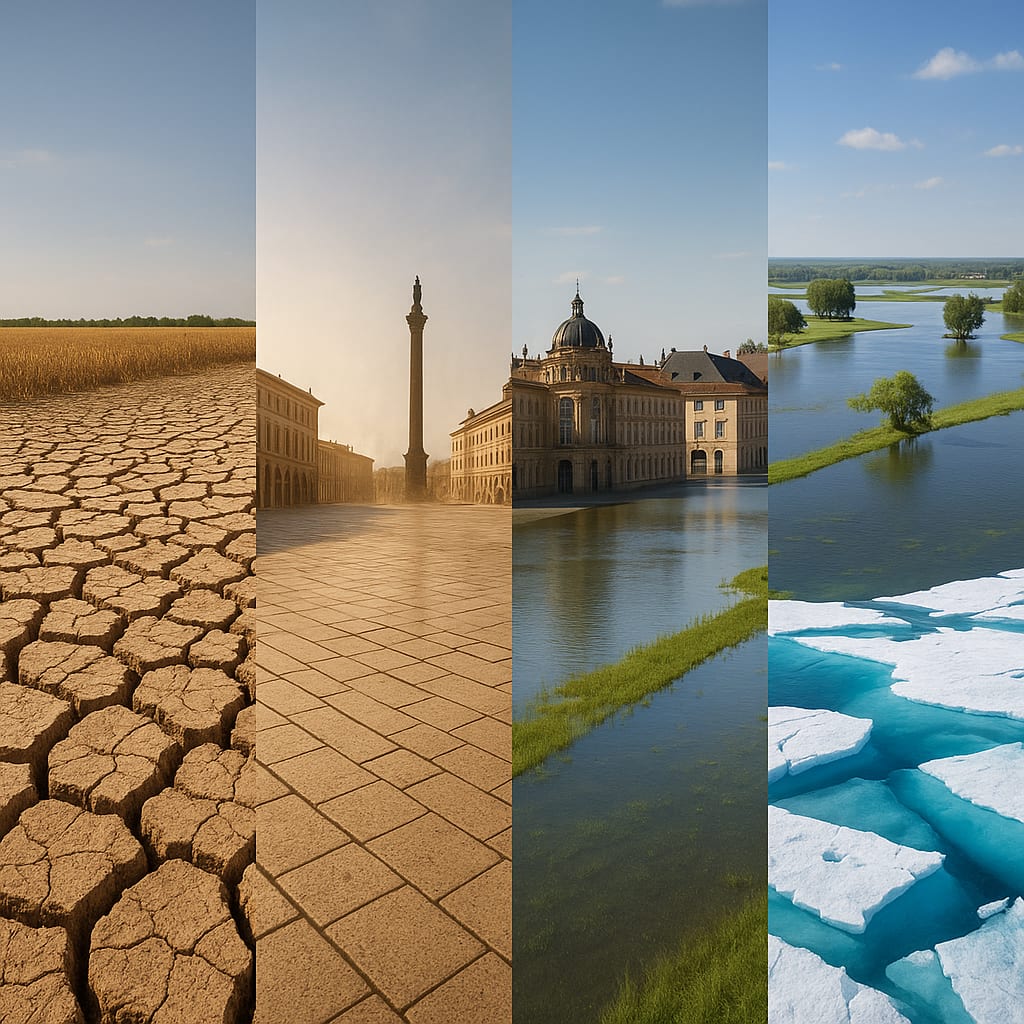
Economically, repeated record heat raises the expected cost of extremes that are already hitting balance sheets: heat-related productivity losses, damage from droughts and floods, and volatility in food and energy markets. The reporting links “spiking temperatures” to a spectrum of impacts—from drought to flooding—reflecting the fact that warming intensifies the hydrological cycle and alters atmospheric patterns, rather than simply making summers hotter.
Socially and in public health, the near-term focus is significant. Heatwaves are among the deadliest weather hazards, and warmer baselines increase the likelihood that extreme heat thresholds—especially dangerous for the elderly, outdoor workers, and people without reliable cooling—are crossed more often. Several outlets use the forecast as a frame for heat already being felt, underscoring the immediacy for urban preparedness, hospital planning, and labor protections.
Scientifically and in risk communication, the forecast’s probabilistic language is itself consequential. By expressing likelihoods—for record years, for crossing 1.5°C in at least one year, for regional changes like Arctic warming—the UN system is offering a decision-making tool rather than a general warning. This nudges climate reporting away from “will it happen?” and toward “how likely is it, and what should we do now?”
Diverging Narratives
While the core facts align, the coverage diverges in emphasis and framing—revealing different editorial priorities and, in some cases, different interpretations of what the same probabilities mean.
1) “Five years” versus “four years,” and the messaging horizon.
Most coverage leans into a five-year outlook (2026–2030). Some Spanish-language reporting emphasizes “the next four years,” even while referencing UN/WMO material. This is less a direct factual contradiction than a framing choice about what to foreground—whether to stress an immediate, tighter window for public attention or the full five-year forecast period. The effect is to intensify urgency by shortening the timeline, but it can also blur the report’s actual forecast range as presented elsewhere.
2) The 1.5°C threshold as a political symbol versus a technical statistic.
International English-language coverage often treats the risk of exceeding 1.5°C in at least one year as the central headline—a shorthand for the world brushing up against a “limit.” Other coverage places more weight on the certainty of another record-hottest year, which is more intuitively graspable to audiences than the technicalities of a global temperature anomaly relative to a pre-industrial baseline. The difference affects reader takeaway: one framing emphasizes Paris-era climate politics; the other emphasizes lived experience and the continuity of records.
3) El Niño: amplifier, explanation, or distraction.
Italian outlets, and a Brazilian podcast treatment, elevate El Niño as a key explanatory device—highlighting ocean conditions in the Pacific and pointing to 2027 as a potential peak year. Other coverage mentions El Niño but keeps the causal center of gravity on human-driven warming, positioning El Niño as a temporary boost layered on top of a rising trend. The divergence is mainly about narrative causality: whether readers come away thinking “El Niño is coming” or “the baseline is rising, and El Niño will make it worse.”
4) Impact framing: from extreme weather catalogues to regional immediacy.
Some reporting leans heavily on a catalogue of extremes—droughts, floods, deadly heat—linking the forecast to a broad hazards map. Other coverage anchors the story to a specific contemporaneous event (such as a European heatwave) to make the forecast feel immediate and geographically tangible. Both approaches are compatible, but they cue different public responses: broad systemic risk versus local, present-tense alarm.
5) The Arctic as headline or footnote.
Where some outlets give prominent attention to faster Arctic warming—often pairing it with the authority of the Met Office and WMO—others treat it as secondary to the global record narrative. This matters because the Arctic is not only a regional concern; it is frequently cited by scientists as influential for sea-level risk (through ice dynamics) and for broader climate patterns. Downplaying it narrows the perceived scope of consequences.
Current Situation
At publication, the immediate status is a world already experiencing abnormal heat and entering a period that forecasters say is highly likely to deliver new temperature milestones before 2030. The near-term outlook presented across coverage is consistent on three points:
- Record-breaking conditions are likely during 2026–2030, with at least one year expected to set a new global annual heat record.
- A one-year exceedance of 1.5°C above pre-industrial levels is a credible near-term risk, treated as a probabilistic outcome within the forecast window.
- El Niño is being watched as a near-term intensifier, with particular attention on the possibility of a notably hot year around 2027.
The immediate outlook, in other words, is not framed as a single impending event but as a sustained period of elevated risk—where the practical question for governments and societies is less whether extraordinary heat will arrive than how frequently it will do so, and how prepared systems are when it does.