
Europe’s summer wildfires force mass evacuations in France and Spain and spread to Greece and the U.K.
Narrative Snapshot
Across outlets, there is broad agreement on the exceptional scale and cascading geography of the fires, and a split in emphasis between short-term containment and longer-term risk. Several report cautious improvements in parts of France and Spain, with officials allowing some evacuees to return and fire fronts slowing in places, even as responders warn that high temperatures and winds could reverse gains. Others foreground the fourth heatwave of the season and the likelihood that extreme conditions will persist into August, undercutting any respite.
Causal framing diverges in emphasis rather than direction. Multiple pieces reference new attribution work concluding that human-driven warming sharply increased the likelihood of the observed fire weather in France and Spain; Spanish meteorological officials add that Western Europe is warming faster than many regions, compounding heatwave risk. French and international reporting also brings land-use governance into view, highlighting failures to enforce defensible-space rules around homes in forests hit by the worst fires. Scientific explainers extend the hazard profile, showing how pyrocumulonimbus fire clouds can intensify fire behavior and create their own weather.
Operational coverage ranges from the scale of the mobilization to the strain on responders. Reports detail thousands of firefighters, cross-border assistance, and more than 20 aircraft on major fronts, alongside hundreds of injuries and frontline “war of attrition” accounts. One outlier narrative argues EU sanctions have constrained Spain’s access to certain helicopters, while most other outlets stress the breadth of aerial and ground deployment without linking capacity gaps to sanctions. Beyond immediate human impacts and evacuations, environmental and infrastructure stakes surface in pieces highlighting mass wildlife losses and a U.K. blaze igniting near a nuclear facility.
What Happened
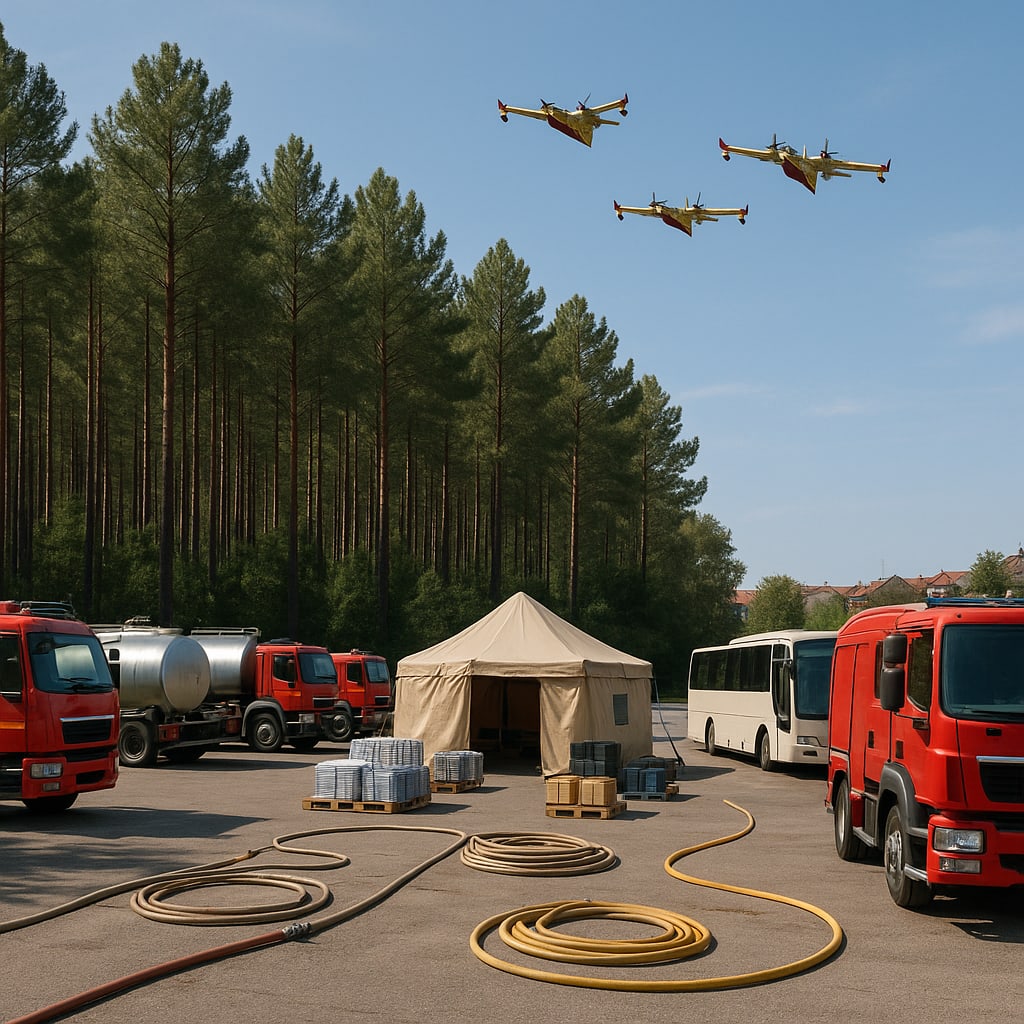
Vast wildfires erupted across southwestern France and parts of Spain in late July, torching pine forests, tourist zones and peri-urban areas. In France’s Gironde, the largest blaze burned roughly 42,000 hectares—about four times the size of Paris—destroyed more than 200 homes, injured over 230 firefighters and forced around 220,000 people to evacuate; two firefighters were killed. Authorities deployed more than 2,200 firefighters and over 20 aircraft, with support from European partners. France also recorded its first pyrocumulonimbus fire cloud over the southwest. Spain battled record fires west of Madrid amid fears that two fronts could merge. Fires spread elsewhere in Europe: about 500 people were evacuated by sea in Greece and a suburb west of Athens faced partial evacuation; three Greek firefighters died. A large U.K. wildfire scorched land near a nuclear power station. Some fronts slowed and half of evacuees in parts of France were allowed to return.
Why It Matters
This fire season tests Europe’s climate adaptation, emergency response, and land-management regimes simultaneously. Rapid attribution work finds that human-induced climate change made the hot, dry conditions that enabled these fires at least twice as likely in France and about 20 times as likely in Spain, reinforcing pressure on EU and national institutions to integrate climate risk into firefighting capacity, forest planning and urban-interface policy. The failure to enforce France’s defensible-space rules around homes underscores governance gaps that escalate losses even when operational resources surge.
Cross-border deployments noted by French and international outlets point to the practical value—and limits—of European solidarity during compound heatwaves. Rising firefighter casualties, mass displacements, and evacuations from tourism hubs reveal economic and public health externalities beyond the burn scar, while wildlife impacts signal longer-term ecological damage. Fires burning near critical infrastructure in the U.K. sharpen the case for resilience planning that spans energy, transport and civil protection, as heat-driven extremes push hazards into regions previously considered lower risk.
Diverging Narratives
Two frames coexist in the reporting: tactical containment versus structural escalation. Several outlets highlight that major French and Spanish fires slowed or were contained in places and that evacuees began returning; others, citing ongoing heatwaves, warn that conditions remain primed for flare-ups and new ignitions in August, especially with strengthening winds.
On drivers, multiple reports converge on climate change as a key enabling factor, backed by attribution studies and national meteorological assessments. Alongside that, prominent coverage spotlights proximate governance failures—especially France’s weak enforcement of vegetation-clearance buffers—and possible human causes for ignitions, such as contractor activity under investigation near the Gironde outbreak. French media analysis notes that European press coverage links the fires to climate change while critiquing a lack of debate within France on root causes.
Resourcing and readiness produce the clearest contrast. Most outlets emphasize the scale of mobilized aircraft and international crews. A dissenting account argues EU sanctions on Russia have deprived Spain of certain helicopters, constraining response—an assertion not echoed elsewhere, where the operational picture centers on expanded deployments rather than sanction-driven shortfalls. Coverage also widens the lens to collateral stakes: mass wildlife losses, maritime tourist evacuations in Greece, and a U.K. blaze near a nuclear site, each inflecting how risks are prioritized.
What Happens Next
Several decision points will shape trajectories. Weather remains the dominant variable: analysts should track heatwave duration, wind shifts and drought indicators cited by European and Spanish meteorological authorities; attribution studies and forecasts suggesting persistent August heat imply elevated risk of reintensification even on contained perimeters. In Spain, whether two fires west of Madrid merge will be a key operational inflection point. In France’s southwest, the phased return of evacuees could reverse if winds strengthen and hot spots reignite; local authorities’ enforcement of vegetation buffers around homes bears watching as a near-term policy response.
Responder capacity and safety are another hinge: injury counts, aircraft availability and cross-border reinforcements will signal whether strain is easing or compounding. In Greece, continued sea and urban-edge evacuations and alerts near Athens will indicate if fire fronts are encroaching on denser areas. The emergence of pyrocumulonimbus clouds—now documented in France—would be a real-time marker of escalating fire behavior.