
[SECTION 1]
Elena: [serious] We’ve crossed the threshold that leads to a health shock.
That’s the head of Paris’s public hospital system talking about heat, not a virus.
Lukas: [quietly] That’s pandemic language for the weather. [short pause] And it lands heavier than the usual “scorching temperatures” line.
Elena: It reframes it. Not summer, not “nature,” but systems under strain: ERs jammed, dialysis interrupted, heat stroke layered on top of chronic illness. Le Monde put it starkly.
Lukas: [skeptical] But most of what I saw was flames — helicopters, orange skies. It’s cinematic.
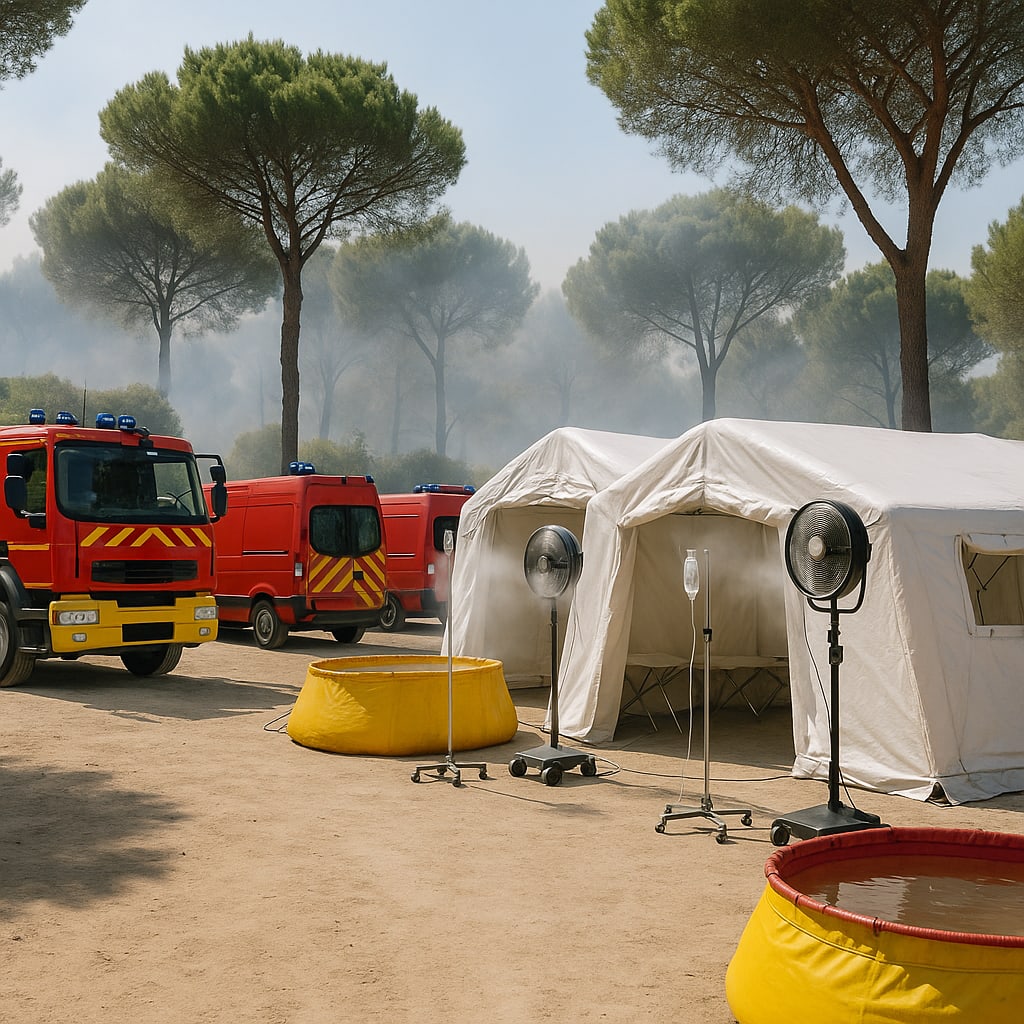
Elena: The fires are real. Around 17,000 hectares across France, Spain, Portugal burned already; forecasts brushing 40 degrees Celsius. That’s twice Manhattan on fire, if you like the comparison. But the more radical break is inside buildings we assumed would stay cool enough.
Lukas: So the tension is… Europe’s climate‑leader story colliding with an infrastructure that was built for a softer climate.
Elena: [matter-of-fact] And different audiences are being told different parts of that. The Japan Times called Europe a net‑zero champion “snared” by climate change right at home — the irony is the point.
Lukas: [short pause] Which stings, because Europe’s brand was: the continent that plans ahead, sets the rules, lectures a little.
Elena: [dryly] Lectures about 2050 while buying fans on a Sunday because the hospital ward is 31 degrees.
Lukas: [exhales] And then there’s the culture hits. DW notes a Tour de France stage might reroute because of wildfire smoke. That’s… summer itself wobbling.
Elena: Symbols matter. Our rituals are tuned to a gentle July that doesn’t exist anymore.
Lukas: The mortality is blunt. Spain’s health ministry put more than a thousand dead in June alone. Other countries counted thousands of excess deaths across the heatwave.
Elena: [quietly] Attribution scientists said this kind of early‑season heat would have been virtually impossible without climate change. So yes, the cause is clear enough. What’s unclear is who owns the fix.
Lukas: [interrupts] Why weren’t we ready? I mean, not as a gotcha. As a boring, literal question.
Elena: Incentives. Mitigation is global theater; adaptation is local plumbing. You get praised for targets, not for shade trees, cool roofs, or installing chillers in an underfunded provincial clinic.
Lukas: [softly] And yet the nurse in that clinic is the one holding a saline bag over someone whose kidneys are failing.
Elena: [long pause] That’s why the “health shock” line matters. It’s saying: this isn’t about weather appreciation. It’s triage protocols, ventilation retrofits, backup power for heat domes — and even how we count heat deaths when the certificate says “cardiac arrest.”
Lukas: Two Europes. The powerpoint with goals, and the ambulance idling in a 42‑degree courtyard.
Elena: [amused] And the media toggles between them: fire porn, then public‑health quotes, then — coming up — political gymnastics.
Lukas: [curious] Political gymnastics how?
Elena: We’re watching parties that long belittled climate risk now sprint to rewrite their lines. But before we go there — notice the shift from “angry nature” to “failed ventilation plan.” That’s accountability.
Lukas: [quietly] And it points back at all of us.
[SECTION 2]
Lukas: [dry laugh] Say it out loud: air‑conditioning.
Elena: [carefully] Air‑conditioning. The uncomfortable noun. There’s a blunt SCMP piece arguing Europeans are finally warming to AC, and it cites the thermoneutral zone — humans do best roughly between 17 and 24 degrees Celsius.
Lukas: [short pause] Which is awkward when nights are sitting at 28. So AC becomes the litmus test: breathe today, or keep score for 2050.
Elena: That’s the symbol. For years, AC was coded as American excess, bad urbanism, bad grid. Now it’s a life‑saving device — especially for the elderly and low‑income households with top‑floor flats. And yet installing it at scale raises emissions and stresses fragile grids.
Lukas: [serious] So if you’re a mayor, the moral math is ugly. Don’t buy units and people die; buy them and you blow your carbon report and maybe the transformers.
Elena: And your budget. Adaptation money is municipal and immediate; mitigation rewards are national and deferred. That’s why Germany’s press is full of arguments over whether the federal government or the cities are responsible for heat preparedness.
Lukas: [curious] And the politics you teased?
Elena: In France, reporting shows the far‑right scrambling to erase years of climate sneering after the June heat made denial untenable. It’s not conversion; it’s repositioning. Meanwhile a Nobel physicist in Italy warned that “a certain politics’” climate denial has real‑world costs.
Lukas: [thoughtful] So the incentives shift: if voters are literally fainting on trains, even denialists need a new script.
Elena: [matter-of-fact] Exactly. And another framing pops up: blame outsourcing. Fox covered a Paris deputy mayor who basically said, “America, your emissions helped cook us — and your 90 percent AC culture wasn’t free.” It’s a moral appeal — and a culture war grenade.
Lukas: [skeptical] Which U.S. audiences will hear as deflection: you lecture us about AC, then buy AC and blame us for buying AC first.
Elena: [dryly] Everyone has a clean conscience in someone else’s story. Meanwhile, Greek authorities warn about toxic smoke from an industrial fire; you need clean‑air shelters, not arguments.
Lukas: [quietly] That’s the other adaptation no one plans for — staying indoors when the indoors are 30 degrees and the air is filthy.
Elena: [softly] It’s all one system: heat, fire, grid, hospital, housing. And Europe’s social model — shaded streets, transit, old stone — is being tested in ways it wasn’t designed for.
Lukas: [exhales] Here’s the part that sticks with me. If we do the humane thing — mass AC, cool centers, night shifts, siesta hours — emissions tick up. If we don’t, people die now. There isn’t a clean lane.
Elena: [long pause] The clean lane was thirty years ago. Now it’s triage and redesign: heat pumps instead of dumb AC, better insulation, reflective surfaces, trees, revised work hours, and yes — backup power for ICUs.
Lukas: And trust. Because telling people “open a window” at midnight in a heat dome is… insulting.
Elena: [quietly] The messaging has to match the physics. And the physics say Europe’s “gentle climate” is gone.
Lukas: So the continent that sold the world on long‑term targets has to master boring, near‑term competence. While the streets start to hum with compressors.
Elena: [softly] And we’ll argue over whether that hum is surrender or survival.
Lukas: [after a beat] Maybe both. Which is why it’s so hard to listen to.