
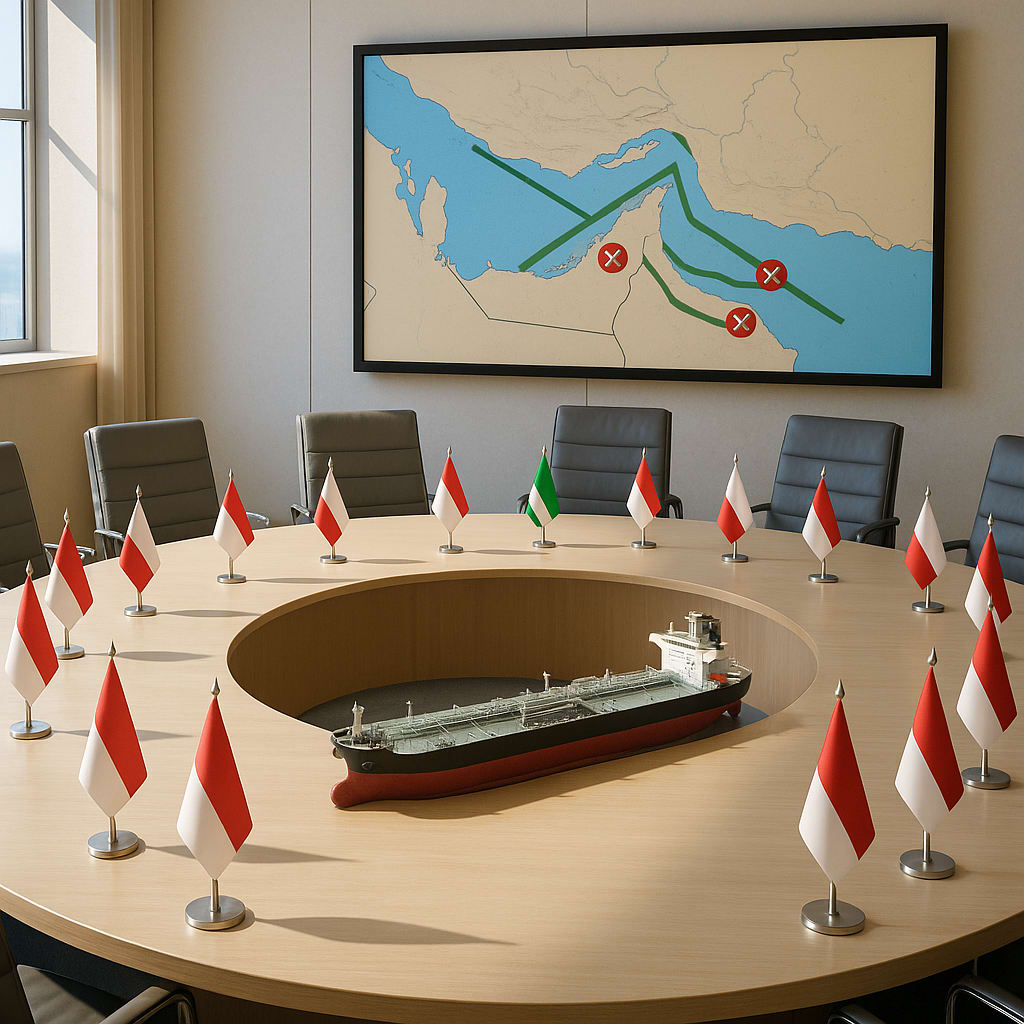
US demands Iran declare Strait of Hormuz open as IRGC orders closure and Muscat talks continue
Narrative Snapshot
Across US and European outlets, coverage coalesces around Washington’s push for a public Iranian commitment that Hormuz is open, toll-free, and safe for commercial shipping, alongside reports that Iranian negotiators have blamed recent attacks on “rogue” elements and privately acknowledged a “mistake” in the strikes on vessels. The New York Times cites US officials expecting a declaration of open passage, and Radio Free Europe/Radio Liberty reports a private Iranian admission of error ahead of talks in Oman. The BBC, Deutsche Welle, and TASS all highlight the US condition that Tehran forswear attacks and not impose tolls.
Iranian and region-focused sources emphasize process, sovereignty, and legal framing. Tehran Times and IRNA portray Muscat as focused on mechanisms for “safe passage” under the June 17 Islamabad MoU, and on a “proportionate mechanism” rather than unilateral US conditions. Parallel hardline messaging is starker: Iran’s IRGC Navy announced the Strait is “closed until further notice,” warning against attempts to open an “illegal route,” as carried by Middle East Eye and Telesur.
Third-party actors pull in different directions. The Guardian reports European exploration of non-compulsory navigational fees backed by the International Maritime Organization, even as Britain’s deputy prime minister warns compulsory tolls would be disastrous. NATO’s secretary-general deems recent US strikes “absolutely necessary” and says the Strait must be open, according to TASS, while China urges restraint and dialogue at the UN Security Council, per CGTN. Qatar publicly presses both sides to uphold the MoU and joined the Muscat discussions, Middle East Eye reports.
What Happened
US officials demanded that Iran publicly state the Strait of Hormuz is open to all traffic, pledge not to attack commercial ships, and rule out tolls, with a short deadline tied to talks in Oman, according to the New York Times, BBC, Al Jazeera, Middle East Eye, TASS, and Deutsche Welle. The Times reported US expectations that Tehran would soon make such a statement and said Iranian negotiators blamed recent attacks on “rogue” units; RFE/RL cited US claims that Iran privately acknowledged a “mistake.” Iran’s foreign minister Abbas Araghchi arrived in Muscat for talks with Oman, with Qatar joining discussions on reopening the central passage in international waters, Middle East Eye and the New York Times reported. In parallel, Iran’s IRGC Navy declared the Strait “closed until further notice,” warning against “illegal” shipping routes, per Middle East Eye and Telesur. After a commercial ship was struck, the US launched further strikes, NBC News and the Japan Times reported. Iranian outlets framed discussions around “proportionate” mechanisms under the Islamabad MoU and rejected an IMO Council draft as politicized, Tehran Times and IRNA said.
Why It Matters
The dispute is a test of who sets the rules at the world’s key energy chokepoint: bilateral bargains, coastal state control, or multilateral maritime governance. The US demand for a “toll-free” pledge and safe passage echoes longstanding navigation norms, while Iranian officials insist on reopening only under “Iranian arrangements” or a “proportionate mechanism” tied to the June 17 MoU with Oman, underscoring a sovereignty-first approach reported by The Hindu, Tehran Times, and IRNA. Europe’s exploration of non-compulsory fees with IMO backing, reported by the Guardian, signals appetite for hybrid arrangements that may blur lines between safety services and access charges. China’s call at the UN for restraint and talks, contrasted with NATO backing of US strikes, highlights competing great-power approaches to crisis management, per CGTN and TASS. For decision-makers, the outcome will shape precedent on fee regimes, third-party verification, and whether ad hoc MoUs can substitute for, or sit within, IMO-centered processes.
Diverging Narratives
US and allied reporting emphasizes Iranian culpability with caveats. The New York Times relays that Iranian negotiators pinned the ship attacks on “rogue” units, while RFE/RL says Tehran privately conceded a “mistake.” Washington’s position is that Iran must publicly affirm open, toll-free transit and non-attack commitments, a line echoed by BBC, Al Jazeera, TASS, and DW. By contrast, Iranian official outlets avoid admissions of fault and frame navigation as already “open under safety and security coordination measures” and subject to the Islamabad MoU, while rejecting an IMO Council draft as overreach, according to Tehran Times.
There is also a split inside Iran’s signaling as reported. Diplomats in Muscat discuss mechanisms to reopen a central passage in international waters with Oman and Qatar, per Middle East Eye and IRNA, while the IRGC Navy declares the Strait “closed until further notice” and threatens to counter “illegal routes,” as carried by Middle East Eye and Telesur. Regional and international actors add their own frames: Europe studies non-compulsory fees within IMO parameters, the Guardian reports; NATO calls US strikes necessary and demands the Strait be open, per TASS; China urges adherence to the ceasefire context of the MoU and dialogue, per CGTN. NHK highlights Iran’s supreme leader Mojtaba’s vow of “revenge,” underscoring domestic pressures on de-escalation rhetoric.
What Happens Next
The first decision point is whether Muscat talks yield a public statement on reopening the central passage. US officials want explicit, toll-free, non-attack assurances; Iranian and Omani readouts emphasize a “proportionate mechanism” under the MoU and continuing technical talks, per IRNA and TASS. Analysts should watch for a joint communiqué or aligned language from Tehran’s foreign ministry and Oman that addresses the “toll-free” and non-attack elements flagged by US and European outlets.
A second hinge is internal coherence on the Iranian side. The IRGC’s closure order sits uneasily with diplomatic messaging about managed reopening. Signals to track include any revision of the IRGC announcement or, conversely, further enforcement actions at sea, as described by Middle East Eye, NBC News, and the Japan Times.
Third, the governance pathway remains open-ended. European deliberations on non-compulsory fees with potential IMO involvement, reported by the Guardian, could become a fallback if a bilateral MoU cannot stabilize transit. Tehran’s rejection of an IMO draft, per Tehran Times, is an indicator of how far multilateral channels can go. Finally, external pressures—NATO support for US strikes versus China’s calls for restraint at the UN—will shape the room for compromise or escalation, as reported by TASS and CGTN.