
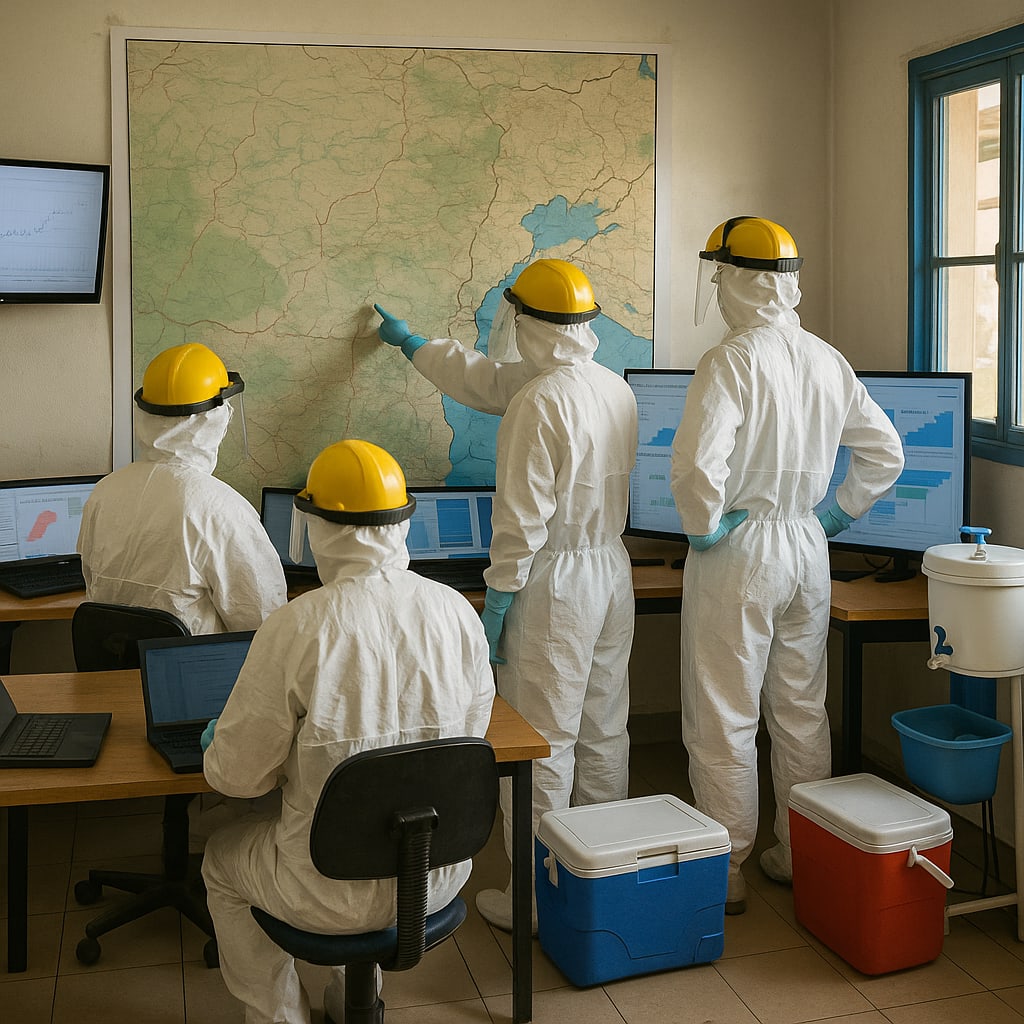
DR Congo’s Ebola outbreak surpasses 3,500 cases, becomes world’s second-largest
Narrative Snapshot
Across outlets, there is broad alignment on scale and lethality, but emphasis diverges. Telesur English, Le Monde, Daily Nation, and Deutsche Welle foreground the numeric milestone—3,532 confirmed cases and 1,556 deaths—while noting its historic ranking. DW and Al Jazeera frame the event in global terms, calling it the world’s second‑largest Ebola outbreak and, per Al Jazeera’s reporting of officials’ statements, the “fastest spreading ever,” paired with a call for the world to “pay much more attention.”
Other coverage pushes different structural drivers to the fore. The Conversation Africa (via AllAfrica) centers conflict dynamics and surveillance gaps, reporting that Médecins Sans Frontières found at least 55 deaths occurring weeks before the alarm, and noting spillover into Uganda—elements largely absent from number‑led dispatches. Le Monde’s focus on spread across five provinces underscores operational stretch inside DR Congo, while DW adds a biological constraint: identification of the Bundibugyo strain, for which no approved vaccine or treatment exists, a fact that reconfigures response options compared with vaccine‑supported outbreaks.
What Happened
Congolese authorities declared an Ebola outbreak on May 15, and by July 31 reported 3,532 confirmed cases and 1,556 deaths across five provinces (Le Monde; Telesur English; Daily Nation). The caseload exceeds the 3,481 infections recorded in the 2018–2020 epidemic in the same region, making the current event the country’s deadliest by confirmed cases and, according to DW and Al Jazeera, the world’s second‑largest Ebola outbreak. Al Jazeera reports officials have described it as the fastest‑spreading ever and urged greater international attention. DW attributes the response challenge in part to the Bundibugyo strain, which lacks an approved vaccine or treatment. The Conversation Africa (via AllAfrica) adds that the epidemic was killing people for weeks before being detected; Médecins Sans Frontières identified at least 55 deaths since early April, and the outbreak crossed into neighboring Uganda.
Why It Matters
The outbreak’s scale and dispersion across five provinces (Le Monde) signal sustained pressure on national response systems and partner support, particularly absent a licensed vaccine or treatment for the Bundibugyo strain (DW). That shifts the operational center of gravity toward classical public health measures—case finding, isolation, safe burials, and contact tracing—while elevating the cost of detection delays documented in conflict‑affected areas (The Conversation Africa via AllAfrica). The reported cross‑border spread into Uganda underscores regional risk and the need for coordinated surveillance and response along porous frontiers (AllAfrica). Officials’ public characterization of the event as the fastest‑spreading ever and their appeal for the world to “pay much more attention” (Al Jazeera) frame a resource‑mobilization imperative and raise stakes for external actors assessing surge support, logistics, and security‑informed access in eastern DR Congo.
Diverging Narratives
Outlets converge on the headline numbers and historical ranking but frame causes and implications differently. Al Jazeera amplifies officials’ depiction of unprecedented spread velocity and explicitly globalizes the stakes by urging international attention. DW emphasizes virological constraints—the Bundibugyo lineage and absence of approved countermeasures—suggesting that tools used in the 2018–2020 outbreak are not available at scale now. The Conversation Africa, by contrast, foregrounds the political‑security context: delayed detection amid conflict, silent transmission that predated the formal alarm, and cross‑border extension into Uganda. Le Monde and Daily Nation hew closely to administrative facts—the multi‑province footprint and the latest counts—without advancing causal narratives.
Uncertainties surfaced across this coverage include the true onset and magnitude of early, undetected transmission given MSF’s findings (AllAfrica), and how much the multi‑province pattern reflects spread versus improved ascertainment (not directly addressed by number‑led reports). The “fastest‑spreading ever” characterization is sourced to officials via Al Jazeera; other outlets do not adopt that framing, leaving room for differing assessments of pace even as they agree on overall scale.
What Happens Next
Key decision points now cluster around surveillance reach, cross‑border coordination, operational resourcing, and tool selection. If authorities and partners can close detection gaps in conflict‑affected areas identified by The Conversation Africa, subsequent bulletins from the Ministry of Communication (cited by Telesur English) should show earlier case finding and shorter delays from symptom onset to isolation; failure to do so would signal persistent blind spots. Given reported spillover to Uganda (AllAfrica), watch for joint announcements or tightened screening along the frontier; absence of such steps would imply elevated cross‑border risk.
With no approved vaccine or treatment for the Bundibugyo strain (DW), response leaders must lean on non‑pharmaceutical interventions; analysts should monitor whether resourcing shifts toward rapid diagnostics, safe burial teams, and decentralized care align with the five‑province spread highlighted by Le Monde. Finally, track whether the public call for greater global attention (Al Jazeera) translates into visible external surge support; if not, sustained high transmission could entrench the current trajectory.