
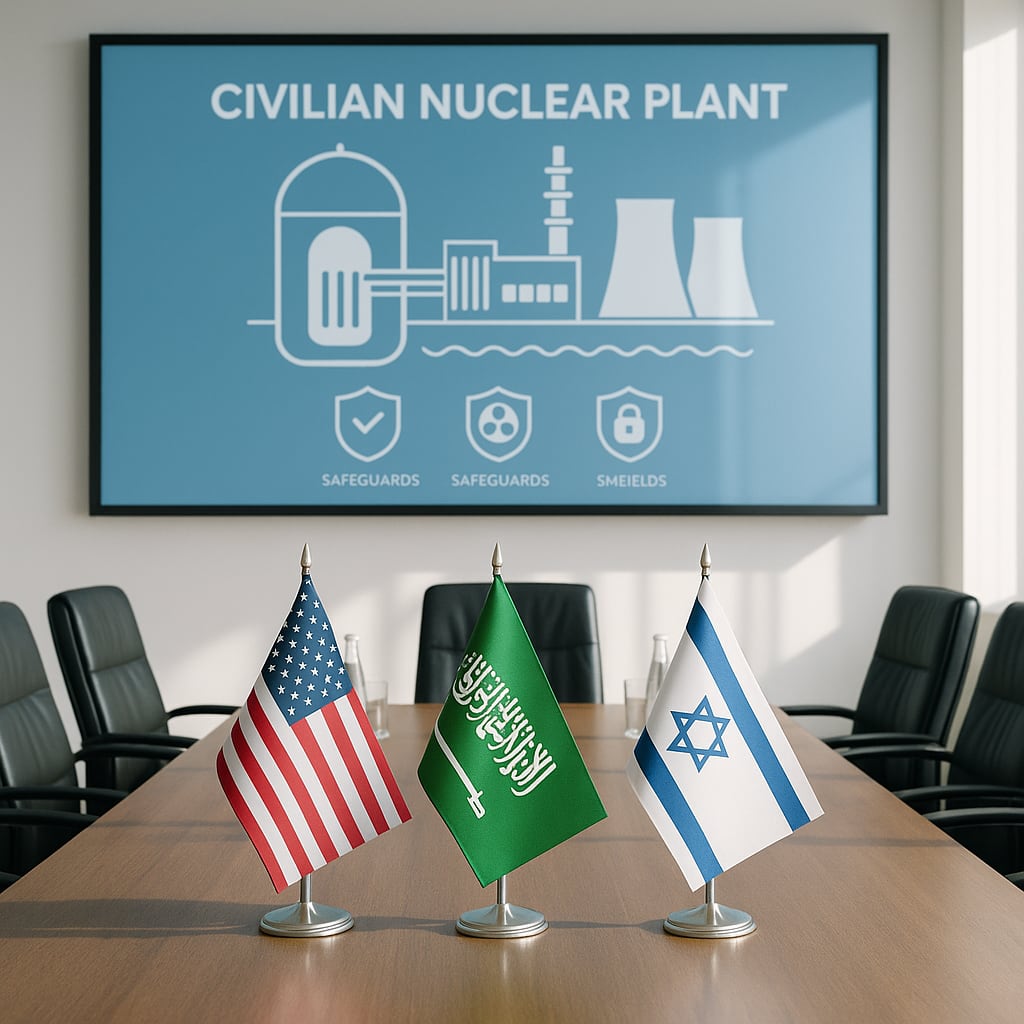
Trump ties US–Saudi civilian nuclear deal to Riyadh’s recognition of Israel
Narrative Snapshot
Across outlets, the common thread is that the condition linking a US–Saudi civilian nuclear agreement to Saudi entry into the Abraham Accords surfaced publicly only after the deal’s announcement. US, European, and Asian reporting emphasizes the surprise and resulting uncertainty for implementation, describing the linkage as a late-stage shift that unsettled Riyadh and raised questions about the negotiated terms and timing (BBC; France 24; South China Morning Post; Japan Times; NBC News; The Hindu).
Coverage diverges on two material issues. First, whether uranium enrichment is contemplated: several outlets report expert concern that the emerging framework lacks clear guardrails or could open a pathway to enrichment, citing prior accounts of permissive terms and even a potential US-built enrichment facility pending a joint study (Toronto Star; Middle East Eye; CGTN; RT). Others highlight President Trump’s categorical assurance that enrichment will not be allowed and that the program would be strictly non-military (Folha de S.Paulo; South China Morning Post). Second, whether normalization was part of the talks at all: Middle East Eye, citing current and former US officials, reports that diplomatic recognition of Israel “never once came up” in months of exchanges, in tension with the White House’s new linkage (Middle East Eye).
Israeli outlets uniformly cast Saudi participation in the Abraham Accords as strategically momentous, while registering unease about the nuclear component. Prime Minister Benjamin Netanyahu’s office framed normalization as a “historic leap forward” created by the war context with Iran, even as other Israeli voices judged the nuclear package itself as damaging to Israel’s security interests (Times of Israel; Middle East Eye live blog; New York Times). Saudi positions are reported indirectly: Haaretz and France 24 stress Riyadh’s longstanding insistence on a clear path to Palestinian statehood and that “the kingdom will not accept or give anything for free,” with no Saudi confirmation that it will accept the new condition (Haaretz; France 24).
What Happened
Media reports on 22 July said Washington had finalized a civilian nuclear cooperation agreement with Saudi Arabia, structured as a US “123 Agreement” and touted as a boost for the US nuclear industry (New York Times; CGTN; Clarin). The next day, President Trump stated the deal “will be approved” only if Riyadh joins the Abraham Accords and normalizes relations with Israel, a condition not mentioned at the deal’s announcement (NBC News; BBC; South China Morning Post; Japan Times; RT). Israeli officials publicly welcomed prospective normalization as “historic,” while analysts in Israel cautioned that the nuclear track could still harm Israeli security interests (Times of Israel; Middle East Eye live blog; New York Times). Reporting differed over technical scope: some accounts flagged permissive enrichment terms under discussion, while Trump and supportive coverage insisted the agreement excludes enrichment and is limited to non-military uses (Toronto Star; Middle East Eye; CGTN; Folha de S.Paulo; South China Morning Post).
Why It Matters
The linkage attempts to fold a bilateral nuclear cooperation framework into a broader regional realignment anchored in the Abraham Accords, elevating a technical 123 Agreement into a lever on Arab–Israeli normalization (New York Times; BBC; The Hindu). It tests whether Washington can use civil nuclear cooperation to advance geopolitical goals without eroding nonproliferation norms. Conflicting reports about enrichment rights and safeguards, including references to possible enrichment facilities or the absence of enhanced IAEA inspection protocols, underscore the stakes for the regional balance and the credibility of US nonproliferation policy (Middle East Eye; CGTN; RT; Clarin; New York Times). For Israel, simultaneous pursuit of Saudi normalization and tolerance for Saudi nuclear capabilities presents a strategic trade-off that Israeli analysts are already debating (New York Times; Middle East Eye). For Riyadh, conditioning access to US nuclear technology on recognition of Israel intersects with its stated prerequisite of progress toward Palestinian statehood (Haaretz; France 24).
Diverging Narratives
A central contention is procedural: was normalization an agreed element or an after-the-fact political add-on? US and European outlets characterize the condition as a new stipulation introduced after the signing, while Middle East Eye, citing current and former US officials, says normalization “was never listed as a condition” in months of technical talks (BBC; France 24; South China Morning Post; Middle East Eye). A second divergence concerns proliferation risk. Reporting in Middle East Eye and CGTN points to draft terms contemplating domestic enrichment, potentially without additional IAEA safeguards, while President Trump and sympathetic coverage insist the deal forbids enrichment and confines activity to civilian uses (Middle East Eye; CGTN; Folha de S.Paulo; South China Morning Post; Toronto Star). Israeli reactions split between celebrating the diplomatic prize and warning that the nuclear component remains “bad for Israel,” with the prime minister’s office promoting normalization as a “historic leap forward” even as the New York Times noted he had not commented on the agreement itself (Times of Israel; Middle East Eye live blog; New York Times). Finally, Saudi intent remains opaque: outlets highlight Riyadh’s consistent linkage to Palestinian statehood and a refusal to concede “for free,” but there is no confirmation that Saudi Arabia accepts the new US condition (Haaretz; France 24).
What Happens Next
Three decision points will shape outcomes. First, Riyadh’s response to the linkage: if Saudi officials reiterate the Palestinian-statehood prerequisite, the White House’s condition will force either parallel movement on a political track or a recalibration of the nuclear deal’s timeline; if Riyadh signals flexibility, US and Israeli claims of a “historic” expansion of the Accords gain traction (Haaretz; France 24; Times of Israel; Middle East Eye live blog). Second, the deal’s technical terms: publication or authoritative briefing on whether enrichment, a joint study for an enrichment facility, and enhanced IAEA safeguards are included will indicate the agreement’s nonproliferation integrity (CGTN; Middle East Eye; Toronto Star; Clarin; New York Times). Third, US executive messaging: further White House or agency clarifications on whether normalization is a hard precondition will reveal if the statement is policy-setting or negotiable rhetoric, especially given reports that normalization was not part of the technical talks (NBC News; BBC; Middle East Eye).