
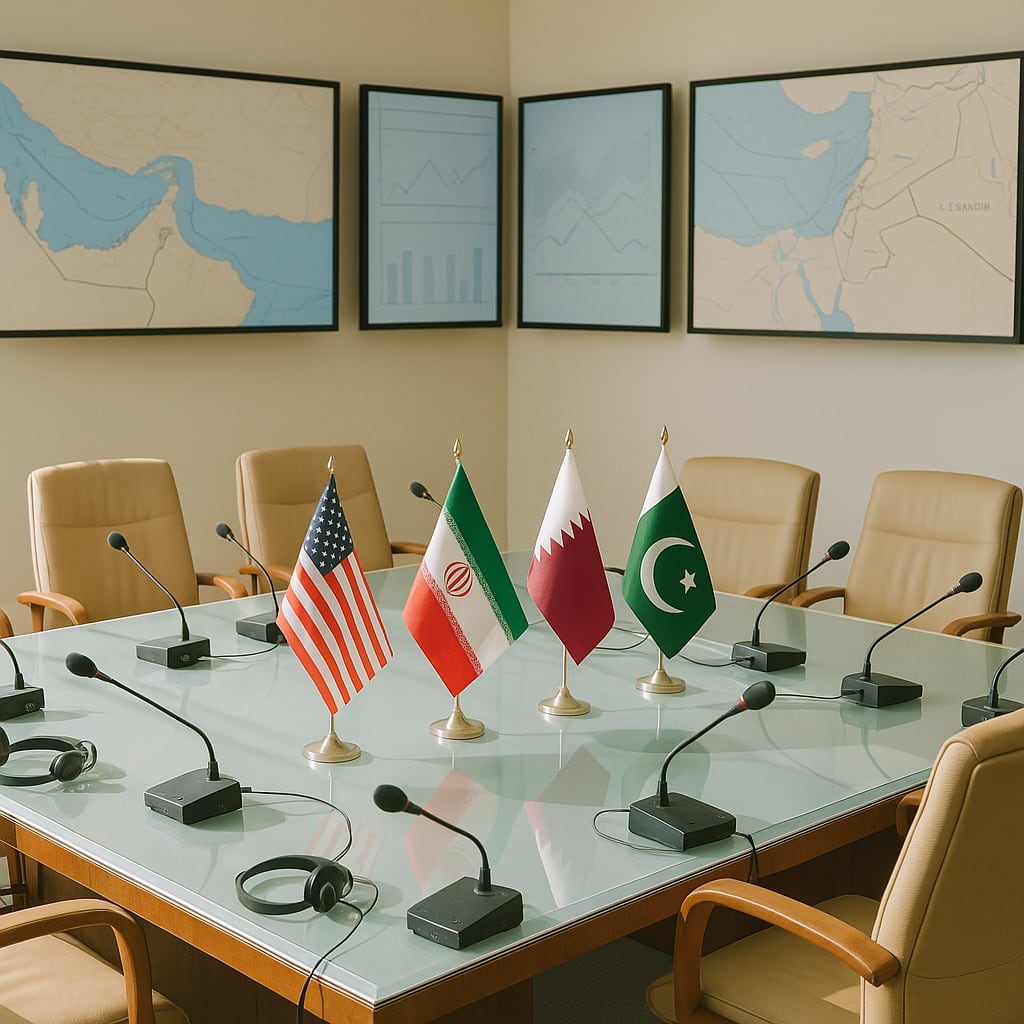
US and Iran hold indirect Doha talks via Qatar and Pakistan, set violations channel amid Hormuz dispute
Narrative Snapshot
- Mediation mechanics vs. deterrence signaling: Regional and European outlets emphasize Qatari–Pakistani shuttle diplomacy and working groups (DW; TASS; Al Jazeera; The Hindu; IRNA), while Fox News foregrounds U.S. threat signaling and claims that Iran sought talks.
- Mandate clarity: Several sources stress the Islamabad MoU’s ambiguous language on Hormuz routing and Lebanon, which now shapes bargaining leverage and compliance claims (New York Times; The Guardian; Al Jazeera).
- Market and maritime indicators: Energy flow and price coverage diverges between risk and normalization—IMO briefly paused escorts (CBC), yet oil prices eased and more ships transited as talks opened (New York Times; Middle East Eye).
- Narratives of authority: Iranian outlets stress sovereign control and fees in Hormuz (IRNA; Middle East Eye; ANSA), while U.S. and allied reporting highlights alternative routing along Oman and rejection of tolls (Fox News; RT).
What Happened
After late-June exchanges of fire around the Strait of Hormuz—triggered by attacks on commercial vessels and followed by U.S. strikes on Iranian sites (DW; Middle East Eye; RT; CBC)—Washington and Tehran moved into indirect “technical” talks in Doha with Qatar and Pakistan mediating (DW; Al Jazeera; SCMP; TASS). U.S. envoys Jared Kushner and Steve Witkoff engaged Qatari leadership to prepare the talks (The Hindu; TASS). Iran’s deputy foreign minister Kazem Gharibabadi met the Qatari prime minister and announced working groups to implement the MoU and negotiate a final agreement (IRNA). Multiple outlets report agreement to establish by Thursday a channel to report and log violations (Le Monde; SCMP). Doha and Islamabad described “positive progress,” with a next round expected after funeral ceremonies in Iran (TASS; Al Jazeera; Middle East Eye). Iran said discussions focused on alleged U.S. MoU violations, the Lebanon ceasefire clause, and access to frozen assets for essential imports (IRNA; The Hindu).
Why It Matters
The Doha track operationalizes a minimally institutionalized ceasefire via working groups and a violations log—light architecture that could stabilize high-friction domains (shipping lanes; escalation control) without a comprehensive political settlement (IRNA; Le Monde; Al Jazeera). Disputes over Hormuz routing and fees test long-standing navigation practices and expose gaps between bilateral arrangements and international maritime expectations (New York Times; The Guardian; Middle East Eye; RT). Mediation by Qatar and Pakistan underscores a regional diplomatic turn, while U.S. signaling of retaliation and Iran’s sovereignty claims reveal persistent coercive bargaining incentives (Fox News; ANSA; IRNA). For energy and trade policymakers, the mixed signals—IMO’s precautionary pause versus rising transits and easing prices—highlight fragile risk normalization that hinges on process credibility (CBC; New York Times; Middle East Eye; SCMP).
Diverging Narratives
- Initiation and format: The White House says Iran requested high-level talks (Fox News), while Tehran publicly rejects direct meetings and initially said nothing was scheduled (Japan Times; The Hindu). The talks proceeded indirectly through Qatari–Pakistani channels (DW; TASS; SCMP; Middle East Eye).
- Compliance and causality: U.S. officials frame strikes as responses to Iranian or Iran-linked attacks on shipping (Fox News; DW). Iranian officials accuse Washington of blatant MoU violations, citing coastal strikes and Lebanon-related clauses (IRNA; Middle East Eye; Tehran Times).
- Hormuz governance: Reporting underscores the MoU’s vague requirement that Iran “make arrangements” for passage (New York Times). Tehran asserts it can designate routes and, with Oman, levy service fees (IRNA; Middle East Eye), while U.S. officials reject tolls and support a southern corridor hugging Oman to dilute Iranian leverage (RT; Fox News).
- Outcome signaling: Qatar, Pakistan, and U.S. sources cite “positive progress” (TASS; Middle East Eye; Al Jazeera), and Trump praised “very good” meetings (Le Monde). Iran said the Doha round concluded, focused on violations and assets, and produced an agreement to set up a communications channel (IRNA; SCMP).
- Risk environment: While energy loadings and transits have resumed and prices eased (New York Times; Middle East Eye), incidents continued—including a drone attack claim involving Bahrain and another vessel hit—sustaining escalation risk (SCMP; CBC).
What Happens Next
- Violations channel: Implementation by Thursday is the first procedural test. Analysts should watch whether both sides promptly log incidents and reference the channel after maritime or Lebanon-related flare-ups (Le Monde; SCMP; IRNA).
- Next round timing and format: Mediators expect talks after Iran’s funeral processions; indicators include scheduling announcements, agendas, and any move toward direct contact or expanded working groups (TASS; Al Jazeera; Middle East Eye; Japan Times).
- Hormuz rules and routes: Signals to track include any formal Iran–Oman fee announcement, U.S. or industry guidance rejecting charges, routing data showing sustained use of Oman-hugging corridors, and IMO advisories (Middle East Eye; RT; Fox News; CBC).
- Lebanon clause and escalation control: Statements linking ceasefire compliance to Lebanon operations, and any de-escalatory steps around U.S. regional bases or Hezbollah–Israel fronts, will reveal whether the MoU’s ambiguous scope can be operationalized (IRNA; RT; The Guardian).
- Frozen assets utilization: Evidence that Iran uses Qatar-based funds for designated goods would indicate progress on implementation mechanics within sanctions constraints (The Hindu; IRNA).