
Venezuela’s twin earthquakes trigger mass-casualty response, contested access controls, and accelerated international aid
Narrative Snapshot
- Scale and pace: Outlets converge on a rapidly escalating toll — from hundreds to at least 1,430 dead within three days — and tens of thousands missing, while the UN warns 6.7–7 million people may be affected (The Hindu; Guardian; DW; TASS). Imagery from La Guaira underscores extensive coastal devastation (Al Jazeera; ANSA).
- State capacity versus citizen initiative: Reporting repeatedly highlights residents digging by hand and improvised volunteer networks amid equipment shortages and delays outside Caracas (The Hindu; Folha; BBC). By contrast, official channels emphasize centralized control and international deployments (TASS; SCMP).
- Access and control: Multiple sources document military restrictions and QR-code entry to La Guaira, prompting anger over blocked civilian aid (Folha; Clarín; Al Jazeera). That access posture is a fulcrum for both operational efficiency and political legitimacy.
- Geopolitics of aid: The crisis has catalyzed rapid U.S. and multilateral engagement — C-17 flights, naval assets, and a $150 million pledge — and reopened channels with governments that had recently cut ties with Caracas (Fox News; Guardian; SCMP). Coverage frames this as an early test of Washington’s revised regional policy and of interim leader Delcy Rodríguez’s standing (Guardian; La Repubblica; Japan Times; NYT).
What Happened
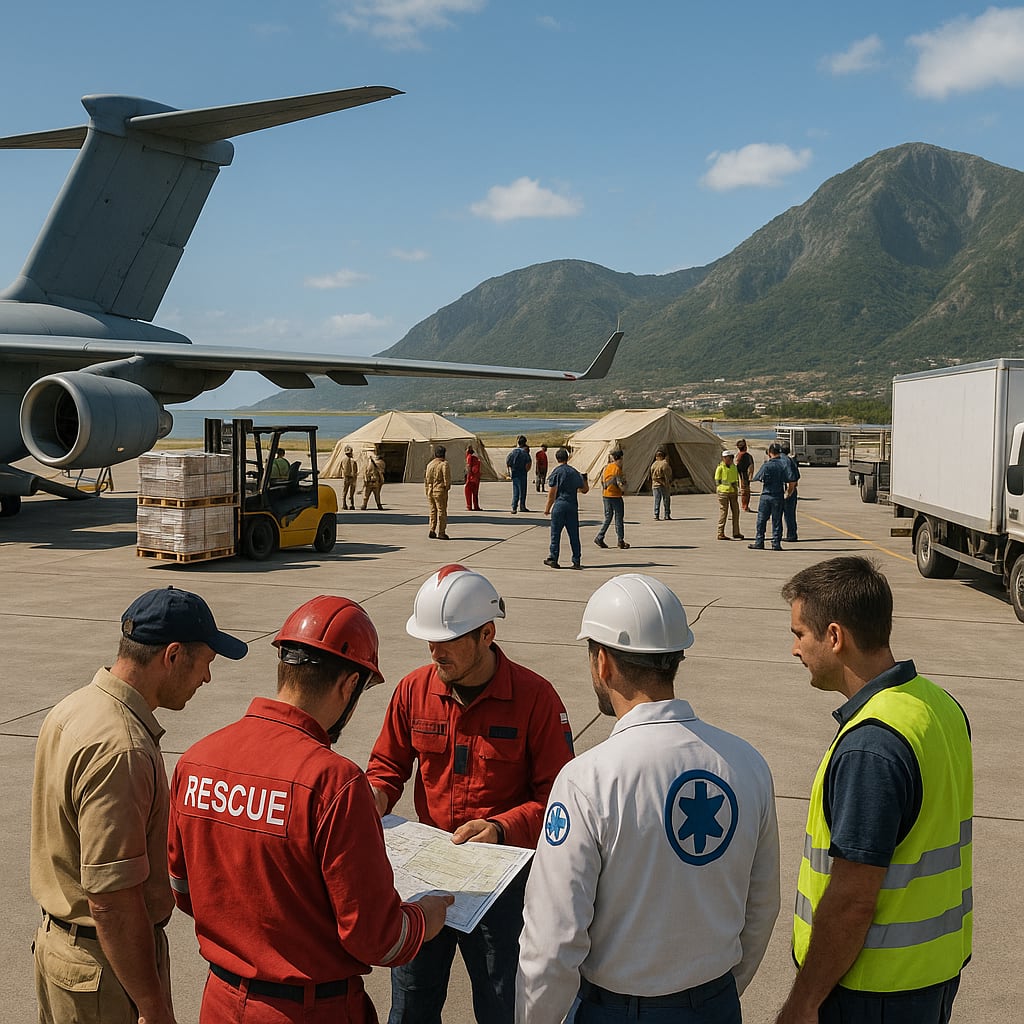
Two powerful, shallow earthquakes of magnitude 7.2 and 7.5 struck northern Venezuela on June 24, roughly 39 seconds apart, with severe damage across the coastal state of La Guaira, including Macuto and Caraballeda (SCMP; ANSA; BBC; Al Jazeera). Initial official fatalities rose from 235 to 589 by June 26, and to 1,430 by June 27, with more than 3,200 injured; families reported tens of thousands missing, including 68,900 recorded by June 27 (BBC; Guardian; The Hindu). The UN assessed that up to 6.7–7 million people could be affected nationwide, including about 2 million in Caracas (DW; TASS). International urban search-and-rescue teams from at least 17 countries deployed; one runway at Simón Bolívar International reopened to C-17 flights, and U.S. naval support was mobilized, while India dispatched a field hospital (SCMP; Fox News; The Hindu; DW). Authorities restricted access to La Guaira, requiring registration/QR codes, as residents organized volunteer relief (Folha; Clarín).
Why It Matters
- Humanitarian systems and norms: The UN’s call for a “massive collective effort” and projections of millions in need test surge capacity, logistics, and civil–military coordination in a high-density urban coastal zone (The Hindu; DW; TASS). Rapid U.S. and multinational deployments against a shattered airport/port backbone stress the importance of interoperable SAR standards and WASH/shelter pipelines (SCMP; Fox News).
- Governance and legitimacy: Reports of constrained access and volunteer frustration juxtaposed with centralized controls and state messaging crystallize a capacity-versus-control dilemma likely to shape public trust and operational throughput (Folha; Clarín; Al Jazeera; The Hindu).
- Regional and great-power signaling: Aid from governments that had severed ties with Caracas, a U.S. assistance surge, and claims of partial sanctions relief frame the disaster as a proving ground for emergent hemispheric policy and crisis diplomacy (SCMP; La Repubblica; Guardian; NYT). Parallel opposition mechanisms, including a missing-persons portal, add a non-state coordination layer with implications for information management and social cohesion (SCMP; Japan Times).
Diverging Narratives
- Performance and presence: Several outlets report residents in worst-hit areas “saw few state rescue teams” and resorted to digging by hand or organizing motorcycle supply chains (The Hindu; Folha; BBC). Others foreground acting President Delcy Rodríguez’s updates, thanks to the U.S., and the inflow of specialized teams and equipment (TASS; SCMP; The Hindu).
- Access controls: Folha and Clarín detail militarization of La Guaira and QR-code entry, echoed by Al Jazeera’s depiction of rising anger over blocked citizen aid. These accounts contrast with official justifications implied by controlled-zone management but not extensively elaborated in state-facing coverage (Folha; Clarín; Al Jazeera).
- Data and scale: Fatalities and missing counts vary by dateline and source — 235, 589, 920, to 1,430 dead; around 50,000 to nearly 70,000 missing — reflecting evolving retrieval and reporting, as well as the emergence of an opposition-run registry parallel to government lists (BBC; Guardian; Le Monde; Al Jazeera; The Hindu; SCMP).
- Geopolitical framing: U.S. media emphasize a “whole-of-government” relief surge and major funding (Fox News; Guardian), European outlets spotlight policy tests after cuts to traditional aid instruments (Guardian), and Italian coverage ties moves to a post-sanctions-relief posture (La Repubblica). Japanese and U.S. reporting examine how the quake intersects with Rodríguez’s domestic legitimacy and Washington’s broader commercial/political interests (Japan Times; NYT).
What Happens Next
- Access regime in La Guaira: Authorities have imposed QR-based entry and military control (Folha; Clarín). Indicators to watch: any easing for vetted NGOs and neighborhood brigades; issuance of clearer credentialing; public guidance on volunteer integration. Tighter controls would prioritize security and traffic management but risk constraining last-mile relief; loosening could accelerate community-led SAR and distributions while raising coordination and safety challenges.
- Aid coordination and lift: With one airport runway functioning and international teams arriving (SCMP), key signals include activation of a UN-led joint operations center, a formal flash appeal, and commitments beyond the U.S. $150 million pledge (Fox News). Effective cluster activation should reduce discrepancies in needs assessments and speed WASH/shelter scale-up.
- Information management: The opposition’s missing-persons site operates alongside government efforts (SCMP). Convergence — data sharing or unified registries — would improve tracing and resource allocation; persistent parallelism will perpetuate uncertainty in casualty baselines and hamper family reunification.
- Urban recovery baseline: Reports of widespread displacement, hospital strain, and building collapses in La Guaira and along the coast (NYT; The Hindu; Al Jazeera) point to protracted shelter and infrastructure needs. Indicators: reopening timelines for Simón Bolívar airport/port, initial debris-clearing targets, and publication of structural safety assessments determining red/green zoning for return.