
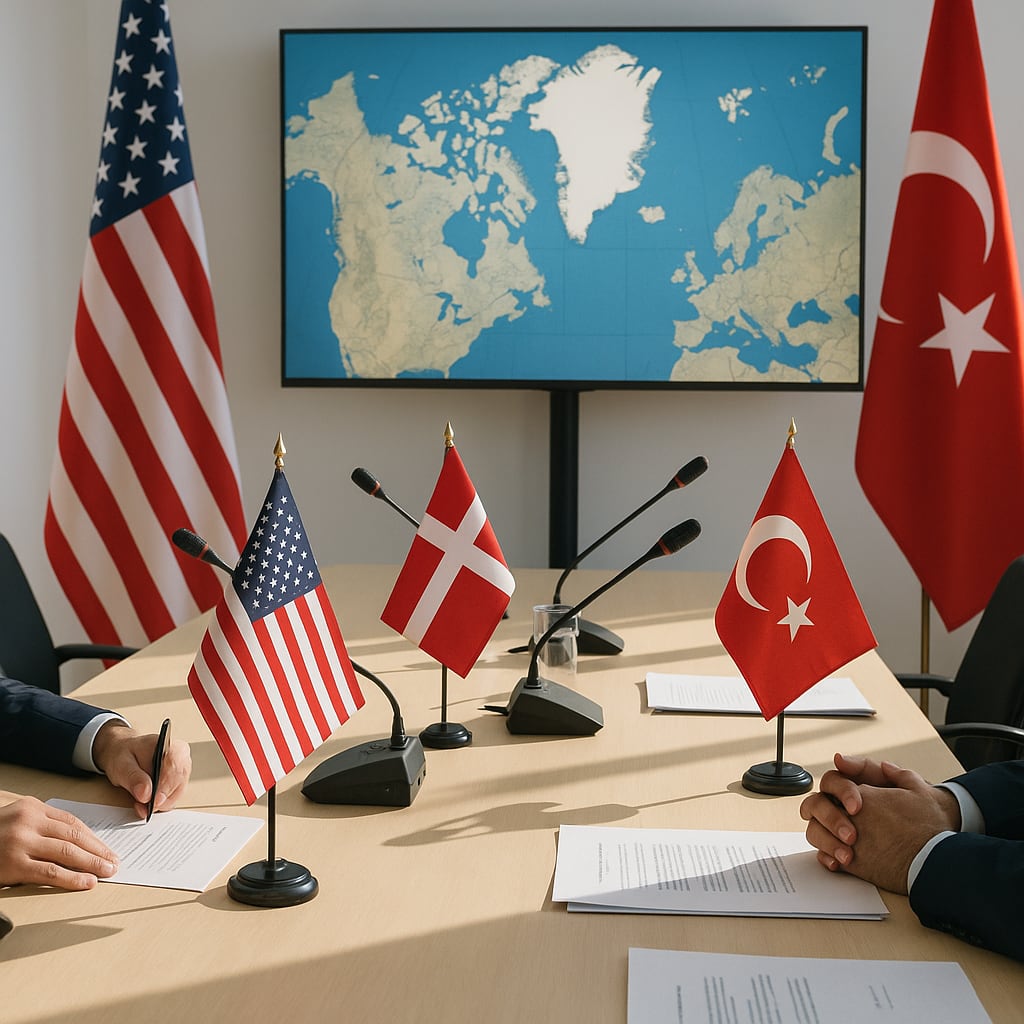
At Ankara NATO summit, Trump says U.S. should control Greenland; Denmark reiterates it is “not for sale”
Narrative Snapshot
- Areas of agreement: All outlets report Donald Trump’s renewed assertion that the U.S., not Denmark, should control Greenland, and that the stance is producing alliance friction; Denmark’s rejection is unequivocal (CBC News; Le Monde).
- Differing emphases: The Guardian foregrounds Trump’s threat to withdraw all U.S. troops from Europe and his criticism of NATO over the Iran war; SCMP highlights his meeting with Recep Tayyip Erdogan and a possible opening to sell F-35s to Turkey after years of deadlock.
- Framing contrasts: TASS spotlights Trump’s claim that the dispute is harming U.S.-NATO ties and quotes him saying “Greenland doesn’t help Denmark,” while La Repubblica underscores that existing U.S.-Danish treaties already permit any needed U.S. bases in Greenland, shifting the debate from access to sovereignty.
- Policy context: Folha situates the episode in Trump’s broader pressure campaign, noting he had secured real increases in European defense spending a year earlier.
What Happened
Arriving in Ankara for the NATO summit, U.S. President Donald Trump reiterated that the United States should control Greenland, a position he linked to U.S. security (CBC News; Le Monde). He criticized allied governments, expressing disappointment over NATO members’ refusal to aid a recent U.S. military operation in the Middle East and saying Washington would consider selling F-35s to Turkey after years of impasse (SCMP). The Guardian reports he also threatened to withdraw all U.S. troops from Europe and tied his tempered commitment to European defense to allies’ political choices on immigration and energy. TASS quoted Trump saying “Greenland doesn’t help Denmark” and asserting the dispute was harming U.S.-NATO ties. The next day, Denmark’s prime minister reiterated that Greenland—an autonomous Danish territory—was “not for sale” (Le Monde). La Repubblica noted that existing treaties already allow the U.S. to build any military bases it deems necessary in Greenland.
Why It Matters
The episode exposes pressure points inside NATO: a U.S. president threatening to pull forces from Europe (The Guardian), voicing dissatisfaction with allied support for U.S. operations in the Middle East (SCMP), and escalating a sovereignty dispute with a fellow member (CBC News; TASS). Denmark’s categorical refusal to negotiate over Greenland (Le Monde), combined with reporting that current U.S.-Danish agreements already provide ample basing rights (La Repubblica), suggests the clash centers on control rather than operational access. Simultaneously, Trump’s signal that Washington might move ahead on F-35 sales to Turkey (SCMP) introduces defense-industrial bargaining into alliance politics at the summit venue itself. Taken together, these dynamics test NATO’s ability to manage intra-alliance coercion, reconcile divergent regional priorities (including over the Iran war, per The Guardian), and contain bilateral disputes so they do not spill into collective decision-making.
Diverging Narratives
Trump frames U.S. control of Greenland as indispensable to American security (Le Monde) and portrays allied underperformance—especially over a recent Middle East operation—as justification for sharper demands (SCMP). He also asserts Greenland “doesn’t help Denmark,” linking the dispute directly to fraying alliance ties (TASS). In contrast, Denmark’s leadership reiterates a sovereignty red line—“not for sale”—and underlines Greenland’s autonomous status within the Danish realm (Le Monde).
Outlets stress different consequences. CBC News and TASS emphasize alliance tension; The Guardian amplifies potential rupture by reporting a threat to remove all U.S. troops from Europe and anger over NATO’s stance on the Iran war. SCMP introduces a countervailing thread: possible movement on F-35s for Turkey, suggesting transactional bargaining alongside confrontation. La Repubblica reframes the utility question by noting that existing U.S.-Danish treaties already authorize any bases the U.S. deems necessary, implying that the sovereignty push is not driven by immediate basing constraints. Unresolved are whether Washington will operationalize troop withdrawals, whether F-35 talks with Ankara advance, and whether any channel opens with Copenhagen beyond its refusal.
What Happens Next
- U.S. force posture in Europe: The Guardian’s report of a withdrawal threat elevates a concrete decision point. Indicators include formal Pentagon directives, consultations within NATO defense channels, or summit language touching on U.S. basing and presence.
- U.S.-Turkey defense ties: SCMP’s account of renewed consideration of F-35 sales sets up a track where Ankara-Washington signals—public statements, licensing steps, or program milestones—clarify whether the “years of deadlock” will ease.
- Greenland diplomacy: With Denmark reaffirming “not for sale” (Le Monde) and La Repubblica noting treaties already cover U.S. basing needs, watch for any U.S. attempt to reopen or reinterpret existing agreements versus continued rhetorical pressure without formal talks.
- Alliance burden-sharing and out-of-area support: Trump’s criticism of allies’ Middle East stance (SCMP) and dispute over the Iran war (The Guardian) put NATO communiqués, national statements of intent, or new capability pledges in focus as signals of whether political rifts narrow or widen.