
Wildfires in southwest France and central Spain force mass evacuations and trigger EU-backed emergency response
Narrative Snapshot
Across outlets, coverage converges on the sheer pace and scale of the fires in France’s Gironde and Spain’s Madrid region, and on the operational strain facing responders. French and European broadcasters emphasize “exceptionally intense” fire behavior and a complex risk environment around the Arcachon basin, with long, flammable maritime pine stands, persistent drought and heavy tourist flows accelerating spread and complicating evacuation logistics (Le Monde; France 24 explainer). International wires and broadcasters detail dramatic maritime evacuations from the Cap Ferret peninsula and precautionary movements around Bordeaux, while in Spain multiple fires merged near Madrid and authorities escalated emergency levels (DW; Bangkok Post, Jul 24; France 24 live, Jul 25).
Where outlets diverge most is on scale and emphasis. Early counts of evacuations in France ranged from the tens of thousands to more than 100,000, later rising to 166,000 across France and Spain, and then to 200,000–220,000 combined as the situation evolved (Sky News; Al Jazeera, Jul 23; Folha de S.Paulo; The Hindu, Jul 24; France 24 live, Jul 25; ANSA). Some reports foreground EU civil protection activation, military mobilization, and aircraft and satellite tasking, while others highlight firefighter fatigue and the limits of direct attack under fast, wind-driven conditions (Politika; France 24, Jul 25–26).
Another line of coverage draws the link between heat, drought, and escalating fire risk. Several outlets situate the fires within a broader southern Europe heatwave and drought—reporting 40°C-plus temperatures and three firefighter deaths across Italy, France and Spain earlier in the week—and cite new assessments tying extreme heat to worsening European drought and wildfire risk (SCMP; France 24, Jul 23; Telesur). French and U.S. coverage also note France’s decision to consult Spain on heat management—an institutional learning angle that situates immediate firefighting within longer-term adaptation policy (New York Times, Jul 24).
What Happened
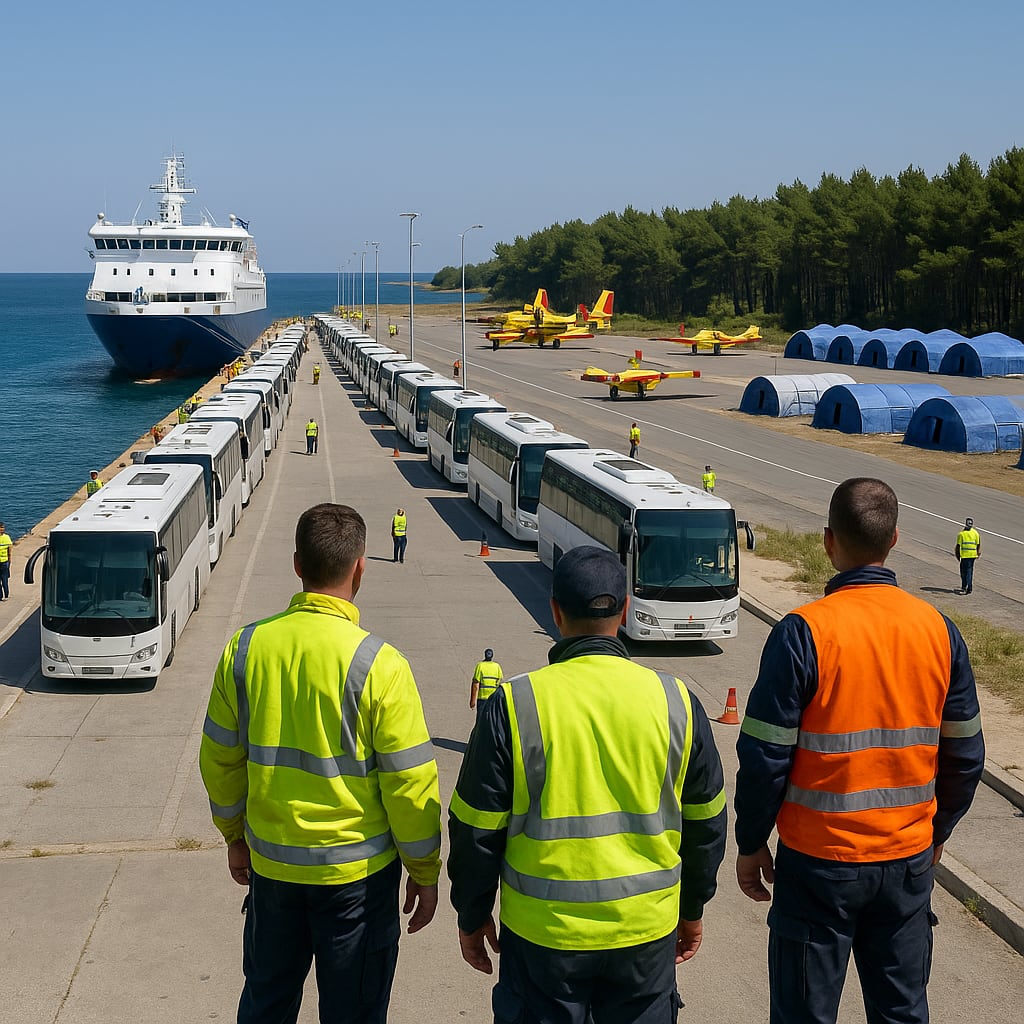
A wildfire ignited in Gironde near the Arcachon basin advanced rapidly toward Arès and Lège-Cap-Ferret, with firefighters describing “exceptionally intense” behavior and explosive growth in hours (Le Monde). Authorities ordered large-scale evacuations, including of the Cap Ferret peninsula, moving people by road and boat as smoke and flames threatened tourist areas (New York Times, Jul 24; DW; Bangkok Post, Jul 24). Evacuation tallies escalated from roughly 15,000–20,000 early on to 40,000 at Cap Ferret and at least 110,000 in France, with combined France–Spain figures later reported at 166,000 and then over 200,000–220,000 as precautionary moves expanded near Bordeaux and in central Spain (Sky News; Al Jazeera, Jul 23; Folha de S.Paulo; The Hindu, Jul 24; France 24 live, Jul 25; ANSA). Paris mobilised the army and activated EU civil protection assets, including aircraft and satellite support; 2,500 firefighters, a Swiss team, 1,500 military personnel and about 1,200 police were deployed in Gironde (Politika; France 24, Jul 26). Spanish authorities declared emergencies around Madrid as fires merged. By July 25, France reported nearly 98,000 hectares burned nationwide, a historic record, with conditions still “very unfavorable” despite a brief moderation from cooler, more humid air (France 24, Jul 25–26).
Why It Matters
The response is a live test of Europe’s multilevel crisis-management architecture. France’s activation of the EU Civil Protection Mechanism and military support underscores growing reliance on pooled aerial assets, satellite tasking and cross-border reinforcement as fire seasons lengthen and intensify (Politika). The French government’s decision to send a delegation to Spain to study heat management operationalizes intra-EU policy learning and could shape national adaptation, from heatwave protocols to fuel management and evacuation planning in high-tourism zones with constrained egress like Cap Ferret (New York Times, Jul 24).
The fires also illuminate structural pressures on European civil protection: record hectares burned in France, firefighter fatigue, and reports from Spain that head-on attacks were often impossible under fast-moving conditions point to capacity and doctrine strains under compounding drought and heat (France 24, Jul 25). For decision-makers, land-use, forest composition, and tourism-season contingencies in climate-exposed regions move from environmental policy to core resilience planning with direct economic and public safety stakes.
Diverging Narratives
Discrepancies in reported evacuation figures reflect timing and geographic scope rather than outright contradiction. Early reports cited 15,000–20,000 people moved near Bordeaux; subsequent tallies climbed to 40,000 at Cap Ferret, at least 110,000 in France, and 166,000 then 200,000–220,000 combined across France and Spain as authorities widened precautionary zones (Sky News; Al Jazeera, Jul 23; Clarin; Folha de S.Paulo; The Hindu, Jul 24; France 24 live, Jul 25; ANSA). Some outlets foreground France-specific figures, others aggregate cross-border totals, producing divergent headlines.
Framing also differs. France-based reporting emphasizes system vulnerabilities—maritime pine monocultures, drought, tourist density—and provides force numbers and operational posture, including the “very unfavorable” outlook and multinational deployments (France 24 explainer; France 24, Jul 26). Several international outlets stress vivid evacuation imagery by sea and states of emergency in both countries (DW; Bangkok Post, Jul 24), while climate-focused pieces emphasize the linkage between extreme heat, depleted water reserves, and wildfire risk (SCMP; Telesur). There are isolated claims of structural losses, such as 100 houses destroyed, that are not widely corroborated across the corpus, highlighting uncertainty about damage assessments amid ongoing operations (Clarin). On outlook, officials alternately warn of threats moving toward Bordeaux and note temporary easing due to cooler, humid conditions, underscoring a volatile operational picture (The Hindu, Jul 24; France 24, Jul 25).
What Happens Next
Key decisions hinge on fire behavior around Bordeaux and Madrid and the pace of resource inflows. French authorities have already ordered precautionary evacuations near Bordeaux; further expansions would signal either new fronts or unfavorable winds overriding the recent weather moderation reported by regional officials (France 24 live, Jul 25; France 24, Jul 25). Watch Interior Ministry updates on force levels, including continued use of EU civil protection aircraft, satellite products, and additional international crews, after deployment figures and a Swiss team were confirmed (France 24, Jul 26; Politika).
Operationally, indicators include whether responders can transition from defensive evacuations to perimeter consolidation as humidity rises, or whether officials reiterate that direct attack remains infeasible under fast spread, as admitted in Spain (France 24, Jul 25). Policy signals to monitor include France’s follow-through on its Spain-focused adaptation review and any expansion of forest closures like those already imposed in the Var, which would reflect a shift toward pre-emptive risk reduction during peak tourism and heat periods (Le Monde; New York Times, Jul 24).