
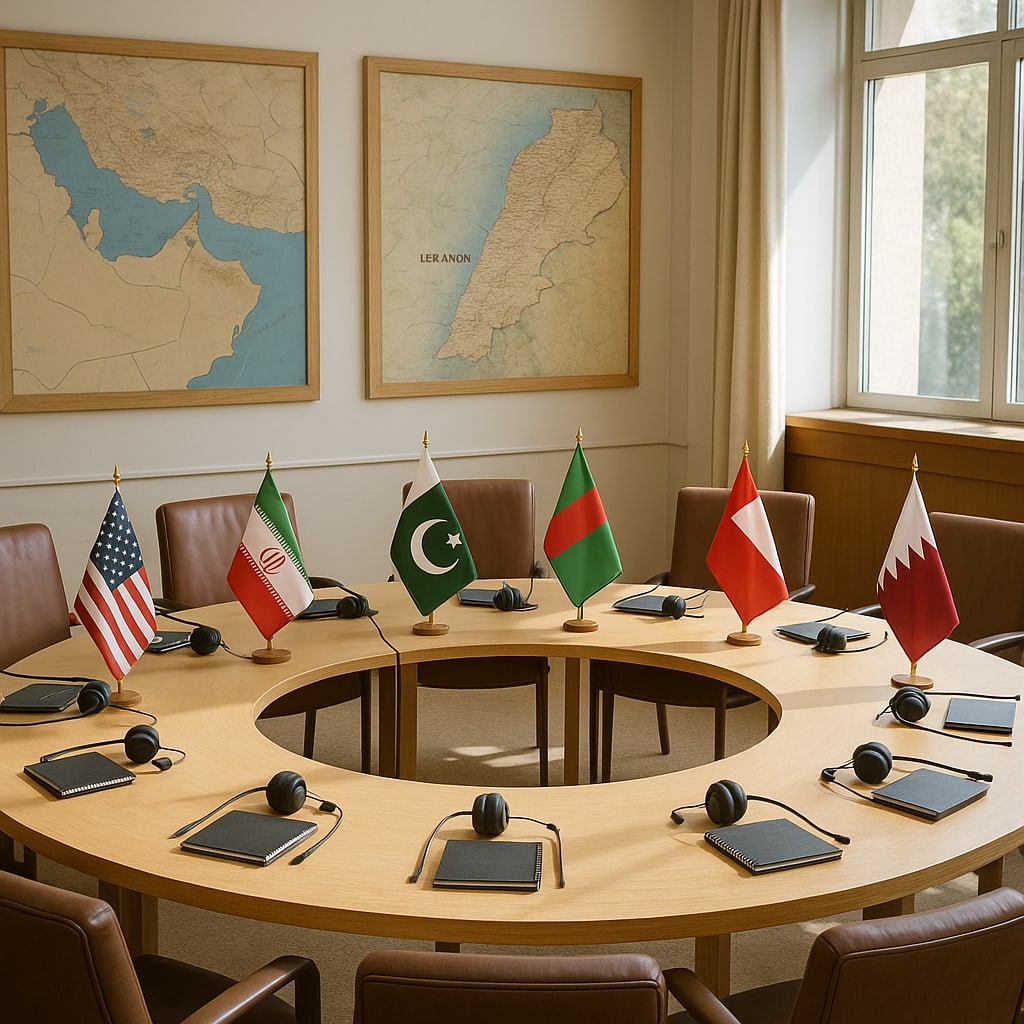
Conflicting signals over resuming US–Iran talks as Tehran sets conditions and mediators work in Pakistan, Oman and Qatar
Narrative Snapshot
Across outlets, there is broad acknowledgment that last month’s Islamabad memorandum of understanding is under acute strain and that multiple regional intermediaries are trying to keep channels open. Al Jazeera frames the question as whether the agreement can be “rescued,” citing fresh attacks that jeopardise both the ceasefire and the MoU, while its newsfeed notes stepped-up mediation in Qatar and Oman. Pakistani and Omani roles recur repeatedly, with Serbia’s Politika highlighting Islamabad’s willingness to continue mediating and Russian state media pointing to prospective technical talks in Pakistan.
The sharpest divergence centers on agency and compliance. US political messaging, reported by The Hindu and Chinese state media, emphasizes that Iran sought to continue talks; Iranian officials and state-aligned media dispute this and recast the impasse as a function of US violations, not Iranian reticence. IRNA lays out a legalistic case that Washington breached military, economic, and security commitments, invoking a “commitment for commitment” baseline for any further steps. In parallel, Middle East Eye carries Tehran’s warning that it will cease observing the MoU if US attacks persist, framing the issue in UN Charter terms rather than tactical bargaining.
A second axis of difference is over venue and proximity. One TASS dispatch, echoing Al Hadath via Politika, says technical teams would meet in Pakistan, while another TASS report the next day cites Iranian intent to stay away until the US position shifts. Oman appears active, but CBS reporting carried by TASS says no US officials will attend in Muscat, suggesting an indirect format through Omani and Qatari interlocutors. Finally, several sources elevate the policy content of any talks: Iran’s conditions, reported by CGTN and Politika, link negotiations to the Lebanon war and navigation rules in the Strait of Hormuz; Telesur spotlights a prospective Iran–Oman arrangement to manage Hormuz traffic as a stabilizer for energy flows.
What Happened
On July 10, The Hindu reported former US President Donald Trump’s claim that Iran had asked to continue talks and that Washington agreed, referencing last month’s interim deal to end a four‑month conflict that disrupted global energy supplies. CGTN the following day cited Trump declaring the ceasefire “OVER” and carried Iran’s denial that it had requested talks. IRNA accused the United States of breaching core military, economic, and security obligations under the Islamabad MoU and asserted a legal basis for reciprocal measures. Middle East Eye quoted Iran’s UN ambassador warning Tehran would no longer be bound by the MoU if US attacks continued. Mediation tracks multiplied: Politika noted Pakistan’s readiness to continue facilitating; TASS, citing Al Hadath and echoed by Politika, said technical teams would meet in Pakistan on July 12, then separately reported Iran would stay away until US positions changed. TASS, citing CBS, said no US officials would attend consultations in Oman, while Al Jazeera reported active mediator efforts in Qatar and Oman.
Why It Matters
The Islamabad MoU was designed as a pathway from cessation of hostilities to a broader settlement; its unraveling would reinforce a tit‑for‑tat logic that weakens negotiated conflict‑management in the Gulf. IRNA’s “commitment for commitment” framing underscores a transactional norm supplanting trust‑based compliance, complicating verification and sequencing for any follow‑on agreement. The substantive linkages Iran draws—ending the war in Lebanon, an Israeli withdrawal, and arrangements for Strait of Hormuz transit—connect the file to regional theaters and to rules for a choke point critical to energy markets. Al Jazeera’s and The Hindu’s emphasis on energy disruption, and Telesur’s portrayal of a Hormuz management mechanism with Oman, point to maritime governance as a near‑term stabilizer or spoiler. With CBS reporting via TASS that US officials are not physically present in Muscat, intermediated diplomacy remains the primary instrument, raising the burden on Pakistan, Oman, and Qatar to translate positions amid contested facts about compliance and intent.
Diverging Narratives
The record splits early over who is driving engagement. Trump’s assertion, carried by The Hindu and CGTN, that Tehran sought continued talks is flatly rejected by Iranian officials quoted by CGTN, who insist Iran did not request negotiations. Iranian media and aligned outlets invert the frame: IRNA argues Washington breached the Islamabad MoU and that any Iranian steps will proceed on a reciprocal basis, while Middle East Eye quotes Iran’s UN envoy threatening to stop honoring the MoU if US attacks continue, casting US conduct as a UN Charter violation. On process, TASS cites Al Hadath to say technical teams would reconvene in Pakistan, but in a separate report the same outlet says Iran plans to avoid talks until the US changes position, suggesting either fluid plans or contested sourcing. CBS reporting relayed by TASS that no US officials will attend Oman consultations contrasts with Al Jazeera’s depiction of active mediation in Muscat and Doha, implying indirect formats. On substance, CGTN and Politika detail Iranian conditions tying talks to ending the Lebanon war, an Israeli withdrawal, and Hormuz transit rules aligned with Tehran’s demands, while Telesur highlights prospective Iran–Oman coordination in the strait as a counterweight to US pressure. Politika also features a warning from Mohammad Bagher Ghalibaf that Washington must keep its word or “pay the price,” reinforcing Tehran’s line that the era of asymmetric concessions is over.
What Happens Next
Two immediate decision points will shape trajectories. First, whether any technical meetings materialize in Pakistan: TASS and Politika relayed plans for a July 12 session, but TASS also reports Iran intends to stay away until the US shifts its stance. Confirmation of delegations in Islamabad—or explicit cancellations—will indicate whether a technical track survives. Second, the operational environment: Middle East Eye reports Iran will not remain bound by the MoU if US attacks continue, while CGTN cites Trump’s claim that the ceasefire is over; measurable de‑escalation or renewed strikes will determine whether the MoU framework has practical effect.
A third hinge concerns content preconditions. CGTN and Politika report Iran will not negotiate unless Washington backs down on Lebanon, agrees to a Hormuz arrangement consistent with Iranian requirements, and enables restoration of Iranian oil flows. Movement by Oman and Qatar, noted by Al Jazeera and CBS via TASS, toward an accepted Hormuz management mechanism could offer a partial off‑ramp. Pakistan’s stated willingness to mediate, reported by Politika, is another signal to watch for bridging proposals that sequence “commitment for commitment” steps.