
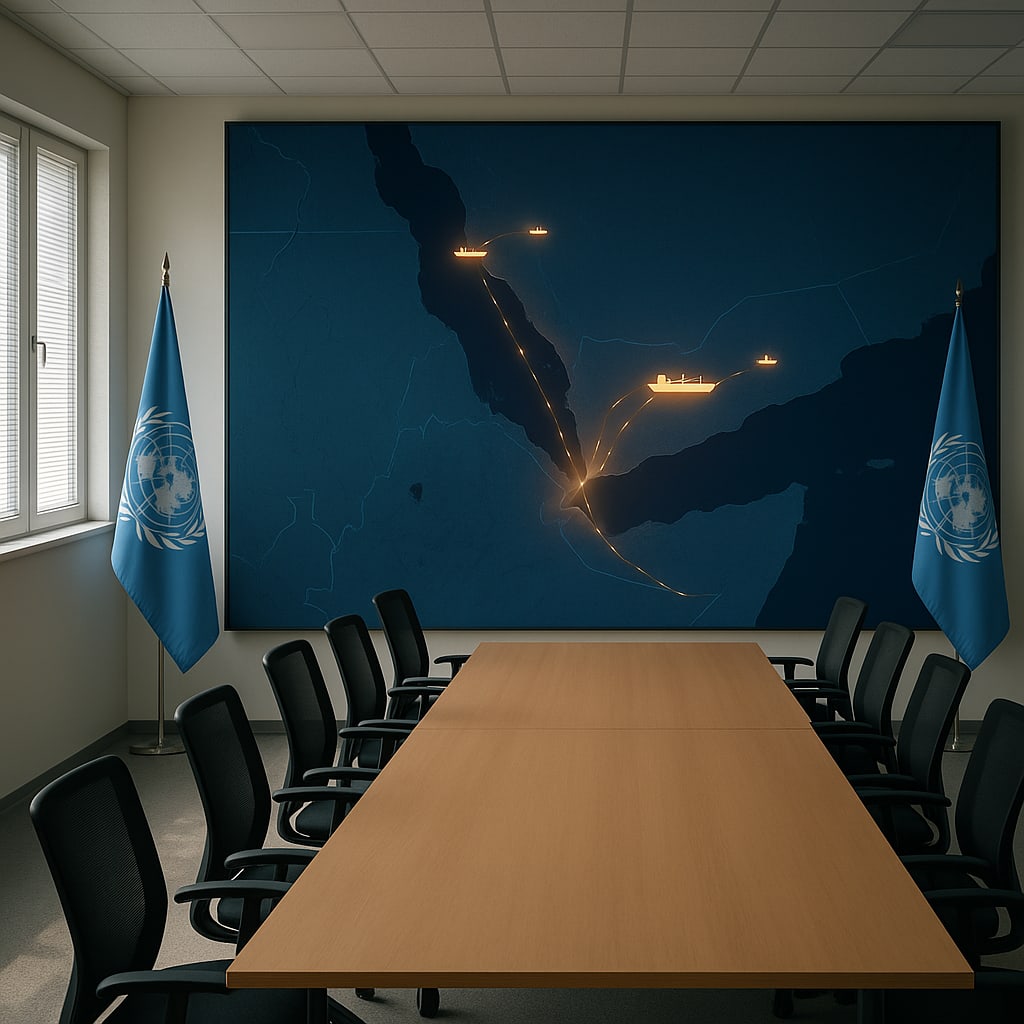
Houthis’ Red Sea “blockade” of Saudi Arabia tests global energy routes and risks a Yemen relapse into war
Narrative Snapshot
Across regions, coverage converges on chokepoint risk and strategic linkage. Japanese, European and North American outlets stress that pressure on Bab el-Mandeb compounds earlier disruptions in the Strait of Hormuz, tightening constraints on Saudi exports and global oil flows. NHK flags uncertainty over enforcement details but highlights potential impacts at the Red Sea’s southern gateway, while the Japan Times and the New York Times frame Bab el‑Mandeb as Saudi Arabia’s primary workaround with Hormuz “effectively closed” (NHK World, July 20; Japan Times, July 21; New York Times, July 21).
Actor framing diverges sharply on motive and legitimacy. Iranian and Houthi channels cast the move as “blockade for blockade,” retaliation for a years-long Saudi-led siege of Yemen (IRNA, July 20; Tehran Times, July 20; CGTN, July 21; BBC, July 20). Western and regional reporting more often interprets it as an escalatory extension of the US‑Iran confrontation, with Saudi Arabia condemning the threat and the Saudi‑led coalition pledging forceful protection of shipping (Al Jazeera, July 21; Middle East Eye, July 20). TASS, citing the International Crisis Group’s Ahmed Nagi, emphasizes the risk that Houthi actions could reignite a full-scale war in Yemen (TASS, July 21).
Operational signals are already visible but unevenly quantified. Reuters-linked alerts relayed by Middle East Eye warn shippers off Saudi ports; multiple outlets report tankers reversing course in the Red Sea, though counts vary from two to at least seven and “six ships” turned back, underscoring fluid compliance and patchy transparency (Middle East Eye, July 21; CBC, July 21; Folha de S.Paulo, July 21; TASS, July 21). Politika notes Asian refineries exploring rerouting via Suez, while Saudi-led forces announce safety measures in Bab el‑Mandeb (Politika, July 21; Middle East Eye, July 20).
The political signaling ladder is also clear. President Donald Trump vows the US will “take care” of any Houthi move to blockade Saudi ports, even as reporting points to a stretched US force posture amid widening regional strikes and maritime incidents (Middle East Eye, July 21; Japan Times, July 22; South China Morning Post, July 21; Toronto Star, July 17). Iran-linked outlets and officials underscore a doctrine of reciprocal denial—“oil for everyone or no one”—and have already broadened the fight with strikes and tanker interdictions around Hormuz (France24, July 15; South China Morning Post, July 17 and 21; RT, July 15).
What Happened
Following weeks of escalation around Hormuz, where Iran closed the strait and warned it could deny other export routes, Reuters reported that Tehran asked Yemen’s Houthis to be ready to shut Bab el‑Mandeb if the US hit power infrastructure (France24, July 15; Middle East Eye, July 16; Fox News, July 16; Politika, July 16). On July 20, Houthi spokesman Yahya Sarea declared an immediate naval blockade of Saudi Arabia, describing it as retaliation for nearly 12 years of Saudi-imposed siege and recent strikes, with enforcement details left unspecified (IRNA, July 20; BBC, July 20; Haaretz, July 20; CGTN, July 21). The Houthis warned shipping firms against calling at Saudi ports; the Saudi‑led coalition said it would respond with force and began safety measures in Bab el‑Mandeb (Middle East Eye, July 20 and 21). Several tankers reversed course, and TASS reported the Houthis claimed to have turned back six ships (CBC, July 21; Folha de S.Paulo, July 21; TASS, July 21). President Trump said the US would “take care” of any blockade (Middle East Eye, July 21).
Why It Matters
With Hormuz constrained, the Red Sea route via Bab el‑Mandeb and Saudi’s Red Sea terminals is central to Riyadh’s export resilience; further disruption threatens the main remaining workaround identified by industry and market coverage (New York Times, July 21; Japan Times, July 21). The move therefore intersects with global energy security, shipping insurance and rerouting decisions, including reported Asian refinery adjustments via Suez (Politika, July 21). Regionally, it tests the fragile Yemen de‑escalation since the 2022 truce, which analysts and reporters warned could unravel amid wider US‑Iran escalation (Al Jazeera, July 16; Clarin, July 20; TASS, July 21). Institutionally, it stresses freedom‑of‑navigation commitments and the capacity of the US‑led security architecture to manage simultaneous chokepoint crises, as assessments note a stretched American posture and expanded strike exchanges across the Gulf (Japan Times, July 22; South China Morning Post, July 21). For multilateral bodies, the episode raises immediate humanitarian-risk calculations for Yemen if conflict intensifies.
Diverging Narratives
The central split is over causality and proportionality. Houthi and Iranian narratives present the measure as reciprocal “blockade for blockade,” grounded in claims of a 12‑year Saudi siege and recent airport strikes, using embargo language that frames their action as defensive and symmetrical (IRNA, July 20; CGTN, July 21; RT, July 21; BBC, July 20). Saudi and coalition statements instead characterize it as an unlawful threat to commercial navigation warranting forceful response and protective measures, emphasizing maritime security over reciprocity (Middle East Eye, July 20; Al Jazeera, July 21). Global outlets differ on operational effect: some stress ambiguity—no enforcement details, warnings via notices—while others foreground immediate behavioral change among shippers, though reported counts of turned‑back vessels vary across CBC, Folha de S.Paulo and TASS (NHK World, July 20; Middle East Eye, July 21; CBC, July 21; Folha de S.Paulo, July 21; TASS, July 21). There is also a gap between assessments of feasibility and impact: Fox News cites experts who doubt the Houthis can fully seal the waterway even as they can sharply disrupt shipping, whereas the Guardian and the New York Times highlight the compounded risk to Saudi exports with Hormuz constrained (Fox News, July 16; The Guardian, July 21; New York Times, July 21). Finally, projections of escalation diverge: ICG’s Ahmed Nagi warns of a Yemen war relapse if attacks occur, while an Al Jazeera op‑ed focuses on the potential limits of Saudi restraint and the likelihood of a kinetic reply (TASS, July 21; Al Jazeera, July 21).
What Happens Next
Three decision points emerge. First, Houthi enforcement: following written warnings to shippers, the group could attempt interdictions or attacks on vessels using Saudi ports; indicators include additional advisories, claimed reversals at Bab el‑Mandeb, and reports of strikes or drone/missile deployments near the strait (Middle East Eye, July 21; TASS, July 21; Fox News, July 16). Second, Saudi‑led coalition posture: stated safety measures and a promise to use force could evolve into escorts, interdictions, or strikes in Yemen; watch coalition rules of engagement, convoy announcements, and any reported engagements near Bab el‑Mandeb (Middle East Eye, July 20). Third, US involvement: President Trump’s pledge to “take care” of a blockade intersects with reporting on a stretched US military amid concurrent Gulf operations; signals would include redeployments, maritime tasking changes, and responses to Iran’s ongoing regional attacks (Middle East Eye, July 21; Japan Times, July 22; South China Morning Post, July 21). Market and route adjustments—such as Asian refineries rerouting via Suez and additional tanker reversals—will reflect perceived risk and enforcement credibility (Politika, July 21; Folha de S.Paulo, July 21; CBC, July 21).