
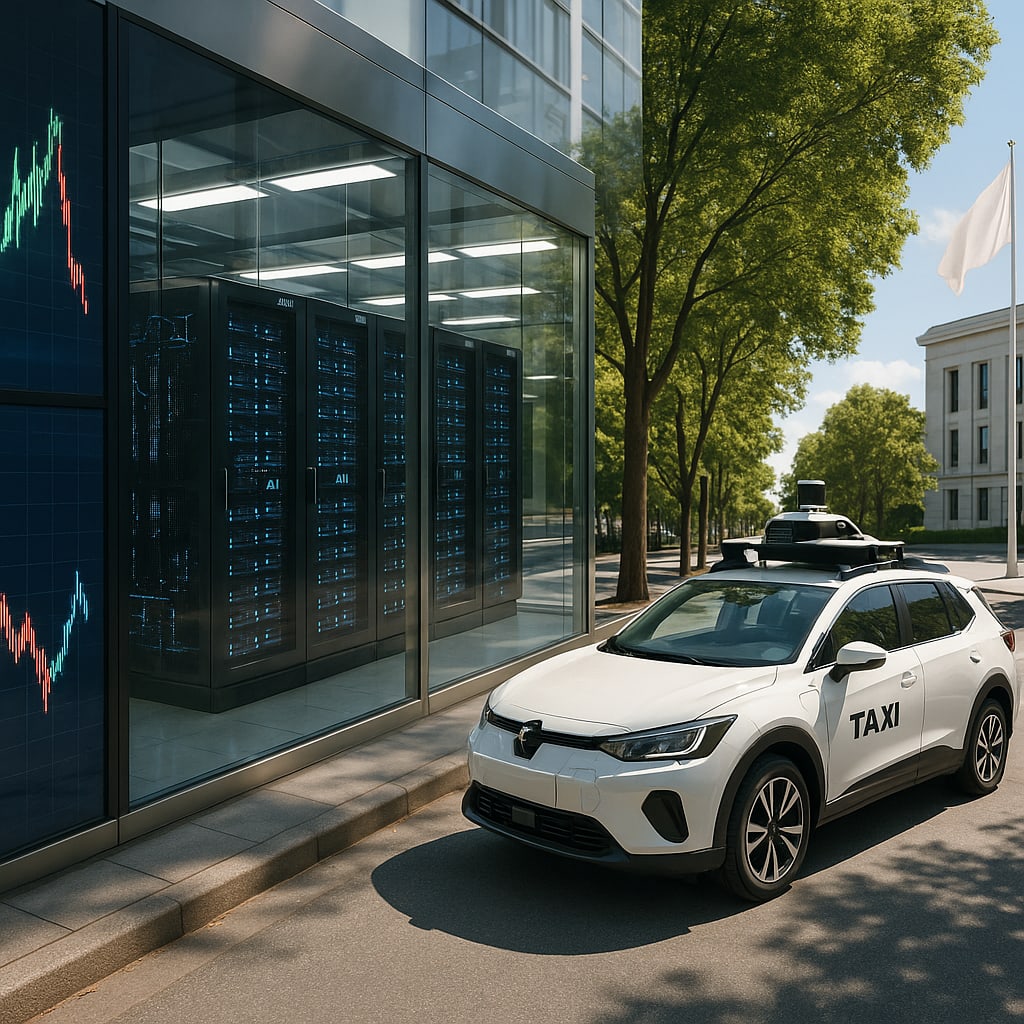
Global AI investment boom draws systemic-risk warnings as agent-based systems advance and regulators move to impose controls
Narrative Snapshot
- Macro risk consensus, differing intensity: Japan Times flags market swings and expert fears of an unprecedented bust, while Folha de S.Paulo relays a BIS warning of a prolonged “investment crisis” harming markets and the global economy. The New York Times takes the strongest view that AI spending is already crowding out the rest of the economy.
- Frontier vision vs governance guardrails: South China Morning Post reports Meta’s incoming AI research chief emphasizing “economically valuable” AI agents, while a separate SCMP piece details China’s plan for unified digital IDs for AI agents via SAMR standards.
- Deployment signals in mobility and robotics: Times of Israel highlights Uber’s Munich robotaxi test with Israel’s Autobrains; Fox News spotlights NVIDIA’s Halos safety stack for physical AI, underscoring industry attempts to preempt workplace risks.
- Public-sector exposure: Fox News links the LAUSD superintendent’s resignation to an FBI probe tied to a failed multimillion-dollar AI contract, pointing to procurement and accountability risks.
What Happened
Market anxiety over AI intensified. Japan Times reported that recent tech stock volatility revived fears of an AI bubble, with some experts warning of fallout larger than past Wall Street busts. Folha de S.Paulo covered the BIS’s warning that big tech’s rapid AI outlays risk a prolonged “investment crisis” damaging financial markets and the global economy. The New York Times argued that capital flooding into AI is already “strangling” other parts of the economy.
On the technology frontier, SCMP quoted Meta’s incoming AI research chief, Dawn Song, saying the next wave is agents doing “economically valuable” real-world work, not replacing humans but increasing effectiveness. China’s SAMR issued a national standard to give AI agents unified identities in a “closed-loop” regulatory system, SCMP reported. Deployment continued: Times of Israel covered Uber’s Munich robotaxi test with Autobrains, while Fox News reported NVIDIA’s Halos, a full-stack safety system for robotics. Fox News also reported LAUSD’s superintendent resigned amid an FBI probe tied to a failed AI contract.
Why It Matters
These reports intersect at systemic risk, industrial strategy, and governance. The BIS warning (via Folha) and Japan Times’ market framing put AI within macroprudential oversight debates about concentration risk and investment cyclicality, while the New York Times highlights capital allocation pressures that could weaken non-AI sectors. For regulators, China’s SAMR standard (SCMP) signals a state-led template for identity, traceability, and interconnection of autonomous agents, with implications for technical standards, cross-border compliance, and potential regulatory fragmentation.
Operationally, NVIDIA’s safety stack (Fox News) and Uber–Autobrains’ robotaxi test (Times of Israel) reflect efforts to institutionalize safety and cost discipline as AI moves into physical domains. Public procurement vulnerabilities underscored by the LAUSD case (Fox News) raise oversight and conflict-of-interest issues that will shape how schools and other public bodies adopt AI. Collectively, these dynamics implicate central banks, standards bodies, transport authorities, and education systems.
Diverging Narratives
- On macro effects: The New York Times contends AI spending is already constraining the broader economy, while Japan Times frames the risk as a prospective bubble with potentially unprecedented fallout. Folha’s BIS coverage positions the threat as a prolonged investment downturn, emphasizing financial stability rather than immediate crowd-out.
- On technology direction: SCMP’s interview with Meta’s Dawn Song stresses “economically valuable” AI agents augmenting real-world tasks, whereas other outlets focus on risks: NVIDIA’s Halos (Fox News) centers safety for “physical AI,” and China’s SAMR standard (SCMP) stresses control via unified agent identities.
- On deployment narratives: Times of Israel presents the Uber–Autobrains robotaxi pilot as a path to scale with lower-cost, agentic systems, contrasting with regulatory containment narratives from China (SCMP) and macroprudential caution (Folha/Japan Times).
- On governance and accountability: The LAUSD resignation amid an FBI probe over a failed AI contract (Fox News) foregrounds public-sector due diligence challenges, a theme largely absent from the growth- or safety-centric tech coverage elsewhere. The gap highlights differing emphases: financial stability and macro allocation vs. deployment, safety engineering, and procurement integrity.
What Happens Next
- Capital discipline vs retrenchment: BIS’s warning (Folha) and Japan Times’ bubble concerns put attention on corporate AI capex guidance, funding conditions, and any shift by large platforms toward profitability over expansion. Signals to watch: earnings disclosures on AI returns, credit spreads for AI-exposed firms, and central bank commentaries on sectoral risks.
- Governance of AI agents: China’s SAMR standard (SCMP) creates a test case for identity-managed autonomous systems. Indicators: implementation timelines, compliance tools vendors adopt, and whether sectoral regulators (e.g., transport, finance) reference the standard in licensing.
- Safety adoption in physical AI: NVIDIA’s Halos (Fox News) suggests a move toward safety stacks. Track: integration by major robot OEMs, references in workplace safety guidance, and incident reporting protocols tied to such systems.
- Mobility pilots to scale: Uber–Autobrains’ Munich test (Times of Israel) presents a regulatory and performance proving ground. Watch: pilot safety data, cost per mile, regulatory feedback, and any expansion decisions contingent on results.
- Public procurement oversight: The LAUSD investigation (Fox News) highlights contracting risk. Follow: outcomes of the probe, any procurement reforms or moratoria on AI contracts, and guidance from education authorities on vetting AI vendors.