
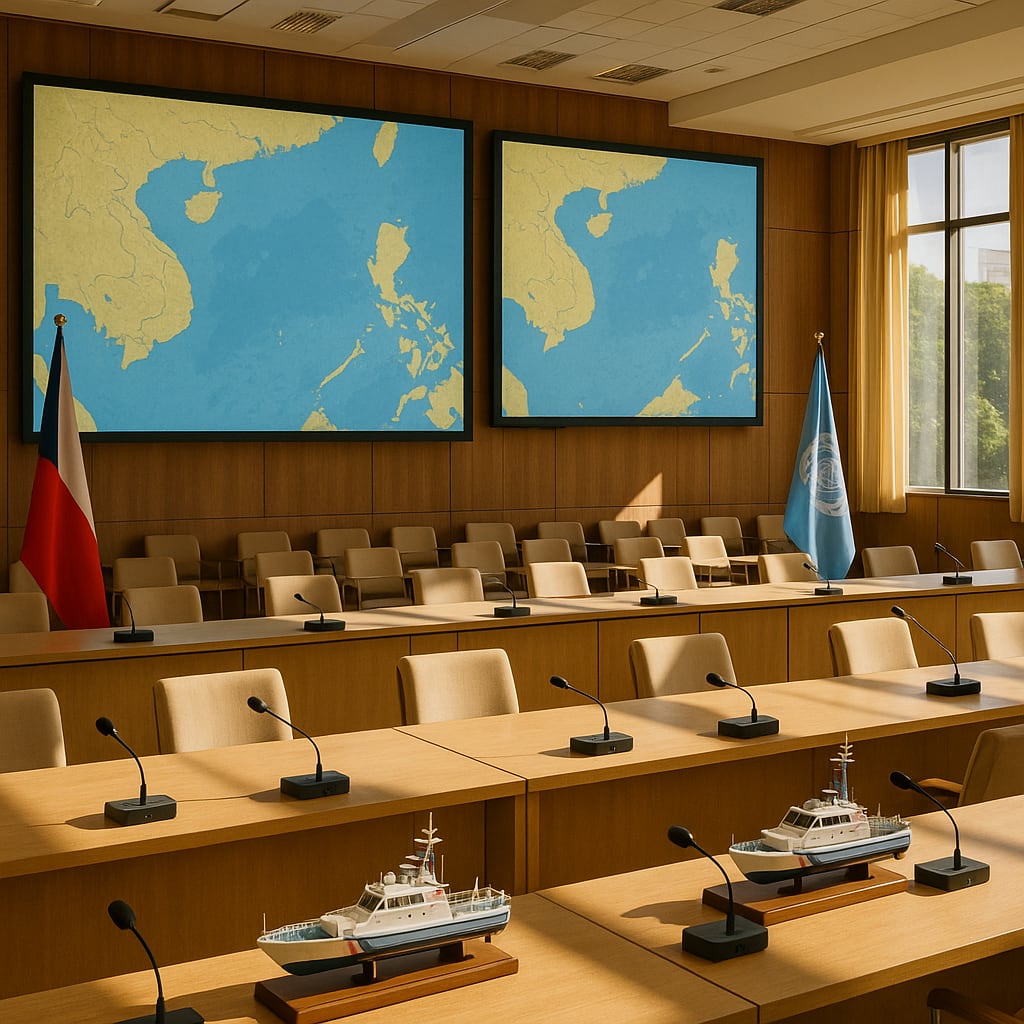
South China Sea standoffs intensify near Scarborough Shoal as Quad stresses maritime stability and ASEAN pursues code of conduct
Narrative Snapshot
Across outlets, two strands of coverage run in parallel: on-water confrontations near Scarborough Shoal and concentrated diplomacy in Manila. International media detail consecutive days of China–Philippines encounters marked by water-cannon use and competing claims of law enforcement and illegal intrusion, while Chinese state-linked outlets emphasize sovereignty over Huangyan Dao and portray Philippine actions as orchestrated provocations. Simultaneously, regional diplomacy projects two different organizing principles: ASEAN’s push to finalize a Code of Conduct this year, and the Quad’s affirmation of maritime peace and stability—read by some Asian reporting as implicitly addressing China’s posture without naming it.
The stakes vary by vantage point. For Chinese sources, the priority is limiting “extra-regional” involvement and keeping dispute management within China–ASEAN channels, with Australia singled out as lacking standing to intervene. For regional and international outlets, the risk calculus centers on escalation dynamics during an ASEAN ministerial week, the credibility of a long-delayed code of conduct, and the operational balance around a flashpoint where both sides contest jurisdiction and tactics. Manila’s bilateral relationship with Beijing is cast by Chinese and Serbian reporting as at a “crossroads,” while Beijing-linked commentary extends the information battle to cross-Strait politics by criticizing Taiwan’s ruling party for echoing Philippine positions.
What Happened
Quad foreign ministers met in the Philippines and issued a document emphasizing the importance of peace and stability in Indo-Pacific maritime domains after sharing assessments on the East and South China Seas, with China’s activities in mind, according to NHK. ASEAN foreign ministers released a joint statement expressing hope to conclude negotiations on a South China Sea “code of conduct” within the year, NHK reported, as The Hindu noted the effort has dragged for nearly a decade. During the same period, the Philippines said its vessels were blocked with water cannons by the China Coast Guard; China stated it lawfully drove them away, NHK reported. Al Jazeera and the South China Morning Post described a second day of clashes near Scarborough Shoal and concurrent Chinese military drills expected to run to month-end. Chinese outlets said Philippine ships and fishing boats intruded into waters of Huangyan Dao, urged Manila to halt provocations, and highlighted an oil leak from a Philippine fishing boat.
Why It Matters
The episode sits at the intersection of two governance models for the South China Sea. ASEAN-led code-of-conduct negotiations aim to channel disputes into managed protocols, and ministers voiced year-end ambitions even as The Hindu underscored a decade of delay that tests institutional capacity. China’s messaging positions the code’s early conclusion as a way to “keep the region’s future in the hands of regional countries” and to deny space for outside actors, according to CGTN’s account of Wang Yi’s remarks. In parallel, the Quad’s Manila statement signals continued alignment among the U.S., Japan, Australia, and India around maritime stability norms without litigating sovereignty.
For decision-makers, the confluence of back-to-back at-sea incidents during ministerial meetings raises the salience of de-escalation mechanisms and communication protocols. Chinese sources explicitly challenge Australian involvement and caution against “hyping” tensions, while also asserting lawful enforcement near Huangyan Dao and Ren’ai Jiao. The net effect is a sharpened contest over who sets rules, who patrols, and which forums arbitrate behavior.
Diverging Narratives
Accounts diverge most on legality, agency, and venue. Philippine authorities and international media report obstruction of Philippine vessels by China’s coast guard using water cannons on consecutive days near Scarborough Shoal, with Al Jazeera citing involvement of China Coast Guard and maritime militia vessels and Corriere della Sera amplifying Philippine Coast Guard video. Chinese government-aligned outlets counter that Philippine government ships and fishing boats “illegally intruded” into China’s territorial waters of Huangyan Dao, justifying “necessary measures” and urging Manila to stop “provocations,” while also publicizing an oil-leak incident attributed to a Philippine fishing boat.
On process and participants, ASEAN statements, as reported by NHK, foreground hopes for a code-of-conduct deal this year, while CGTN stresses that the South China Sea issue should not impede China–ASEAN ties and that early COC conclusion would preclude external meddling. ECNS quotes a Chinese foreign ministry spokesperson asserting Australia has no right to intervene, placing the Quad’s maritime stability language from NHK in contrast with Beijing’s warnings against “extra-regional” involvement. Chinese reporting further extends the discursive front by criticizing Taiwan’s ruling party for echoing Philippine positions on Ren’ai Jiao, adding a cross-Strait layer absent from other outlets. Politika quotes Wang Yi framing China–Philippines ties as at a turning point, assigning responsibility for the next steps to Manila.
What Happens Next
Three decision points emerge from the reporting. First is the ASEAN–China code-of-conduct track: ASEAN ministers’ year-end target (NHK) intersects with China’s call for an “early conclusion” to keep control with regional states (CGTN). Analysts should watch for announced negotiation rounds, draft text milestones, and whether language on external actors and law-enforcement conduct reflects Beijing’s preferences.
Second is on-water operating patterns around Scarborough/Huangyan and Ren’ai Jiao: Philippine assertions of interference and China’s stated “control measures” (NHK, SCMP, CGTN) define a narrow margin for miscalculation. Indicators include frequency and scale of Philippine sorties, China Coast Guard posture and drills through month-end (SCMP), and publicized incidents such as alleged oil leaks (CGTN).
Third is the scope of third-party signaling. The Quad’s emphasis on maritime stability (NHK) contrasts with Chinese statements that non-parties, including Australia, should not intervene (ECNS). Watch for any concrete Quad or Australian statements or activities tied to these incidents, and for whether Beijing–Manila rhetoric shifts after Wang Yi’s “crossroads” framing reported by Politika.