
SpaceX Falcon 9 upper stage to crash into the Moon; NASA plans to observe, no risk to Earth
Narrative Snapshot
Across outlets, coverage converges on three points: the collision is unintentional, it poses no danger to Earth, and it will leave a new crater on the lunar surface. Le Monde, France24, and the Bangkok Post emphasize the reassurance angle, explicitly citing NASA’s assessment that the impact is safe for Earth while noting the expected crater. The South China Morning Post anchors the technical picture with a reported impact time around 2:35 am ET (06:35 GMT), an estimated speed near 8,690 km/h, and a mass of roughly four tonnes for the upper stage.
Where they differ is in framing and emphasis. The BBC and NHK treat the event as a “useful accident,” underscoring the scientific upside of observing the ejecta and crater to inform future lunar exploration. Folha de S.Paulo and the South China Morning Post invoke the language of space junk, with Folha characterizing humanity as once again spreading trash on the Moon. Clarin focuses on practical questions for audiences—when any debris trail might be visible and what specialists say about hypothetical risks—whereas Le Monde and France24 stress cause and mechanism, with Le Monde pointing to an unexpected trajectory change and France24 attributing the path to a mix of solar activity and gravitational forces.
What Happened
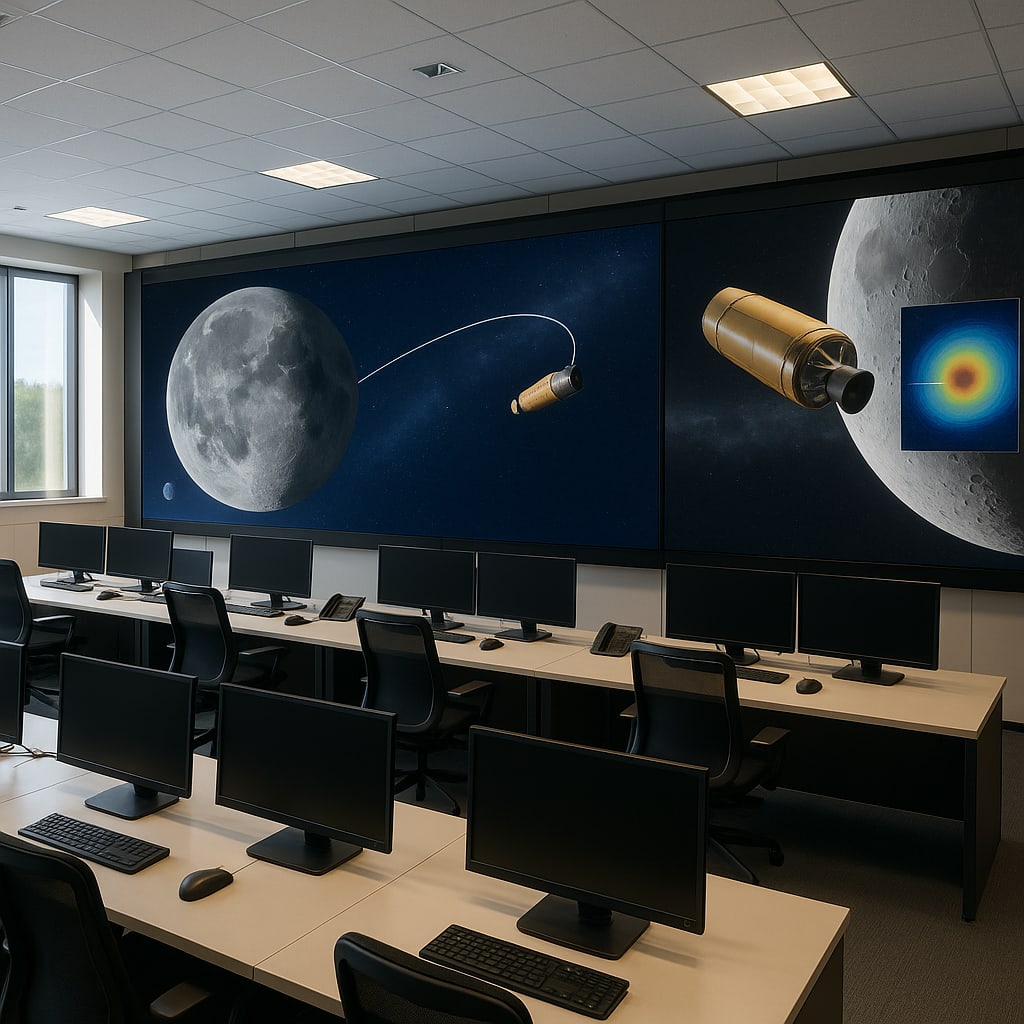
A school bus-sized second stage from a SpaceX Falcon 9, left over from a January 2025 mission that launched Firefly Aerospace’s lunar lander, is on track to strike the Moon at high speed. The South China Morning Post reports a mass of about 4,000 kg, an impact velocity near 8,690 km/h (5,400 mph), and a target time around 2:35 am ET (06:35 GMT) on Wednesday. Multiple outlets state the collision is unintentional and will excavate a new crater and toss up a plume of lunar dust. France24 attributes the trajectory to a combination of solar activity and gravitational forces, while Le Monde describes an unexpected course change. NASA, cited by Le Monde, the Bangkok Post, France24, and NHK, says the event poses no danger to Earth and plans to observe the impact to extract insights for future lunar missions.
Why It Matters
The incident underscores how cislunar trajectories are shaped by forces beyond routine low-Earth-orbit traffic management. France24’s reference to solar activity and gravitational influences and Le Monde’s “unexpected trajectory change” highlight a navigation and tracking environment where commercial and governmental actors must manage extended, multi-body dynamics. At the same time, the BBC and NHK point to a scientific dividend: NASA intends to observe the impact, with the promise of practical knowledge for lunar surface operations and exploration planning. The language of “space junk” used by Folha and the South China Morning Post signals a parallel concern—stewardship of the lunar environment as commercial lunar activity grows. For decision-makers, the episode illustrates the dual imperatives now visible in the public record: operational learning from a real cislunar impact and rising scrutiny of how spent stages are left to wander in Earth–Moon space.
Diverging Narratives
Two interpretive threads are most pronounced. One centers on scientific utility: the BBC frames the event as potentially informative for astronomers, and NHK reports NASA’s intent to observe to gain knowledge relevant to future lunar exploration. The other stresses debris and stewardship: Folha calls the stage “lixo” on our celestial neighbor, and the South China Morning Post labels it space junk drifting since last year. Safety messaging is consistent—Le Monde, France24, and the Bangkok Post all highlight that NASA judges the impact harmless to Earth—yet Clarin’s coverage shows there is audience demand for clarity on visibility and hypothetical risks, prompting outlets to revisit basic risk communication even in low-hazard scenarios.
Causality is also framed with varying granularity. Le Monde refers to an unexpected trajectory change without elaboration, while France24 specifies a mix of solar activity and gravitational forces, a difference of detail rather than disagreement. Together, these threads map a spectrum from science-forward opportunity to environmental concern, under a shared baseline of reassurance about terrestrial safety.
What Happens Next
The immediate indicator is whether NASA and partner observatories publish impact observations and post-impact imagery or spectra of the ejecta and crater, as NHK reports NASA intends. If detailed results are released, the emphasis will likely be on operational lessons for lunar exploration; if observations prove sparse, follow-on reporting may focus on the limits of remote monitoring rather than scientific returns. Analysts should also watch for consistency in post-event safety communications that echo Le Monde, France24, and the Bangkok Post’s no-danger framing, including any updates on impact timing and location relative to the South China Morning Post’s schedule.
A second indicator is how agencies and companies address the debris narrative surfaced by Folha and the South China Morning Post. Follow-up statements that contextualize the unintentional path through solar and gravitational influences, as described by France24, would signal attention to stewardship concerns. Clarin’s emphasis on visibility suggests near-term telescope or instrument reports may further anchor the public record of what was actually seen.