
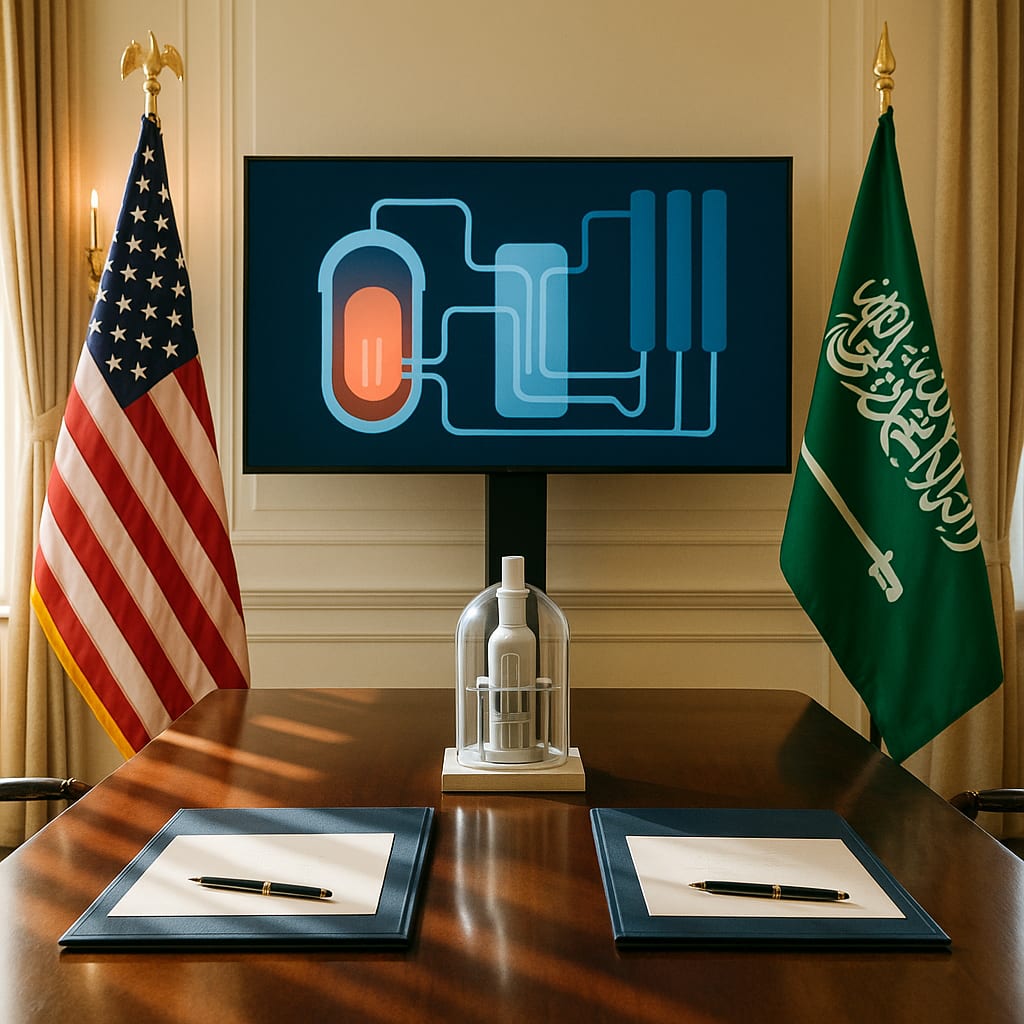
US and Saudi Arabia sign civilian nuclear cooperation deal with bilateral safeguards and congressional review
Narrative Snapshot
Across outlets, coverage converges on the announcement of a “historic” or “landmark” US–Saudi nuclear cooperation pact that includes a parallel bilateral safeguards arrangement and enables Riyadh to pursue a civilian nuclear program. European and Asian reports emphasize the formalization and symbolism of the accord and its signatories, with France 24 noting the Energy Secretary and the Saudi energy minister signed both agreements in Washington, and Deutsche Welle framing it as further evidence of deepening ties during President Donald Trump’s second term.
Regional and Israel-focused reporting centers on proliferation-sensitive elements. Haaretz highlights that the pact omits the IAEA Additional Protocol and allows enrichment and reprocessing, while the Times of Israel underscores Israeli alarm and the prospect of an enrichment facility that could be repurposed for weapons. Middle East Eye similarly flags regional proliferation risks. In contrast, US government messaging carried by The Hindu and echoed by the Bangkok Post stresses safeguards and an explicitly nonproliferation-oriented, long-term economic partnership. There is also a disparity in detail: some outlets recount signatures and the bilateral safeguards deal; others note that few specifics have been publicly released, sharpening scrutiny of the terms governing fuel-cycle activities.
What Happened
The United States announced it had reached a civilian nuclear cooperation agreement with Saudi Arabia, alongside a separate bilateral safeguards arrangement, according to the US Energy Department. France 24 reports Energy Secretary Chris Wright signed the pact and the safeguards deal with Saudi Energy Minister Prince Abdulaziz bin Salman in Washington. Outlets including Deutsche Welle and Al Jazeera describe the agreement as a landmark step permitting Saudi Arabia to develop a civilian nuclear program and build reactors, while Politika emphasizes that the program would be on Saudi territory. The Energy Department framed the twin agreements as laying a legal foundation for a decades-long, multi-billion-dollar partnership advancing economic, strategic, and nonproliferation objectives, The Hindu reports. Haaretz notes the pact now enters a congressional review period of 90 session days, and reports it permits uranium enrichment and reprocessing and does not include the IAEA Additional Protocol.
Why It Matters
The deal intersects with multiple policy regimes and alliances. It signals an expansion of US–Saudi cooperation during Trump’s second term, as underscored by Deutsche Welle, while The Hindu relays Washington’s assertion that the package supports nonproliferation through a bespoke bilateral safeguards track. The omission of the IAEA Additional Protocol, reported by Haaretz, squarely places oversight on the bilateral arrangement, a choice likely to draw scrutiny in Washington during the statutory review and in Vienna given established international verification practices.
Regionally, reported permissions for enrichment and potential reprocessing—flagged by Haaretz, Clarin, and the Times of Israel—raise sensitive fuel-cycle questions with implications for Israel’s security calculus and broader Gulf dynamics. Al Jazeera’s focus on reactor construction highlights the prospective scale of Saudi nuclear infrastructure. For decision-makers, the agreement’s structure will test how far tailored safeguards can satisfy nonproliferation concerns while enabling indigenous fuel-cycle steps that some stakeholders view as strategically consequential.
Diverging Narratives
US officials, via statements carried by The Hindu and echoed in the Bangkok Post, present the package as a safeguarded pathway to civil nuclear energy that advances nonproliferation and economic goals. European and international outlets such as France 24 and Deutsche Welle largely track the diplomatic milestone and formalities, using “historic” and “landmark” descriptors. By contrast, Haaretz and the Times of Israel emphasize risk: the absence of the Additional Protocol, allowances for enrichment and reprocessing, and Israeli alarm over an enrichment facility that could theoretically be converted for weapons use. Middle East Eye similarly foregrounds regional proliferation concerns.
There are also discrepancies in perceived transparency. While France 24 and Middle East Eye specify the signing of both the cooperation pact and a bilateral safeguards deal, the Times of Israel notes that few details have been released, leaving the exact parameters of enrichment, reprocessing, and inspection modalities partially opaque to the public. Clarin’s formulation—that the deal could allow Saudi Arabia to enrich reactor fuel—underscores that not all outlets present the same level of certainty about fuel-cycle terms, accentuating the space for contestation during congressional review and among regional stakeholders.
What Happens Next
The immediate decision point is in Washington: Haaretz reports Congress has 90 session days to object before the pact takes effect. Analysts should watch for committee hearings, resolutions of disapproval, or negotiated conditions; sustained acquiescence would allow the agreements to enter into force, while significant pushback could delay or alter implementation.
A second hinge is how safeguards are operationalized. With Haaretz reporting the omission of the IAEA Additional Protocol, the effectiveness of the bilateral safeguards deal—announced by Middle East Eye and France 24—will be central; look for any published terms, technical annexes, or coordination with the IAEA.
On the Saudi program’s rollout, Al Jazeera notes plans to build reactors, and the Times of Israel and Clarin point to enrichment as a potential component. Indicators include reactor site selections, procurement or contracting moves, and any steps toward an enrichment facility. Regionally, the Times of Israel’s account of Israeli alarm suggests close monitoring of official reactions or diplomatic engagement that might seek clarifications or constraints.