
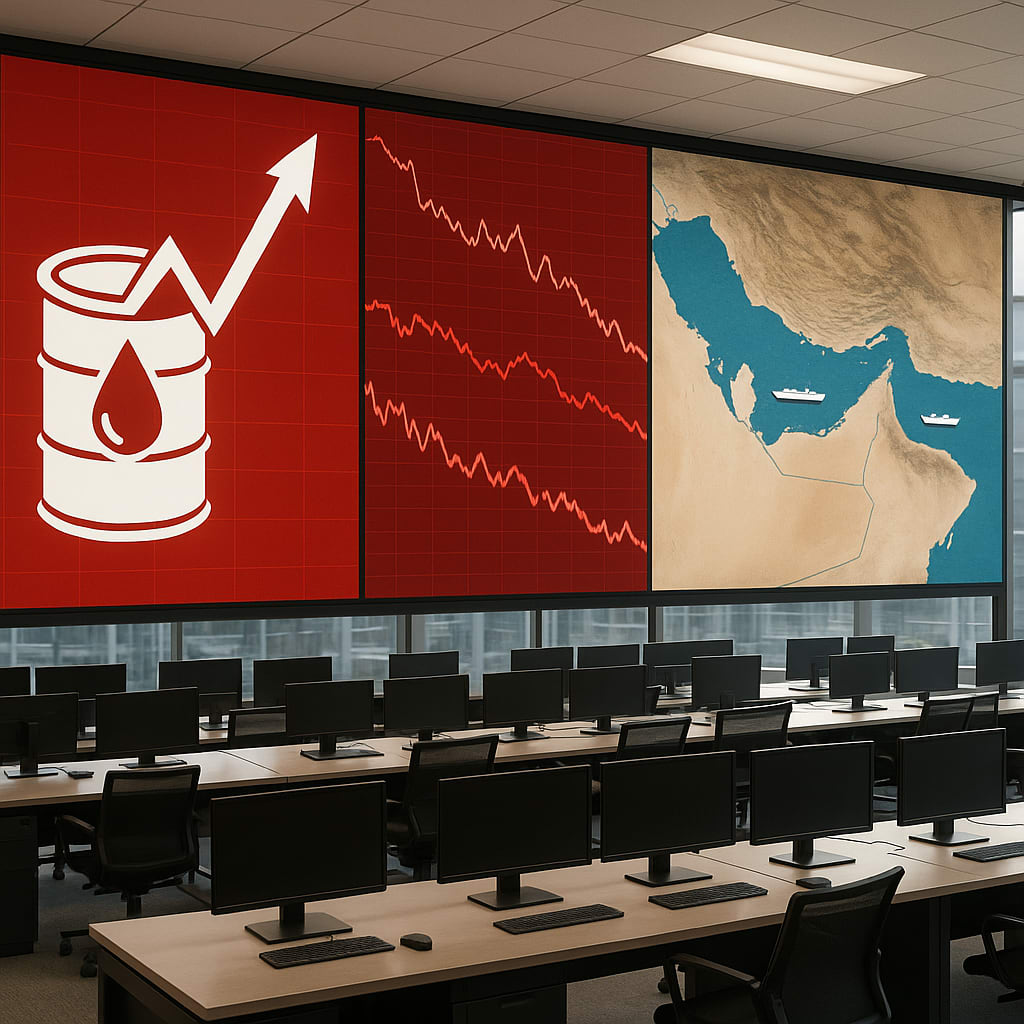
Oil jumps 5–6% as U.S.–Iran hostilities resume and Trump declares ceasefire ‘over’
Narrative Snapshot
- Across outlets, the market move is uncontested: Brent rose roughly 5–6% into the high-$70s, with the intraday range running from about $78 (Middle East Eye, The Guardian, Clarin) toward ~$79 (CBC) and briefly above $80 on ICE (TASS). WTI advanced into the mid-$70s (MEE, RT, TASS).
- Causal framing varies. U.S. presidential remarks ending the ceasefire anchor coverage at the New York Times, The Guardian, CBC, and Clarin. RT and MEE emphasize resumed U.S. strikes; RT alone highlights a U.S. sanctions waiver revocation.
- Risk emphasis differs by geography and beat: the NYT centers on the Strait of Hormuz chokepoint; ANSA and Sky News stress broad equity sell-offs; Al Jazeera details sector rotation (travel down, energy up); Folha tracks Brazilian FX stability amid the shock.
- Attribution language around the tanker incidents is cautious or sourced: U.S. claims Iran attacked vessels (Folha); others reference reported or recent attacks near Hormuz without definitive sourcing (NYT, The Guardian, RT).
What Happened
Following reported attacks on commercial tankers near the Strait of Hormuz, U.S. President Donald Trump said the ceasefire or “deal” with Iran is “over” (New York Times; The Guardian; CBC; Clarin). Multiple outlets report renewed U.S. strikes: Middle East Eye describes “extensive” strikes on Iran and a wave of reprisals against U.S. bases in the Gulf, while RT says U.S. forces carried out a new wave of strikes overnight. RT also reports the U.S. revoked a two‑month sanctions relief license for Iranian oil. Oil prices spiked: Brent rose about 5–6% to roughly $78–79, with a print above $80 on ICE (MEE; RT; CBC; TASS), and WTI climbed to the mid‑$70s (MEE; RT; TASS). Equities sold off broadly—European markets fell (ANSA), major U.S. indexes declined (CBC), and global stocks slid on renewed hostilities (Sky News). Travel shares dropped while energy names gained (Al Jazeera).
Why It Matters
The immediate market impact reflects structural exposure to the Strait of Hormuz, a critical energy artery. The New York Times warns that attacks there could throttle energy flows and that volatility will persist while Washington and Tehran leave the strait’s status unresolved. The Guardian links the price jump to the highest level since the ceasefire that accompanied talks to end the war, underscoring the fragility of that diplomatic track. If, as RT reports, sanctions relief was withdrawn alongside military action, the policy mix shifts back toward pressure over de‑escalation. Equity reactions—Europe’s declines (ANSA), global sell‑offs (Sky News), and sectoral moves (Al Jazeera)—signal transmission channels to airlines, logistics, and inflation-sensitive economies. For governments and multilateral bodies, the episode tests crisis-management capacity around maritime security, energy-market stabilization, and any forum capable of reconstituting negotiations that had recently paused hostilities (The Guardian; New York Times).
Diverging Narratives
Coverage is aligned on direction but not measurement: Brent’s peak is cited variously as “more than $78” (The Guardian), “about $79” (CBC), “as much as 6% … to $78.53” (RT), and “tops $80 … for the first time since June 22” (TASS). Timeframes differ too—Al Jazeera calls it a two‑week high, while The Guardian frames it as the highest since the ceasefire began. On causality, several outlets foreground the president’s declaration that the ceasefire is over (New York Times; Clarin; CBC; The Guardian). Others stress operational steps: MEE reports extensive U.S. strikes and subsequent reprisals against U.S. bases; RT reports both strikes and a sanctions‑waiver revocation. Attribution to Iran for the tanker incidents is presented through U.S. claims (Folha) or reported attacks without definitive sourcing (NYT; The Guardian; RT). Market lenses also diverge: European and global equity stress (ANSA; Sky News) versus sector‑specific dislocations (Al Jazeera).
What Happens Next
- Ceasefire and talks: Outlets indicate the ceasefire tied to negotiations has collapsed (The Guardian; New York Times; Clarin). Watch for any statements on resuming talks or formalizing an end to the truce—either would shape risk premia and shipping posture.
- Military tempo and retaliation: MEE and RT describe renewed U.S. strikes, with MEE noting reprisals against U.S. bases. Indicators to watch include additional strikes, cross‑border attacks, or changes in U.S. force protection postures in the Gulf.
- Sanctions posture: RT’s report of a revoked U.S. oil sanctions waiver, if confirmed or expanded, would reinforce supply‑side constraints. Monitor U.S. Treasury/OFAC notices and allied alignment.
- Maritime security and price thresholds: NYT highlights Hormuz’s centrality; further incidents there would keep volatility elevated. Price prints at or above $80 Brent (TASS) and sectoral market moves—airlines down, energy up (Al Jazeera)—are near‑term gauges of perceived duration and severity.
- Global market transmission: Continued equity weakness (ANSA; CBC; Sky News) and FX sensitivity in emerging markets tracking headlines (Folha) will indicate spillover breadth.