
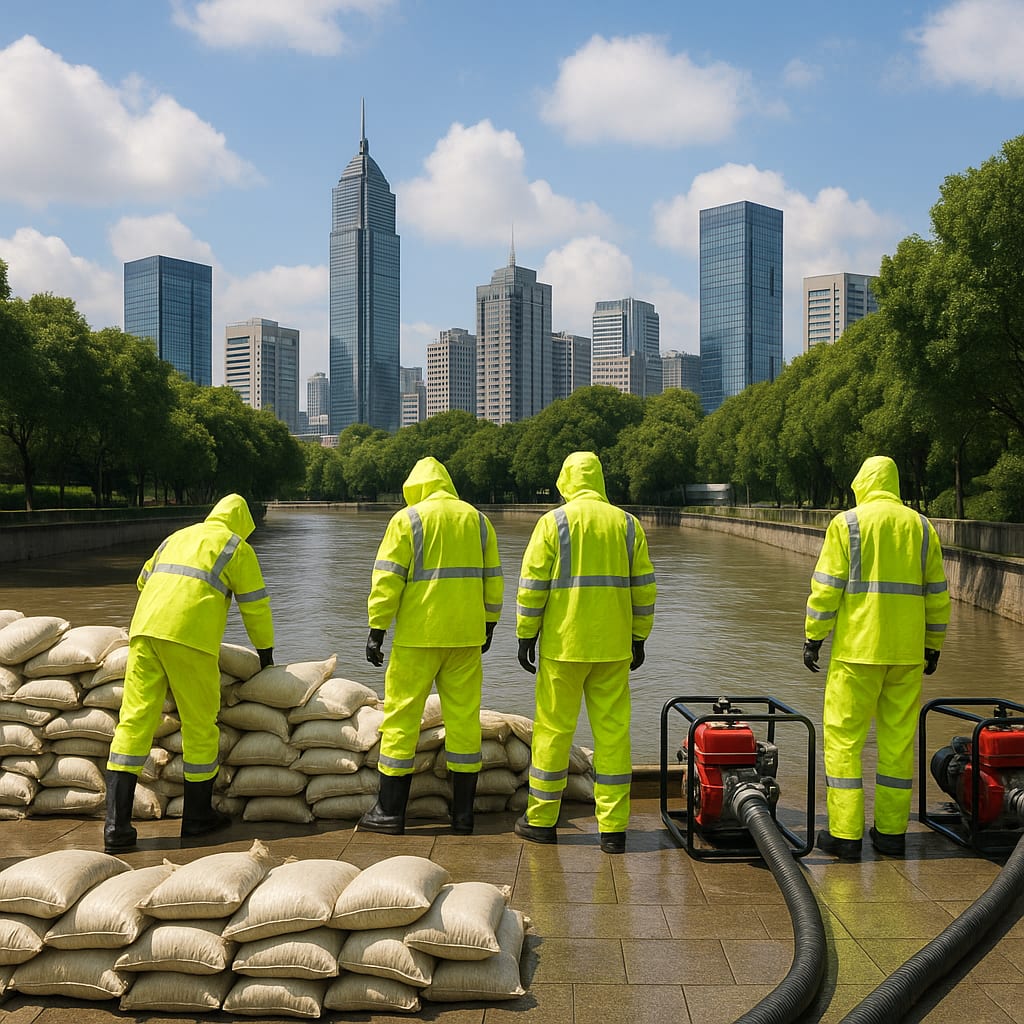
Typhoon Dolphin makes landfall in eastern China, triggering mass evacuations and major flight disruptions
Narrative Snapshot
Across international outlets, there is wide alignment on the scale of pre-emptive action and disruption: a top-tier red alert from China’s National Meteorological Centre, large-scale evacuations exceeding one million people, and sweeping flight cancellations concentrated in Shanghai and coastal Zhejiang and Fujian (South China Morning Post; CBC; Bangkok Post; BBC; Al Jazeera; France24). Coverage diverges on quantification and emphasis. Some reports foreground record-setting rainfall in Shanghai and municipal hydrology pressures, citing surging water levels along Suzhou Creek and “record rainfall” in the city (The Guardian; ECNS). Others stress aviation paralysis, with estimates ranging from “hundreds” to nearly 1,500 flight cancellations, reflecting different cutoffs, airports, and reporting windows (Sky News; Bangkok Post; Politika; Deutsche Welle; SCMP).
There is also variation in how landfall is framed. Several outlets describe a broad landfall corridor from Sanmen in Zhejiang to Fuding in Fujian, while others pinpoint Yuhuan in Zhejiang with timing and peak winds near 150–151 km/h (The Hindu; Corriere della Sera; Clarín). Post-landfall trajectories are read in two keys: a rapid weakening to a tropical storm with localized flooding, and a still-dangerous rainmaker carrying north into inland provinces and even parts of Beijing under flood alert (Toronto Star/AP; Deutsche Welle; The Guardian). Regional context appears mainly in Japanese coverage noting prior impacts on Okinawa as the system crossed the East China Sea (Japan Times).
What Happened
China’s National Meteorological Centre issued a red alert on Sunday as Typhoon Dolphin approached from the southern East China Sea, about 215 km east of Wenzhou, Zhejiang, prompting Shanghai to cancel nearly 60% of flights (SCMP; Le Monde). The storm made landfall along the Zhejiang–Fujian coast, described broadly from Sanmen to Fuding, with some outlets specifying Yuhuan, Zhejiang, around 17:30 with winds near 150 km/h (The Hindu; Corriere della Sera). Authorities evacuated more than one million residents across eastern provinces; Wenzhou alone relocated over 900,000 people and opened more than 1,500 shelters, while Fujian moved nearly 99,000 (CBC; The Guardian). Flight disruptions ranged from more than 1,000 cancellations to close to 1,500 in Shanghai, depending on timeframe and airport coverage (Bangkok Post; Politika; Deutsche Welle). As the system weakened on Monday, it continued to dump heavy rain, inundating parts of Shanghai and sharply raising Suzhou Creek’s water level, while inland flood alerts expanded northward (Toronto Star/AP; ECNS; Deutsche Welle).
Why It Matters
The episode stress-tests China’s disaster-preparedness architecture around megacity flood control, mass evacuation logistics, and information management. The red alert, relocation of over one million residents, and rapid shelter activation in Wenzhou reflect substantial local–central coordination capacity and pre-emptive risk reduction, a priority since past flood emergencies (Le Monde; CBC; The Guardian). Shanghai’s role as a national and international aviation hub magnified the disruption’s systemic footprint, with cancellations reported from hundreds to nearly 1,500, underscoring how weather shocks propagate through regional and global air networks (SCMP; Sky News; Deutsche Welle). Reports of exceptional rainfall in Shanghai and surging creek levels illuminate urban drainage vulnerabilities that drive medium-term investment decisions in riverine management and stormwater systems (The Guardian; ECNS). Law-enforcement action against storm-related misinformation, noted by Italian media, indicates a parallel focus on maintaining information discipline during emergencies, shaping the operating space for civil society and local media (Corriere della Sera).
Diverging Narratives
Key metrics vary across outlets. Evacuation totals are consistently framed as above one million, but Argentinian coverage cites 1.6 million, while city-level details show Wenzhou’s 900,000 relocations and Fujian’s roughly 99,000, revealing both aggregation and local granularity in reporting (Clarín; The Guardian). Flight disruption counts range widely—from “hundreds” to more than 1,000 to close to 1,500 in Shanghai—reflecting different cut times, airport scopes, and whether totals include pre-emptive cancellations or same-day operational decisions (Sky News; Bangkok Post; Politika; Deutsche Welle). Landfall is presented either as a corridor between Sanmen and Fuding or as a precise landfall point and time at Yuhuan, indicating distinct editorial choices between conservative geographic bands and pinpointed locations (The Hindu; Corriere della Sera).
Severity is framed in two ways that do not contradict but steer emphasis. Several outlets call Dolphin the most powerful storm to hit China this year and highlight fears of landslides and flooding, including records in Shanghai; others foreground the storm’s weakening to a tropical system while acknowledging continued flooding (CBC; France24; The Guardian; Toronto Star/AP). A minority of coverage includes public-order dimensions, such as arrests for spreading fake news and a report of a missing child, which most English-language summaries omit, underscoring selective inclusion of social impacts and enforcement measures (Corriere della Sera).
What Happens Next
The policy inflection points cluster around hydrology, mobility, and risk communication. As the system tracks inland and north, authorities must decide on the duration and scope of flood and landslide warnings, especially in Zhejiang’s rain-saturated terrain and areas now under alert farther north, including parts of Beijing; extension or downgrading of alerts will signal evolving risk assessments (Le Monde; Deutsche Welle). In Shanghai and coastal hubs, aviation recovery will hinge on wind and runway drainage conditions; airlines and airport authorities will calibrate ramp-ups from widespread cancellations reported over the weekend and Monday (SCMP; Deutsche Welle; Sky News). Urban water management will focus on drainage and river levels, with Suzhou Creek’s surge a watchpoint for further overflow control and pumping operations (ECNS). Finally, officials have already acted against misinformation, so analysts should track official channels and enforcement updates for cues on information governance during the response phase (Corriere della Sera).