
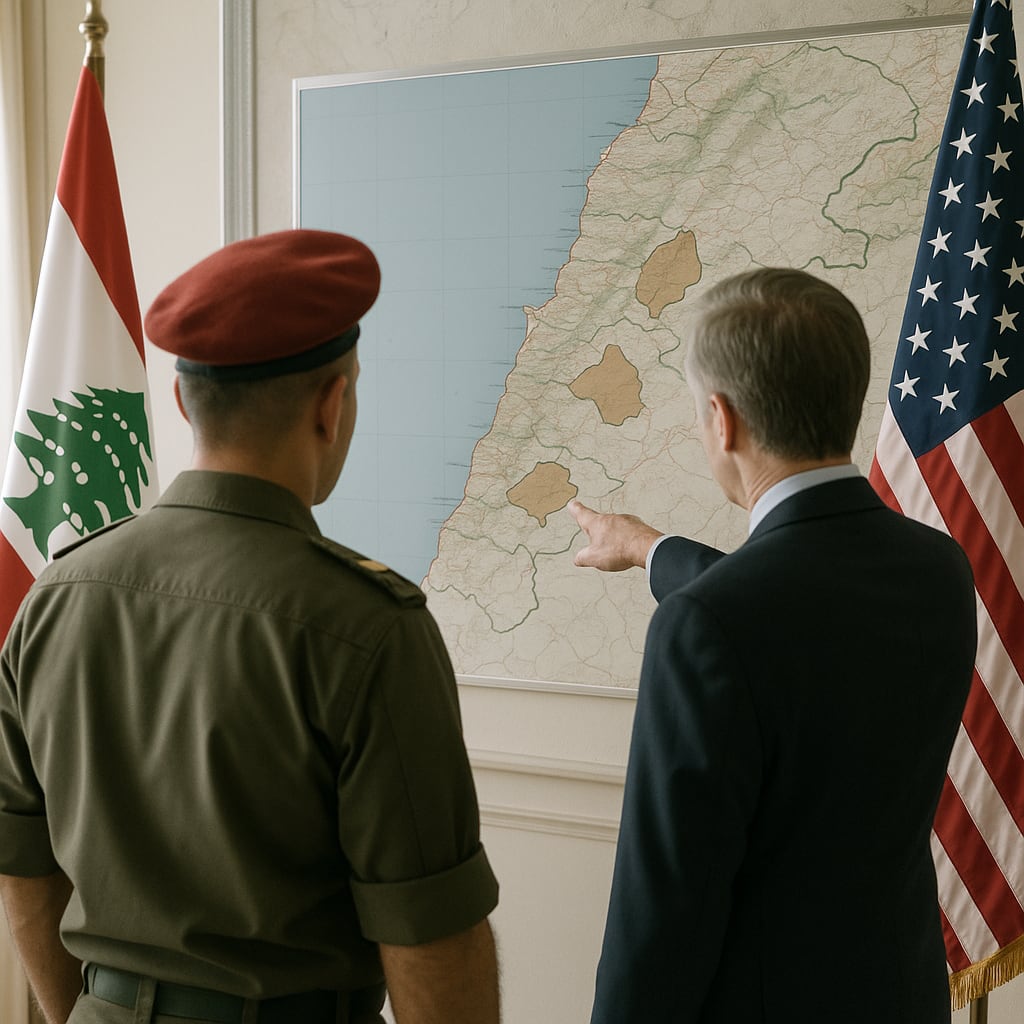
Lebanese army assumes security in three southern ‘pilot zones’ under U.S.-brokered deal as Aoun seeks Trump backing for Israeli pullback
Narrative Snapshot
Across outlets, there is shared acknowledgment that implementation of a U.S.-brokered trilateral framework has begun with the Lebanese Armed Forces assuming security in three southern villages. France24 and Folha de S.Paulo underscore the framework’s stated aims—phased Israeli withdrawal and the disarmament of Hezbollah—while Al Jazeera describes the move as the start of a “pilot zone” experiment and Haaretz attributes the handover to recent discussions overseen by Washington at the diplomatic level.
The ground picture is contested. Middle East Eye cites a Lebanese official saying Israeli forces withdrew from Zawtar al-Gharbiyeh before the LAF deployed there, whereas Serbia’s Politika reports Israeli forces had not yet pulled back from around Froun. Al Jazeera adds local voices who say the “pilot zones” were never occupied by Israel, challenging the premise of a transfer.
Oversight and monitoring are also framed differently. Haaretz reports the U.S. State Department is supervising diplomatically without American personnel on the ground and that it remains unclear who will monitor implementation. By contrast, TASS relays an IDF statement that coordination teams include the IDF, the LAF, and the U.S. military, implying a more direct American operational role.
The diplomatic choreography is in sharp focus. Aoun’s White House meeting, billed by France24 and the Toronto Star/AP as an effort to secure Israeli withdrawal and advance a plan to disarm Hezbollah, unfolds as Haaretz links an Iranian strike in Jordan to signaling over Lebanon—Tehran’s assertion that it will resist any process that sidelines its influence in Beirut.
What Happened
The Lebanese Armed Forces began taking over security in three southern “pilot zones”—Froun, Srifa and Zawtar al-Gharbiyeh—under a U.S.-backed framework agreed by Israel, Lebanon and the United States. The U.S. State Department, cited by Haaretz, said Israel’s handover followed talks the previous week; Washington is overseeing the process diplomatically but, according to the same reporting, will not place personnel on the ground and it remains unclear who will monitor implementation. The IDF, via TASS, said it has started coordinating “pilot zone” actions with the LAF and U.S. military teams. A Lebanese official told Middle East Eye that Israeli forces withdrew from Zawtar al-Gharbiyeh before LAF deployment, while Politika reported Israeli forces had not yet pulled back around Froun. Meanwhile, Aoun is in Washington to press for Israeli withdrawal and present a Hezbollah disarmament plan, as France24 and the Toronto Star/AP report. Earlier, Middle East Eye noted the framework still lacked Lebanese government approval.
Why It Matters
The pilot zones are a test of whether a U.S.-brokered trilateral arrangement can substitute state security forces for a conflict front in southern Lebanon while creating conditions for Israeli withdrawal and addressing Hezbollah’s arms. France24 and Folha describe disarmament as integral to the framework, and France24 notes Israel has made this a condition for pullback, situating the LAF’s role at the center of a sensitive internal–external bargain. Haaretz’s account of diplomatic oversight without clear monitoring arrangements, contrasted with the IDF’s claim (via TASS) of U.S. military involvement, highlights verification and sovereignty issues that will shape credibility. Middle East Eye’s report that the framework lacks Lebanese government approval points to institutional hurdles that could constrain implementation. Haaretz’s analysis of Iranian signaling from a strike in Jordan introduces a regional veto player calibrating pressure as Aoun engages Washington, underlining how external power competition will influence compliance and sequencing.
Diverging Narratives
Accounts diverge on the status and substance of “withdrawal.” Haaretz reports Israel handed back three villages, and a Lebanese official told Middle East Eye Israel withdrew from Zawtar al-Gharbiyeh. Politika counters that Israeli forces remained around Froun, while Al Jazeera features residents asserting the designated villages were never occupied. These contrasts reflect competing claims over facts on the ground and whether the pilot constitutes a meaningful redeployment or a symbolic reflagging of areas.
There is also a split over the U.S. role. Haaretz relays a State Department line that Washington is overseeing diplomatically without ground monitors and that monitoring arrangements are unresolved. TASS cites the IDF saying U.S. military teams are part of “pilot zone” coordination, implying a more hands-on presence. The difference matters for perceptions of impartiality, enforceability and domestic buy-in.
Finally, implementation is advancing amid uncertain domestic legitimacy. Middle East Eye previously reported the framework still lacked Lebanese government approval, even as France24 and the Toronto Star/AP frame Aoun’s Washington visit around delivering Israeli withdrawals and a plan to disarm Hezbollah. Haaretz’s reading of Iran’s strike in Jordan as a message to Lebanon underscores that external actors are actively contesting the diplomatic track’s direction and scope.
What Happens Next
Three decision points will determine trajectory. First, monitoring and enforcement: Haaretz reports no U.S. ground monitors and unclear mechanisms, while TASS cites U.S. military coordination. Clarification from Washington, the IDF, and the LAF on who verifies compliance will indicate how disputes are adjudicated. Second, withdrawal sequencing: Middle East Eye’s claim of pullback from Zawtar and Politika’s report of an IDF presence around Froun set village-by-village benchmarks. Confirmed LAF deployments and corroborated IDF redeployments in Srifa and Froun will show whether the pilot is scaling. Third, the Hezbollah file: France24 says Aoun is presenting a disarmament plan, which Israel has tied to further withdrawal. Readouts from the White House meeting, Lebanese official statements, and any indication—per Middle East Eye—that the framework gains formal government approval will signal whether the political conditions exist to expand beyond the pilot. Haaretz’s note on Iranian signaling suggests watching Tehran- and Hezbollah-linked responses to any tightening of the framework’s terms.