
Turkey passes limited-clemency PKK disarmament law with broad cross-party support
Narrative Snapshot
Across outlets, there is consensus that Ankara has taken an unusually wide-backed legislative step to enable the disarmament and reintegration of Kurdistan Workers’ Party members under defined conditions. France24, The Hindu and Deutsche Welle frame it as a key move in a broader peace process, while Telesur stresses that the government explicitly avoided a general amnesty, limiting clemency to lower-ranking members not implicated in killings or other serious crimes.
Coverage diverges over whether the measure is primarily a security instrument or the start of a political settlement. Le Monde argues the law’s security-centric design sidesteps Kurdish political demands and leaves Abdullah Öcalan’s status unresolved. By contrast, Middle East Eye highlights the symbolism and breadth of the parliamentary coalition, underscored by a public handshake between nationalist and pro-Kurdish leaders, as evidence of a new political opening.
Outlets also differ in the weight they place on implementation and process. Balkan Insight points to the next procedural gate—the National Security Council’s approval—while local reporting via the Toronto Star/AP captures ambivalence in the southeast: relief and joy at a pathway to integration tempered by uncertainty about how the conditions will actually be applied on the ground.
What Happened
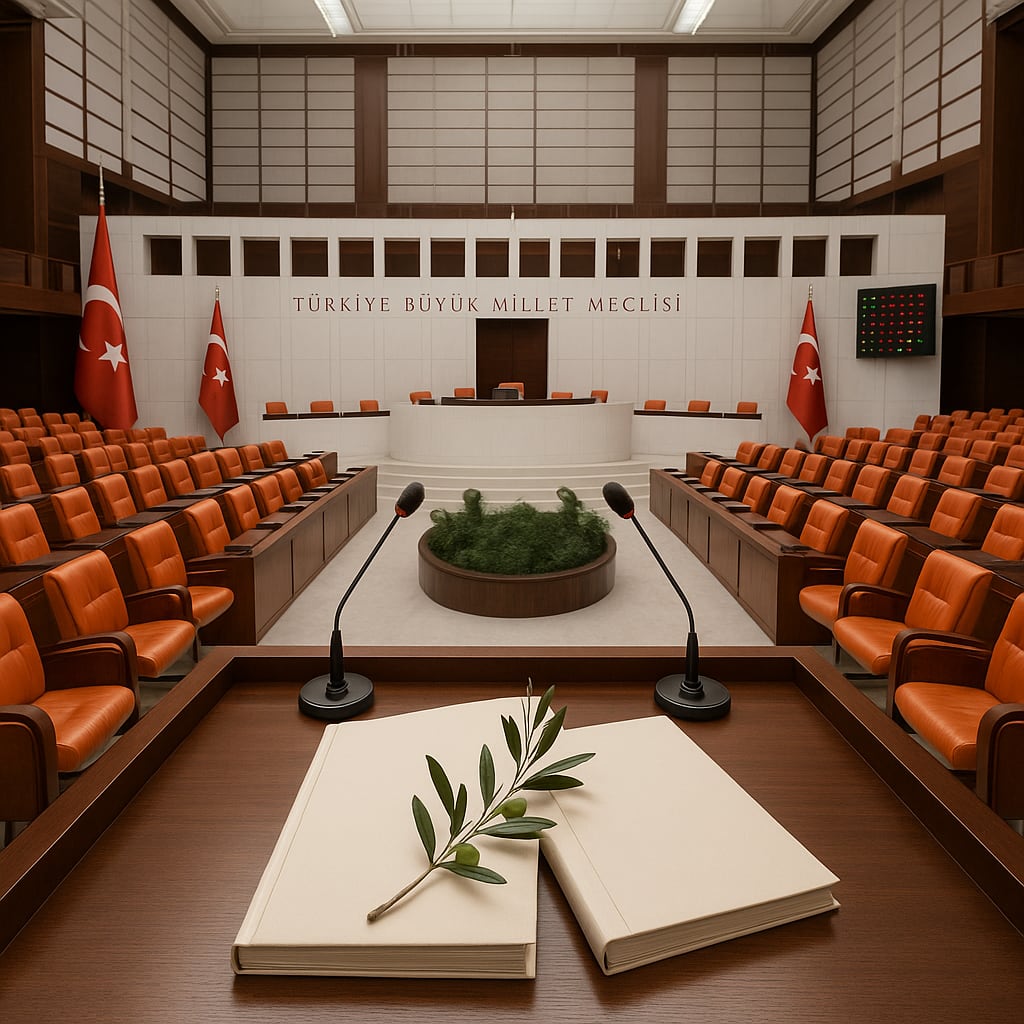
Turkey’s parliament approved a framework law on August 10 establishing a legal basis for the disarmament and reintegration of PKK members. Telesur reports that of 562 lawmakers present, 468 voted in favor, 88 against, and six abstained after nearly 10 hours of debate; the bill drew support from President Recep Tayyip Erdogan’s ruling alliance as well as the pro-Kurdish DEM Party and other opposition groups. The government emphasized that the measure facilitates disarmament rather than providing a blanket amnesty, allowing lower-ranking PKK members not involved in killings or other serious crimes to return. France24 describes the legislation as a limited amnesty seen as a step within a peace process aimed at ending decades of violence. Balkan Insight notes the bill now proceeds to the National Security Council for approval. Deutsche Welle characterizes it as a framework law for the peace process.
Why It Matters
Beyond the immediate vote, the law codifies a pathway for demobilization and reintegration, potentially shifting a decades-long conflict onto a more institutional track. France24, The Hindu and Deutsche Welle situate the measure within a peace process logic, while Telesur underscores its calibrated scope, signaling a state preference for conditional, security-led normalization rather than sweeping clemency. The breadth of parliamentary support noted by Telesur and Middle East Eye—spanning the ruling alliance, pro-Kurdish DEM, and other opposition parties—suggests a rare, cross-party convergence on conflict de-escalation tools.
For decision-makers, two structural implications stand out. First, Balkan Insight’s reference to National Security Council approval highlights the salience of security institutions in sequencing any settlement. Second, as Le Monde argues, keeping Kurdish political demands and Abdullah Öcalan’s status outside the law’s remit indicates that Ankara is separating security reintegration from political bargaining, a design choice likely to shape the contours and durability of any future deal.
Diverging Narratives
Outlets differ in their characterization of the law’s ambition and sufficiency. France24 and The Hindu emphasize its role as a step toward ending violence, while Deutsche Welle foregrounds the unresolved questions about stipulations, controversy, and the future of the process. Telesur details the law’s limits and the government’s insistence that it is not a general amnesty, setting expectations about who qualifies. Middle East Eye portrays the vote as historically cross-partisan, using the public interaction between the Nationalist Movement Party’s Devlet Bahçeli and DEM’s Pervin Buldan to illustrate an emergent coalition for peace legislation.
Le Monde, however, stresses what the law omits: political dimensions of the Kurdish question and the continued uncertainty surrounding Abdullah Öcalan. That framing contrasts with Toronto Star/AP reporting from Diyarbakir, which centers on community-level reactions—relief and joy at a potential integration pathway, mixed with doubt about implementation. Balkan Insight’s note that the bill still requires National Security Council approval underlines procedural hurdles that could influence both scope and tempo, a consideration largely absent from celebratory depictions of cross-party unity.
What Happens Next
The first decision point is institutional: Balkan Insight reports the law advances to the National Security Council for approval. Swift approval would clear implementation; delays or conditions would signal a more guarded security posture. A second hinge lies in eligibility criteria. As Telesur notes, clemency applies to lower-ranking members not involved in killings or serious crimes; how authorities define “lower-ranking” and “serious” will determine who benefits and how quickly reintegration proceeds.
A third axis concerns the political track. Le Monde highlights that Kurdish political demands and Abdullah Öcalan’s status remain unresolved; any official movement—or continued silence—on prisoners and political dialogue will indicate whether Ankara keeps security and politics on separate rails. Finally, the durability of the cross-party coalition spotlighted by Middle East Eye bears watching. Coordinated messaging or follow-on bills would suggest sustained consensus; visible fractures during implementation would point to a narrower, security-first approach.