
[SECTION 1]
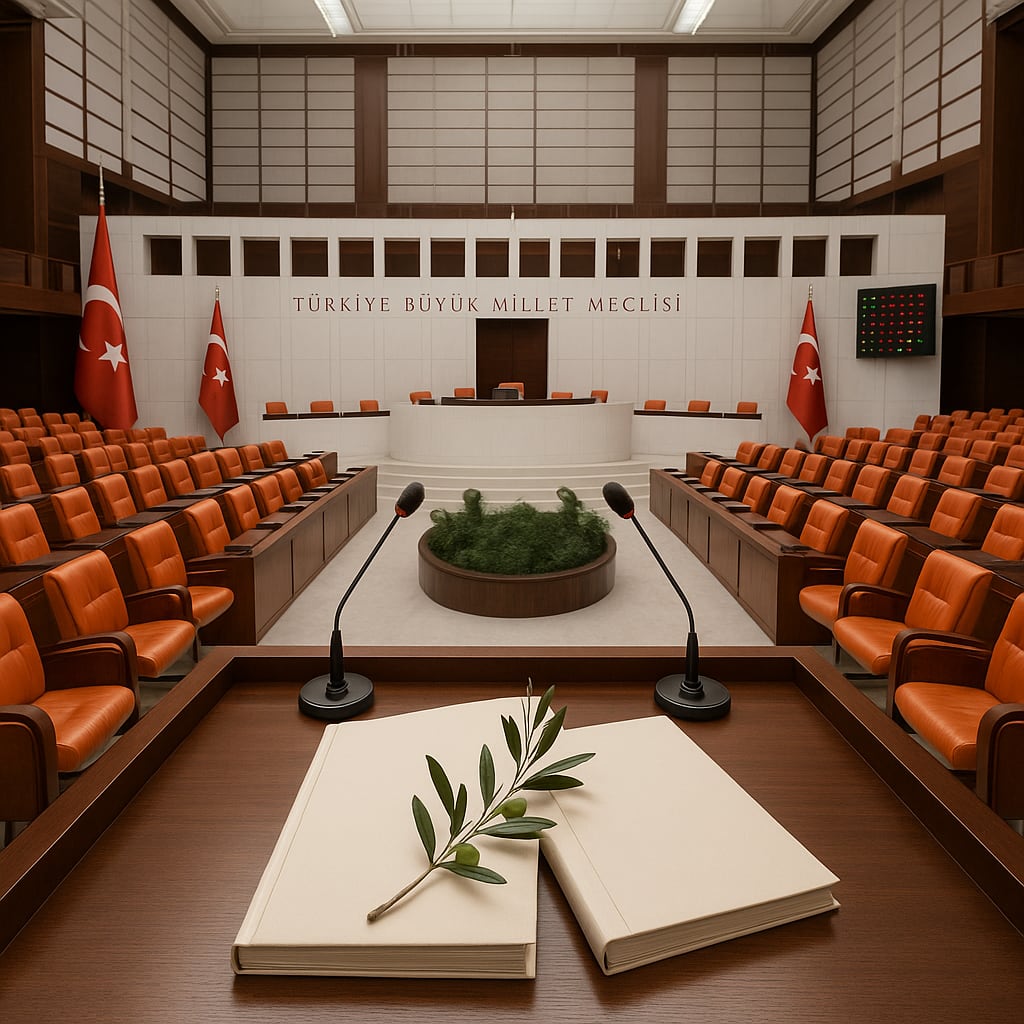
Lukas: [curious] You know what image I can’t shake? Devlet Bahçeli shaking hands with Pervin Buldan on the parliament floor.
Elena: [amused] It’s not a scene you expect in Ankara. Middle East Eye described it as “historic” cross‑party support — and said that moment would’ve been unimaginable a few years ago.
Lukas: [short pause] So the story, in that frame, is reconciliation. Enemies turning into partners for peace.
Elena: [matter-of-fact] And the numbers back that tone. Of 562 lawmakers present, 468 voted in favor, 88 against, with six abstentions — after nearly ten hours of debate. That’s broad.
Lukas: [thoughtful] Ten hours. So it wasn’t perfunctory. It sounds like they wrestled with it.
Elena: [serious] Some outlets call it a key step in a peace process meant to end decades of deadly violence. You can hear the relief in that phrasing.
Lukas: [quietly] And on the ground, a Toronto paper carried reactions from Diyarbakir — relief, joy, and uncertainty. That mix feels real.
Elena: [carefully] There’s also the promise baked into policy details: lower‑ranking PKK members not involved in killings or other serious crimes can return to Turkey. Conditional pathways, not blanket pardons.
Lukas: [skeptical] Not blanket — that matters. Because a different framing swaps “peace” for “security.”
Elena: [serious] Le Monde does that pivot. It says the law is security‑focused, ignoring the Kurdish movement’s political demands, and it leaves the fate of Abdullah Öcalan uncertain.
Lukas: [short pause] That line about Öcalan lands heavy. For someone hearing mostly that, the law sounds like demobilize first, dignity later — if ever.
Elena: [matter-of-fact] And the mechanics feed that reading. Balkan Insight notes the bill still goes to the National Security Council for approval.
Lukas: [dryly] Which is a very different vibe than “the nation embraced a new social contract.”
Elena: [carefully] Even the language sets expectations. One channel says “limited amnesty.” Another stresses it’s designed to facilitate disarmament rather than grant a general amnesty.
Lukas: [curious] So a person scrolling those upbeat headlines might feel: this is the beginning of the end of a war. And a person reading the skeptical ones might think: this is the state managing a problem, not solving it.
Elena: [thoughtful] Exactly. Same vote, different emotional residue. One version hands you a handshake to remember. The other hands you a gatekeeper — the Security Council — and a name not spoken in the chamber.
Lukas: [quietly] And if you’re Kurdish, that difference isn’t abstract. It’s: do my cousin and I have a future here, or only he does if he keeps quiet?
Elena: [long pause] Or: does this open a door for several thousands of fighters and leaders, as one outlet put it — or mostly for lower‑rank returnees under tight conditions?
Lukas: [sigh] Two readers. Two tomorrows. [short pause] Which one do you carry into work with you?
[SECTION 2]
Elena: [carefully] Let’s sit with the central tension. Is this a peace breakthrough — or a security instrument with better lighting?
Lukas: [curious] Walk me through how the narratives make those feelings reasonable, not naive.
Elena: [matter-of-fact] Start with the “breakthrough” arc. It points to unprecedented support across the spectrum. One outlet literally showed nationalist and pro‑Kurdish figures shaking hands. Others called it a landmark step toward ending decades of violence. A reader marinating in that would see responsibility shared, trust expanding, and risk embraced.
Lukas: [thoughtful] And they’d hear Diyarbakir’s relief and joy as confirmation. People who’ve carried this fear forever finally exhale — even if just a little.
Elena: [serious] Now, the security‑first arc. It highlights what’s omitted. Le Monde says the law ignores political demands and keeps Öcalan’s fate uncertain. It underscores that this isn’t a general amnesty, but a conditional one — lower‑rank, no killings, case‑by‑case.
Lukas: [skeptical] Plus that National Security Council step. A reader there sees a gate. A heavily guarded one.
Elena: [carefully] And scale becomes ambiguous. One account says “paving the way for the release of several thousands of fighters and leaders.” Another limits eligibility to lower‑ranking members not linked to serious crimes. Different inputs, different expectations.
Lukas: [dryly] If you expect leaders to walk free, you’re bracing for a political deal. If you expect foot soldiers to trickle back, you’re picturing reintegration without recognition.
Elena: [thoughtful] Which loops back to trust. In the “breakthrough” frame, the broad vote reads as politicians risking backlash to end bloodshed. In the “security” frame, the same vote reads as the state tightening its grip with a softer touch.
Lukas: [quietly] And both people can be smart, informed — just standing on different tiles of the same floor.
Elena: [amused] Different tiles, same echo. Even Deutsche Welle frames its coverage around questions: what does it stipulate, why is it controversial, what does it mean for the peace process? That uncertainty is part of the honest story.
Lukas: [serious] So you leave breakfast either believing Turkey produced a coalition brave enough to bury a war — or a system disciplined enough to demobilize fighters while dodging the hardest politics.
Elena: [softly] And in both cases, the stakes feel personal. The Toronto piece gives you “relief, joy and uncertainty.” That last word is the hinge. People can hold hope and doubt at once.
Lukas: [exhales] The olive branch looks different depending on which side of it you’re on.
Elena: [carefully] Or depending on which part you read first: the handshake or the hold on Öcalan.
Lukas: [long pause] Maybe the uncomfortable truth is that a law can be both an opening and a boundary. An invitation with a foot in the door.
Elena: [quietly] And that two reasonable readers, meeting at lunch, could argue all afternoon — not because one is wrong, but because the story they were handed taught them to expect different futures.
Lukas: [thoughtful] The paradox sticks with me: the broader the vote, the sharper the split in what people think it means.
Elena: [softly] Which leaves one question hanging: is peace here a security file, or a political promise? [pause] The answer determines whether the door stays open after the cameras leave.